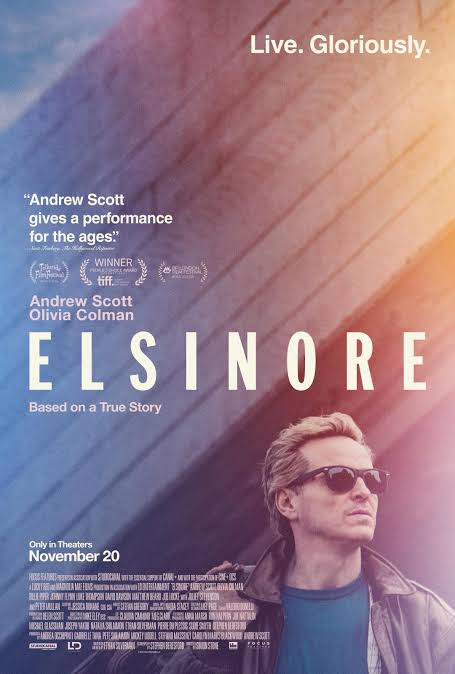
Elsinore is the castle in Denmark where Hamlet lived. It’s the place he reclaims from his dastardly uncle, who poisoned his father and married his mother. But the castle isn’t the only Elsinore in this movie.
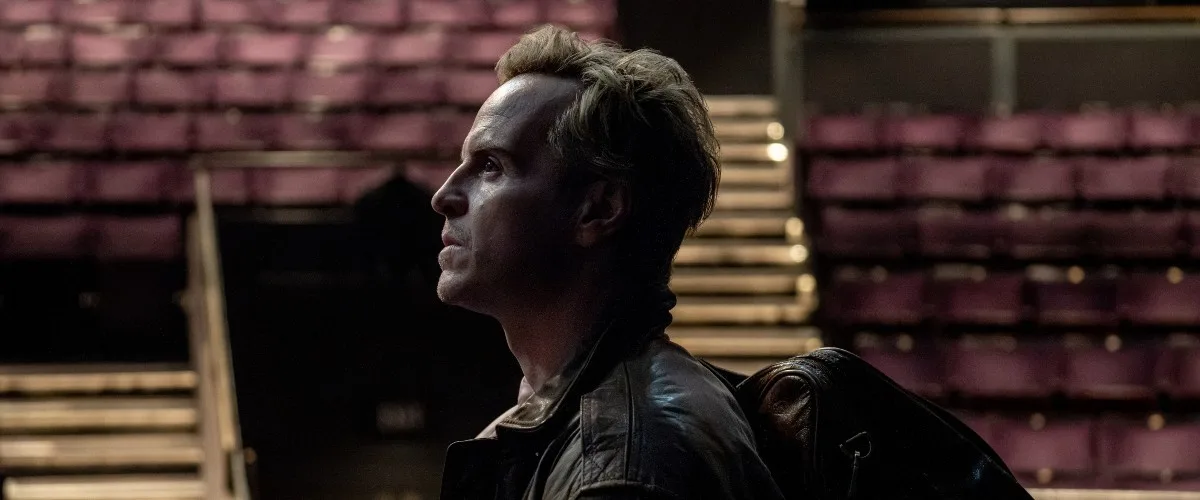
English actor Ian Charleson (Andrew Scott) happens to be friends with an accomplished theater director, Richard Eyre (Johnny Flynn), who’s doing Hamlet at the National Theater in 1989. The original leading man, Daniel Day-Lewis, recently walked offstage and out of the theater, never to return. Richard asks Ian if he’ll step in and take over the role. Playing Hamlet at the National has been Ian’s dream since childhood. The only impediment, Ian says, is that he has AIDS and might not live until opening night.
Richard casts him anyway, and Ian rewards himself by shopping for a motorcycle. The one that catches his eye is an older model: a Honda Elsinore. It belongs to the shop owner, who tells Ian it’s the only motorcycle he’ll never sell. Cut to Ian riding it home. This is a lovely example of a movie giving us the information that matters and ignoring the rest. We don’t care how Ian convinced the shop owner to part with his bike, only that it’s Ian’s now. The scene also introduces a key element of the film: its belief that one’s existence is as thick with metaphors, symbols, and foreshadowing as any play or film, and when we spot them in the wild and interpret them to our advantage, dreams become reality. Ian’s decision to buy the Elsinore shows that he isn’t just good at reading Shakespeare, but the text of life itself.
HIV is a virus that causes AIDS, a syndrome that destroys the immune system. When we first meet Stephen, he has HIV, but it hasn’t yet evolved into AIDS. No one would know Stephen had AIDS unless they knew the meaning of the small purplish lesion on his right temple. He’s handsome, magnetic, an amazing storyteller, and has a quick wit that tends towards the absurd. When a physician asks him, “Do you self-examine?” he replies, “Oh, yeah—I wake up every morning and wonder, ‘Who am I?'” (This is one of the film’s many self-reflexive jokes about a Shakespeare play that gave us the most self-conscious hero in theater history.)
Ian’s other childhood ambition was to act in movies. He became semi-famous playing one of the main runners in the Oscar-winning 1981 sports drama “Chariots of Fire,” but he hasn’t been able to translate that into bigger film roles. He’s also a working-class, public school-educated man who resents having to compete against actors from “posh” backgrounds, those with the best education money could buy. Ian’s only played one gay character, in his friend Derek Jarman’s 1978 film “Jubilee,” because he’s afraid of getting blacklisted. Back then, a lot of people in show business believed an openly gay actor could never be convincing as a straight character if the audience knew he was gay in real life. And if he had AIDS, too? Forget it.
Derek (David Dawson), in contrast, is openly gay and went public about his health status. These were fearless choices at a time when a lot of straights thought HIV was like leprosy or smallpox; the bedding of deceased AIDS patients was burned while that belonging to victims of every other ailment got washed and reused. Derek chides Ian for being given an opportunity to publicly remind straights that gay men with AIDS are human beings, not statistics, but choosing to stay in the closet. Ian counters that an actor’s first duty is to convince people they’re somebody they aren’t. This is what a psychologist might call internalizing the values of the oppressors, but Ian can’t see it that way because if he does, he’ll forfeit Hamlet.
“Elsinore” is a tight film but never feels rushed, except at the end—and you’ll only feel that way if, like me, you would happily watch another hour consisting entirely of Charleson/Scott as Hamlet. The script makes space for Ian’s relationships with fellow stage actors played by Juliet Stevenson (cast as Hamlet’s mother, Gertrude), Alyth Ross (Ophelia), Danny Webb (Polonius), and David Rintoul (Hamlet’s father’s ghost). Offscreen, Ian is haunted by his own dear parents, who have no idea he’s a gay man with AIDS—in particular his dad, who is played by Peter Mullan, an unpretentious powerhouse whose specialty is dinosaurs of machismo.
The film sketches the social as well as physical experience of having AIDS in the late 20th century. Younger viewers who don’t know how brutal things were will get a hard education on top of the story itself, which is brisk, rousing, and intriguingly borrows elements from athletic dramas, including “Chariots of Fire.” Ian’s determination to play Hamlet despite warnings that it will kill him is reminiscent of a boxer whose doc tells him he’s got brain damage and will die if he keeps fighting. There’s even a “Creed”-like training montage, with Ian enduring chemotherapy while running lines with friends, colleagues, his mother (Georgie Glen), and a hospital nurse.
“Elsinore” was written by actor-writer Stephen Beresford and directed by another actor-writer, Simon Stone. It’s steeped in Shakespeare’s lines and lore, and in the rituals and vernacular of theater (like how actors describe non-actors as “civilians”). One layer down, it’s a film about the complex, continuous interactions of art and life, which sometimes sync up so well that we may feel as if they’ve merged. The story jumps back and forth between life and art, building to a final act that shows they were always intertwined.
Notice, for instance, how the movie will cut from a “life” scene—Ian’s struggling to memorize his dialogue, or interacting with his physician, influential AIDS researcher Margaret Johnson (Olivia Colman)—and return to the “art” part of the tale, with the theater company working on the production and interpreting Shakespeare’s text. Stone and editor Valerio Bonelli move out of life and into the theater world, then backtrack to give us one more fragment of the non-theater scene we thought we’d left, then return to the theater scene and stay in it. As the story progresses toward Ian’s 24 performances as Hamlet, the cutting becomes an increasingly expansive back-and-forth pattern, as if an unseen hand is cross-stitching two swaths of fabric into one.
Scott’s work as Ian is impeccable. The detail he’s embroidered into the character is a show in itself, from the disappointed, faintly sarcastic grin he flashes when others offend him to the way his eyes pop and his torso contorts when he roars with laughter. From the second Scott appears onscreen, you know exactly who Ian is. He becomes deeper and more complex the more time we spend with him. Scott’s Hamlet is every bit as intricately imagined and performed, informed by but different from the man playing him.
It’s also a vehicle for showing how performance is a part of everyone’s lives even when they aren’t onstage. Whether we’re selling ourselves to a prospective employer or lover, psyching ourselves up before taking a risk, or telling little lies to make others feel better, believability is all. We see a tenderhearted illustration of this principle when Ian visits an ex-lover and fellow AIDS patient, Georgie (Luke Thompson), on his deathbed. When Georgie asks if his deep love for Ian was reciprocated. Ian turns his face away and pauses for an uncomfortably long moment, then looks Georgie in the eye and says yes, it was. Then he tells Georgie, “You’re going to live.”
If you’re thinking, “All right, I’m sure this is a good film, but I don’t want to watch something depressing,” take my word for it: this is a thrilling, often blisteringly funny work that shatters preconceptions about this type of story, just as Ian shatters the ones standing between him and Hamlet. The first rule of theater is that no matter what, the show must go on. “Elsinore” suggests this is the first rule of life as well. The text is all around us. If we learn how to read it, we’ll find our own Elsinore.