Each fall, the Roger Ebert Fellowship program selects three College of Media undergraduate students at the University of Illinois Urbana-Champaign to participate in a yearlong fellowship that aims to shape their skills in critical writing through immersion in the film industry. The Roger Ebert Fellows for the 2026-27 academic year are media and cinema studies students Ciel Baptiste, Ali Kilmek, and Kris Modi. This festival dispatch from the 62nd Chicago International Film Festival was authored by Modi, who attended screenings and events in his capacity as a fellow.
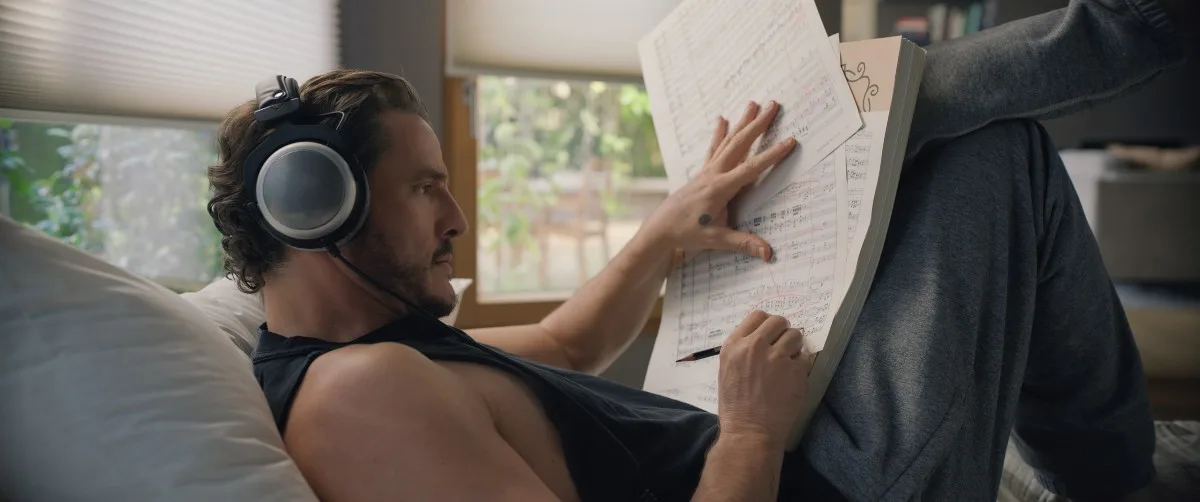
One of nine composers for “Behemoth!,” Lukas Frank can recall the exact moment he watched writer-director Tony Gilroy dream up his sweeping music-driven drama, about a gifted cellist (Pedro Pascal) who returns home to Los Angeles after a long absence to record film scores.
“Tony and I were at this other film festival, and there was this orchestral performance,” Frank told the Music Box audience at this year’s Chicago International Film Festival’s closing-night presentation of “Behemoth!,” where he spoke alongside co-composer Michael Abels during a post-screening Q&A to discuss their work in the nine-strong “Behemoth!” Collective that’s credited with co-scoring the film.
“All of the [musicians’] cases were next to us in the audience,” Frank recounted. The unusual sight of all these touring-grade cases, gig bags and accessories, taking up residence in the movie theater, seemed to strike a chord in Gilroy: “He looks over and goes, ‘That’s my movie.’”
Before the screening began, I had stumbled my way across the aisle of a dimly lit Theater 1 at the Music Box Theatre in Chicago, the elegant music of a live string quartet accompanying me to my seat. I gave the music my undivided attention, like everyone else in the audience, for five seconds—before conversing with my co-Ebert Fellows seated beside me. Frank later quipped in his introduction: “This [film] is about the music dorks that none of you guys think about, that make all this stuff possible. We saw four of them before—whom you guys were so attentively listening to.”
As the lights in an already dim theater reduced even further—the red backlights, the tungsten side lamps all going down—the movie began to play. A dark screen in a dark room, the heads of the audience poking out of their seats in front of me—and the music starts up again. Finally, everyone is paying attention to the strings.
A title slowly appears as the music crescendos—“Behemoth!”—and we enter the life of Alex Serian, played by the ever-charming and omnipresent Pedro Pascal. For the first twenty minutes, everyone in the audience seems glued to the screen, immersed in the music.
“Behemoth!” starts with Alex at a concert hall in Chicago, playing all the right notes on the cello, before it soon flawlessly transitions into a story narrating all the notes he plays in life. We see behind-the-scenes details and dynamics of his life in the orchestra: instrument cases, notebooks and water bottles; the bracing winter temperatures outside; but also the frosty interactions between musicians and the particular tension between Alex and rich donor Carol (Olivia Wilde), with whom he’s been having an affair. As co-composer Abels later remarked during the Q&A: “When Alex is playing, it becomes the soundtrack of his life—but [what is it for]? It’s for something else [other than him].”
Then, Alex moves to Los Angeles. What the movie was building up to—what Gilroy seemed to promise in that early section—disappears when Alex shifts from a wintry Chicago, which “Behemoth!” films beautifully, to an LA neither characterized well nor shown fully enough in the rest of the film to register. The film moves through a series of characters as if hitting successive beats: Alex’s mother (JoBeth Williams), then his father (Hank Azaria), then his brother (Will Arnett). A new love interest (Eva Victor) enters the picture, while Carol flies to LA to track Alex down. Most fatefully, Alex encounters a young musical prodigy named Viviana (Alexa Swinton). As for Alex? Well, our protagonist simply flies through all his “conflicts” with these supporting players without any repercussions or responsibility.
The strange ease with which Alex moves through “Behemoth!” at points echoes what Abels explained in the Q&A about how musicians stay in practice. “You’re practicing things you probably haven’t played,” he said, “or you’re practicing techniques that you need to make sure you keep them in your fingers, for when you need them.”
To borrow that parlance, Alex not only has his fingerings down, but seems to have rehearsed the conflicts he comes by in the film. Like the sheet music he plays, everything Alex encounters feels like it’s been written in ink—too tidy and perfectly aligned. And unlike the pieces he performs, Alex doesn’t seem to have a clear motive—or, should I say, leitmotif—that connects him to the audience.
It’s only late in the film, when Alex evidently realizes Viviana may be his daughter, that we start to see something true in his eyes. His fingers start to play, in a recording session, for Viviana, who is conducting his orchestra. They both look at each other, and in an inverse of “Whiplash” (which introduces its action in the same manner as “Behemoth!”, albeit more aggressively), it is clear that Alex yearns to see recognition in her eyes.
When the lights come up after “Behemoth!” sounds its final notes, some of the audience leaves the auditorium before the Q&A starts. The subsequent conversation centers around the score of the movie, and how it came to be. Co-composer Abels remembers the process behind casting members of the Behemoth! Collective for the film.
Gilroy “had, in the script, each of those films you see Alex Serian recording,” Abels said, and with that came a specific musical identity he needed to provide. “He wanted to cast the composers, just as he had cast the actors.”
Easily, music is the lifeline of Behemoth!, and Gilroy is excellent at using Pascal to reveal what he wants to show about that world; Pascal fulfills this mandate with such commitment that a part of me wants to overlook the mundane, long, and (at times) too comedic middle section. To witness Alex playing music with his daughter is a moment that makes one want to forgive the monotony of the scenes that led us there. But I can’t, and neither should you.