Nuance and complexity are rare in films about dementia. Mostly because they focus more on the people caring for their stricken loved one than on the person undergoing that unforgiving transformation. That approach demands self-reflection, an inward look not consumed by trying to figure out where the former person ends and the current one begins. It takes a special movie to pinpoint the human at the center of erratic changes in mood, recognition, and thought, and the reverberations of their decline.
“Queen at Sea” is that kind of exceptional film: a spare, effortlessly controlled narrative whose many profound moments quietly shock you. The picture twists around life’s cyclical motions, using four characters at different points in their lives to define this disease in human terms. After leaving this fragile film, you feels compelled to cherish the feelings and thrills, memories and hopes that can disappear without control. These observations come through revealing framing, poised camera movement, and powerhouse performances.
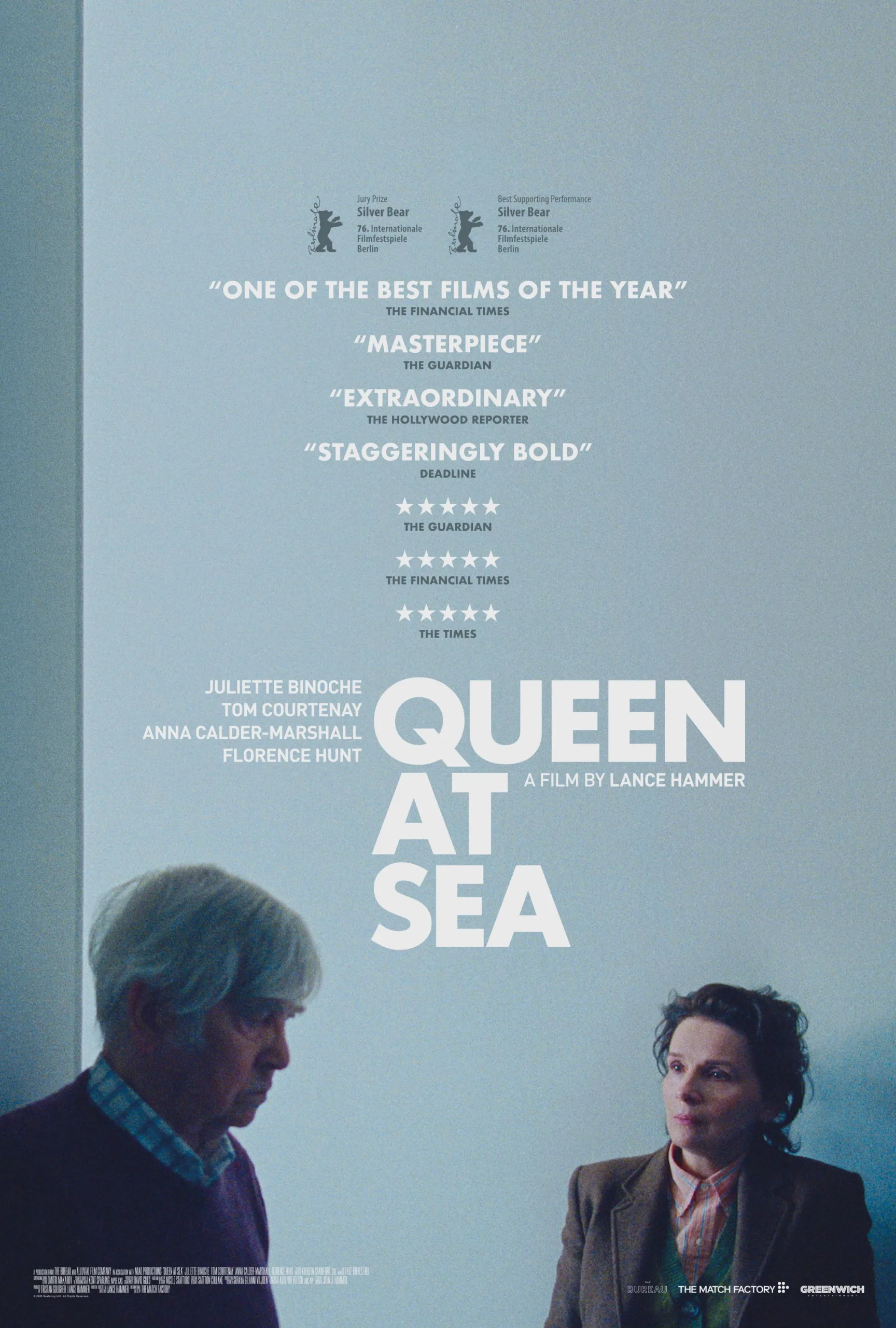
The film begins with a startling sight: Amanda (Juliette Binoche), visiting with her daughter Sara (Florence Hunt), walks in on Amanda’s stepfather, Martin (Tom Courtenay), and her mother, Leslie (Anna Calder-Marshall), having sex. This apparently isn’t the first time Amanda has discovered this. In fact, she’s warned Martin to stop before. Leslie has dementia, and it’s not altogether clear if she’s capable of giving consent. Martin, nevertheless, doesn’t believe he’s done anything wrong. He’s merely having intercourse with his wife. Amanda understandably calls the police, but the complications that follow her decision keep “Queen at Sea” from becoming some tawdry procedural.
Amanda doesn’t want Martin arrested. He’s Leslie’s caregiver, and he’s quite effective at it. He understands her routines—they eat breakfast, go out for walks, and he washes her hair—and shows loving affection outside of intercourse as well. Amanda, whose ex-husband is teaching in Montreal, is also only visiting London with Sara from Newcastle. She’s a professor on sabbatical to write her book, leaving her with little bandwidth to care for her mother. Amanda solely wants the police to warn Martin away from sex with Leslie and to help him understand that he can’t care for Leslie on his own.
That pursuit proposed by writer/director Lance Hammer—who also meticulously edited the film—finds immense resonance by visually juxtaposing the characters against one another. Within Leslie and Martin’s beige home, the camera remains fixed, distant and sterile. Their white-cream bedroom, for instance, reads as blank—matching both the sometimes vacant look behind Leslie’s eyes and the ambiguity of her supposed consent. Stairs and archways are important fixtures; Hammer blocks Binoche and Courtenay on the opposite ends of frames and at the top and bottom of stairs to emphasize their separate outlooks on Leslie’s wellbeing. Nevertheless, as the film wears on, even Amanda becomes ensnared in the studied confines of Leslie and Martin’s house, suggesting that, much like them, she’s nearing the end of one chapter in her life.
Hammer takes a different approach with Sara. His lens comes alive, capturing her budding romance with her classmate, James (Cody Molko), and the energetic friend group that accompanies him. Unlike the frozen, classical framing of her mother and grandparents, the camera whizzes around her on handheld tracks that move faster than youthful desire on a warm summer’s day. Lollipop-red and key lime green walls fill the apartment she shares with Amanda, further foreshadowing an exuberance that will see Martin and Leslie’s difficulties as obstacles to adventure.
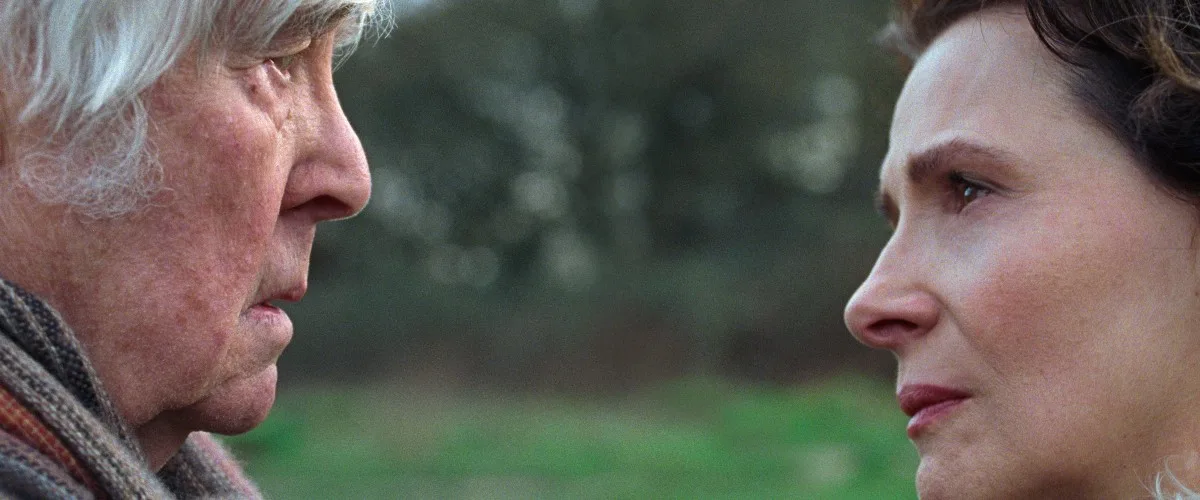
If “Queen at Sea” relied only on these formal and aesthetic decisions, it would quickly lose one’s interest. But these incredible actors keep the film from becoming too academic, inspiring a groundedness that feels intimate despite Hammer’s conscious decision to visually distance us from these characters. That fractured relationship with the camera carries vast meaning, given by Binoche and Hunt, who give their delicate characters rich inner lives whose urgent concerns are sharply contrasted with the potential for misfortune that looms over Leslie and Martin. Calder-Marshall also explores every dimension of Leslie; she never overworks a reaction or undersells an impulse. Courtenay, meanwhile, delivers some of the movie’s most devastating scenes, using his rigid body and tightened face, often shot in profile, to sell a lie Martin so desperately wants to believe.
“Queen at Sea” can be crushing in that way. But it can also be non-judgemental, uplifting, and even warm. We see people grappling with their twilight years and the start of their journeys, trying to make sense of feelings they can’t quite name. They find an understanding in one another, even if they don’t understand themselves. We see them for what they are and what this movie is: brave and irreplaceable.