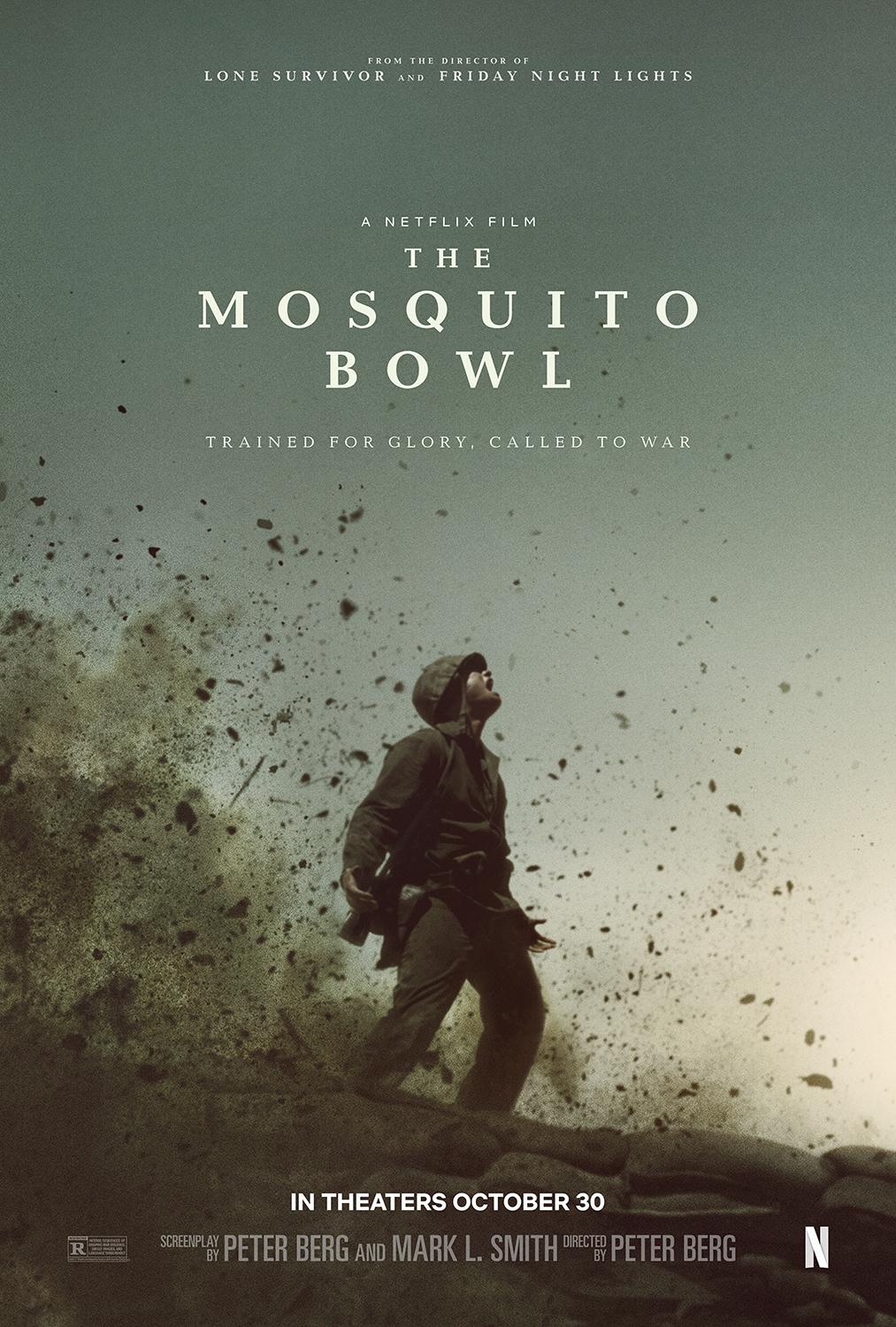
Lacking humanity and relying almost exclusively on shock, “The Mosquito Bowl,” a heinous World War II epic coming to Netflix, struggles to define its story. Ostensibly about a real-life football game played by Marines on Christmas Eve before the invasion of Okinawa, the film is really about how four college players endured hell during the Pacific theater. As one watches the film, which lurches forward from 1941 to 1944, one wonders if anyone is really interested in its characters or if they’re actually enamored with the exploitative violence it depicts.
In some respects, this adaptation of Buzz Bissinger’s historical survey, The Mosquito Bowl: A Game of Life and Death in World War II, is a natural fit for director Peter Berg. His first critically acclaimed work was “Friday Night Lights,” another Bissinger adaptation, which gave him the cachet to helm a series of big-budget Mark Wahlberg movies: “Lone Survivor,” “Patriot’s Day,” “Deepwater Horizon,” and “Mile 22.” Unlike those heightened thrillers, where the tone could be broader and more entertainment-forward, this material needs gravitas and care. Instead, Berg strips this aching story of its meaning.
The hyperactive war picture inelegantly introduces these men and takes massive liberties with their backstories. For instance, the film opens with Tony Butkovich (Ray Nicholson), playing for Purdue, setting the single-season touchdown record against a Wisconsin team led by Dave Schreiner (Tom Francis) and featuring Bob Baumann (Bill Skarsgård). The game supposedly took place on December 6, 1941. In another sequence, Brown University, led by John McLaughry (Nicholas Galitzine), is also playing on December 6, 1941. Obviously, these games, where these young men feel invincible, are supposed to be juxtaposed with the reality that’ll hit them when Japan attacks Pearl Harbor on December 7, 1941.
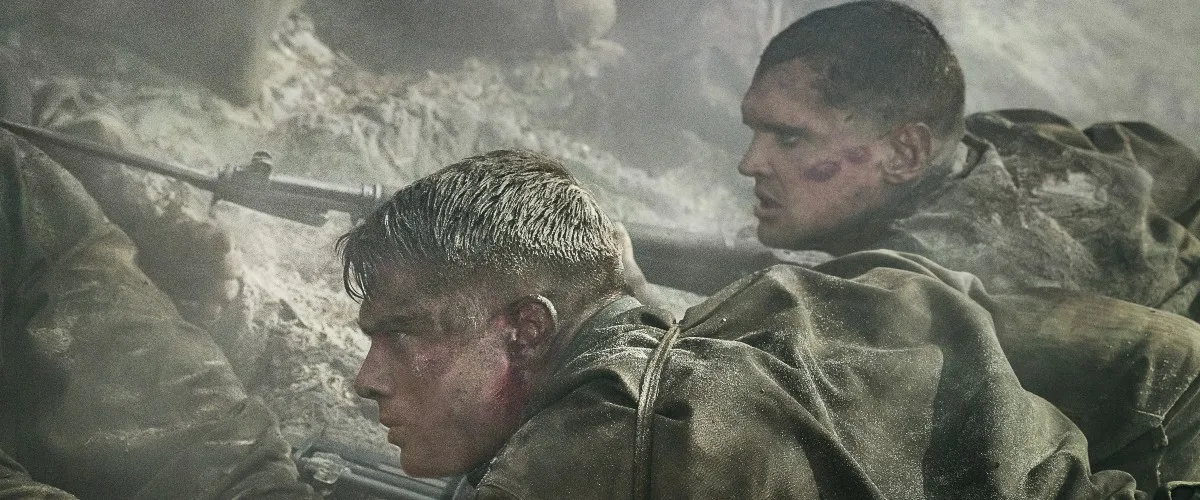
Consequently, Butkovich, Schreiner, Baumann, and McLaughry all enlist in the Marines. We follow them through grueling basic training, with a few nods to “Full Metal Jacket,” and their first taste of action on Tarawa. They also have to overcome their shared grudges. Schreiner hates Butkovich because the former set the touchdown record against him.
Here’s the problem: None of these games happened. McLaughry left Brown by 1939. Schreiner left Wisconsin after the 1942 season. Baumann enlisted in 1943. Butkovich broke the record in 1943. Re-working real-life events to fit a movie format isn’t always a dealbreaker, but it’s odd to place soldiers in battles they weren’t in, like the deadly Battle of Tarawara.
Those liberties would be easier to stomach if Berg actually took full advantage of them to deliver tangible people, but we don’t find out anything about these men outside of them loving their families and wanting to kill the Japanese. Heck, in Butkovich’s case, we don’t even know if he has a family. We only know his touchdown record. Even in the quiet moments between rapid gunfire and falling shells, the conversations, delivered via cumbersome dialogue, give us little else to chew on. The closest thing to a personal conversation happens when one soldier asks another how many children he wants, probably the most banal conversation you could have in the 1940s, next to asking what detergent somebody uses.
The war scenes offer little additional interest. The sound is overcooked, using layered tracks of people screaming to denote horror and panic, and the drab cinematography undercuts any detailed emotions the actors attempt. Berg and his DP, Jacques Jouffret (“The Purge”), deliver a heavy dose of oblique and canted angles, elongated pans, and meandering tracks to mirror the confusion of the soldiers on the ground. The wonky editing, unsurprisingly handled by several hands, Jon Otazua and Garret Donnelly, throws a barrage of blood, guts, and slaughter at the viewer, including a sequence set during one of Bob Hope’s USO tours. While trying to visualize the randomness of death in war through chaotic imagery can be admirable, there’s a fine line between matching the fury of battle and making the action indistinguishable from the spin cycle on a washing machine.
The same goes for Berg’s depiction of the enemy. Once again, you wouldn’t expect to see defined Japanese characters in this movie. This is, after all, told from the perspective of four agitated American soldiers who’ve been taught to eliminate their foe. But when one soldier takes umbrage at other Marines selling trophies, like the teeth and skulls of dead Japanese, to him, one becomes confused. The film and its characters care enough about their enemy to defend the sanctity of their remains, but not enough to only depict them as suicidal others screaming toward oblivion? Why doesn’t Berg, at the very least, explore those two opposing ideas?
If you’re hoping the football game will make everything right, it also goes by in a flash. The basic rules are given: 11-on-11, no tackling, two-hand touch. Watching these men play reminds us of the invincible college boys they once were, not the hollowed-out husks we’ve seen them become. Despite these actors’ best efforts, it’s difficult to feel anything as they smash their bodies into one another. You come to wish Berg had built up to this moment better, giving more time to understand the game’s pre- and post-impact. Instead, it dissolves away, which is kind of the point: War doesn’t stop. The Battle of Okinawa awaits these men, not holidays and vacations.
And while “The Mosquito Bowl” could be described as inept, it fumbles into vile with its confused ending. Every twenty minutes or so, the film drops in an insert of Earth seen from space. These asides build toward Truman’s dropping of the atomic bomb, footage of which is interspersed in a montage featuring sights of a young Japanese survivor and weary soldiers returning home, and a shot of the Statue of Liberty. Is the bombing meant to feel triumphant? The dejected faces we see would indicate otherwise. But the Statue of Liberty, a patriotic image, says something totally different from condemnation. Like the rest of his film, it’s never clear what Berg wants to say or why he made this movie.