Cathy Ames is one of the most (in)famous characters in all of literature. The subject of endless debate among readers and literary critics since she was introduced in Chapter 8 of John Steinbeck’s 1952 novel East of Eden, she is (depending on who you ask) either the author’s most complex fictional creation or a misogynistic caricature; a symbol of pure evil, or proof that even the worst among us can contain surprising multitudes. Into this decades-long debate steps Netflix, with a seven-part prestige television adaptation that does its level best to complicate our understanding of a difficult, polarizing fictional figure. And though it doesn’t always succeed at things like subtlety, it adds necessary depth and shading to Cathy’s story, thanks to star Florence Pugh’s complicated, layered lead performance.
A tale that spans multiple generations and decades, “East of Eden” is, in its most basic sense, a story of family. It initially follows brothers Adam (Christopher Abbott) and Charles Trask (Mike Faist), whose lives are turned upside down when they find a battered, bloody woman on their doorstep. Telling them to call her Cathy (Pugh), she recuperates in their home and becomes romantically entangled with Adam, despite Charles’s obvious and open mistrust of her and her motives. What follows is a story of inheritance, heritage, rivalry, and hope, as the Trasks—and many others—struggle to deal with the long-tail impact of Cathy’s influence on their lives.
As befits its longer run time, the show tackles more of the book’s story than the 1955 James Dean film, which really only covered its final third. The sheer heft of Steinbeck’s novel means that even a seven-hour run time isn’t sufficient to cover every plot beat, and series creator Zoe Kazan (granddaughter of Elia Kazan, who made the aforementioned feature film) has not been terribly subtle about the fact that her primary interest in this adaptation is Cathy, and doing justice to a character who is undoubtedly an evil figure in Steinbeck’s world but who has found herself hard done by the decades of discourse surrounding her story. To Kazan’s credit, her “East of Eden” isn’t about anything so basic as turning Cathy into a heroine or even making her particularly sympathetic. Instead, it is about granting her character the depth and context that she is often denied on the page, while still following the primary narrative beats of the rest of the novel. And, for the most part, that’s exactly what “East of Eden” does.
To be clear, Cathy Ames is and remains an unrepentant sociopath throughout this series’ seven episodes, a woman who burns down her family home, commits multiple murders, and abandons her children. But what this adaptation—and Pugh’s performance—gets across most clearly is that, while Cathy may believe she is monstrous because of some innate quality within herself, her deeds are most assuredly the result of choices. Does she regret some of those choices at various points? Maybe. Maybe not. But this is, after all, the true message of “East of Eden”. That, in the end, we are who we choose to be.
Steinbeck conveys this through the concept of “timshel,” which in his story translates to “thou mayest”. Yes, yes, technically this is both a misspelling and a mistranslation of the actual Hebrew word “timshol,” but let’s just embrace the emotional weight of this thematic throughline. We are not doomed to become our parents, nor hopelessly tied to our bloodlines or our history. We can choose for ourselves—for good and for evil—and that is an unparalleled freedom if only because it is an unwavering constant. This is a remarkably sweeping and thought-provoking concept for a story that’s an allegory for the Book of Genesis, features multiple stand-ins for the Biblical figures of Cain and Abel, and a woman you could argue either represents the Serpent in the Garden or Satan himself. But simple stories need not be simplistic ones, and it is through this larger theme that Steinbeck—and this “East of Eden” finds grace.
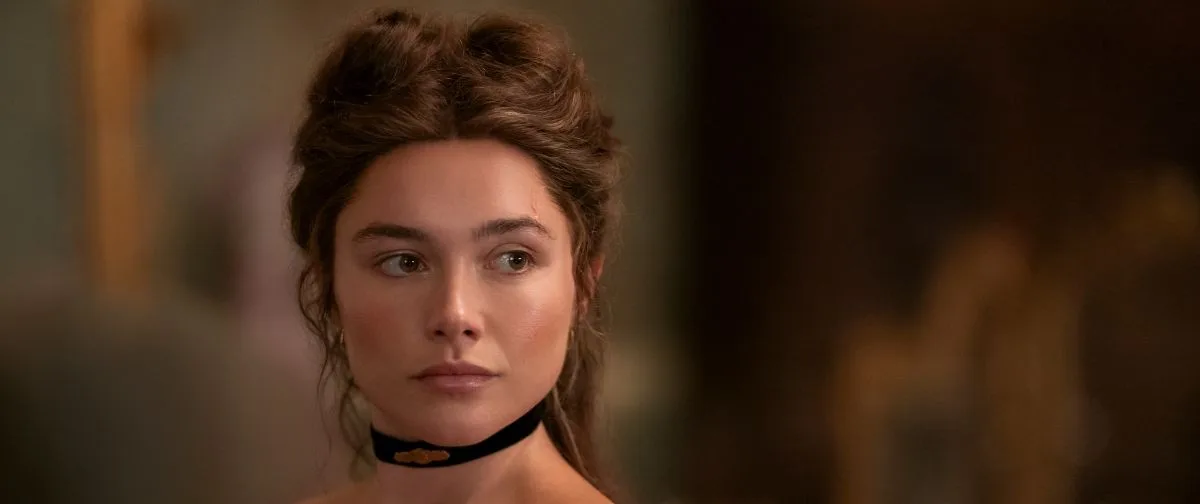
Pugh is mesmerizing as Cathy, removed, scheming and furious by turns. Kazan’s version of the much-debated character isn’t an inexplicable force of nature so much as a ruthless survivor, a keen magpie acquiring trinkets and money and favors and secrets to protect her against a world she’s been taught from a very young age not to trust. Horrible things have happened to Cathy, who has in turn done horrible things. Yet she is not seeking forgiveness or pity, but agency.
It’s a surprisingly physical performance, full of subtly shifting facial expressions, loaded glances, and a posture that reflects the version of herself she wishes those in front of her to see. There are occasional cracks: an uncontrollable burst of rage when yet another man tries to tell her what to do, a moment in the fourth episode when she finds herself unexpectedly alone and bodily shakes off the role she’s been playing, stretching and twisting like a snake uncoiling itself. Liquor, of course, is Cathy’s great weakness, and the way Pugh allows her walls to fall the moment wine or champagne crosses her lips inspires the same dread as the silent arrival of a killer in a horror film. Something terrible is assuredly about to happen.
If there’s a downside to the strength of Pugh’s performance, it’s that it’s so commanding that other parts of the series can feel pale and underbaked in her absence. (She features less prominently in the show’s back half.) Adam is largely a cipher, occasionally rousing himself to work out his feelings about his own complicated relationships with his father and brother through his parenting of his sons or to come up with an idealistically hare-brained business scheme. It can be difficult to make the concept of innate goodness translate onscreen, and Adam is more valuable to Steinbeck’s tale as a symbol than a fully formed person.
Cal (Joseph Zada) and Aron (Joe Anders) fare better as brothers bound by rivalry, secrets, and genuine, obvious affection. Zada is particularly strong as a young man fighting the darkness he feels within his own nature—not always winning, of course, but through that struggle he feels most fully formed and human. The show’s supporting cast is strong throughout, particularly Ciarán Hinds and Yoon Lee, who play neighbor Samuel Hamilton and the loyal Trask family servant, Lee, who both model a warm, expansive, moral masculinity that stands in direct opposition to the men Cathy has spent her life running from. (It’s a shame that most of the Hamilton family’s plot has been almost completely excised from this version of the story.)
This East of Eden is not perfect. It struggles to do justice to some of the story’s larger moral and philosophical themes, and its unapologetic focus on Cathy means that other characters like Adam and Charles are less fully developed than they probably should be. Yet, the combination of Pugh’s performance and the show’s unabashed insistence that her story is worth telling in its own right—on her own terms—makes for something that’s still deeply satisfying to watch.
All seven episodes screened for review. “East of Eden” premieres October 1 on Netflix.