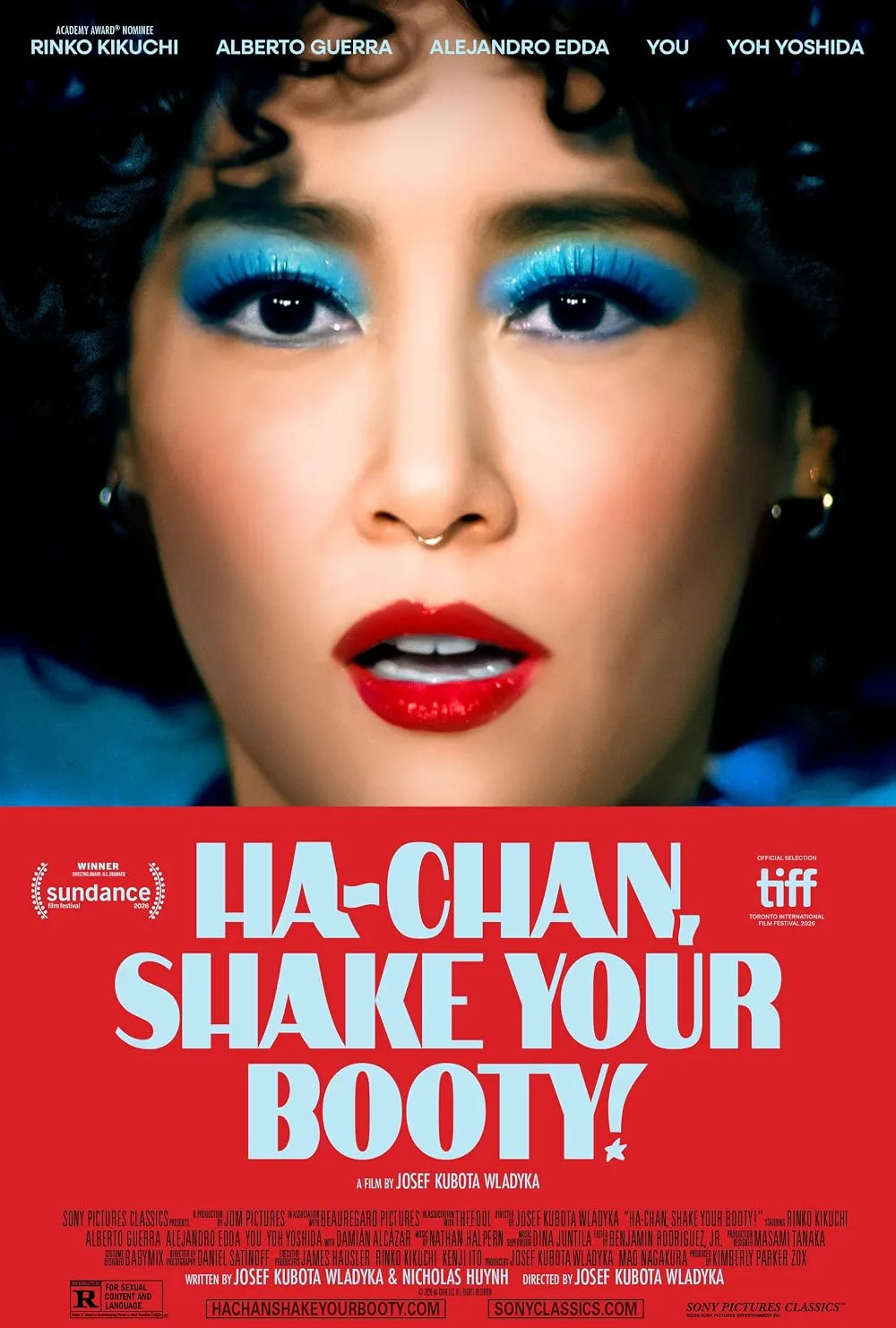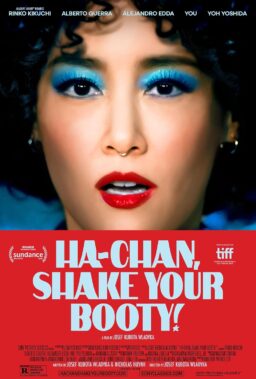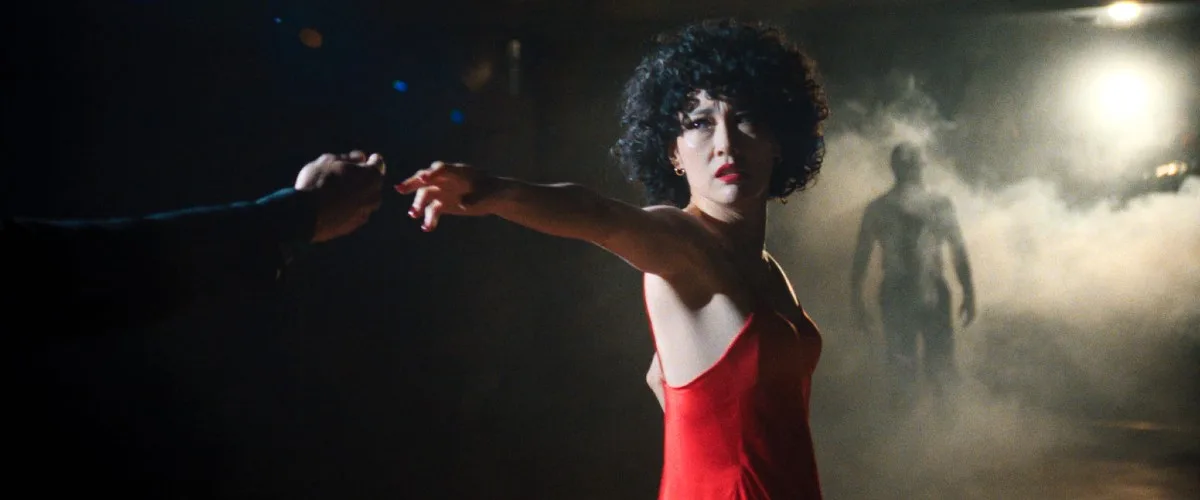
Director and co-screenwriter Josef Kubota Wladyka dedicates “Ha-Chan, Shake Your Booty!” to his Japanese-American mother, who loved a curly perm and ballroom dancing. Rinko Kikuchi is radiant in the film, playing Haru, a young widow in Tokyo with a mop of curls and a discreet nose ring. Her sister and cousin call her Ha-Chan.
Nine months after her husband’s death, Haru begins to process her loss by returning to the dancing she and her husband loved.
In the first few moments, the film shows how deep and loving Haru’s relationship is with her Mexican husband, Luis (Alejandro Edda). They talk in a mix of Japanese, Spanish, and English, and sometimes a loving mash-up word, but their real shared language is music and dance. We see that when she looks at him through the window as he works in the garden and they communicate by swaying their hips – or perhaps it is more like a sinuous shaking of their booties.
Haru and Luis have a large collection of vinyl records, lovingly displayed in their living room and gently placed, one at a time, on an analog turntable. They compete in the Tokyo Dance Classic, dazzlingly shot and edited, spangles, fringe, and feathers spinning everywhere. Their category is Amateur Latin Seniors. Their dance is so magical they float up toward the ceiling. And then, Luis falls to the floor. He has had a heart attack.
His father and sister arrive, and we witness a kind but painful clash of cultures when it comes to his final resting place. Haru says that Luis wanted a traditional Japanese burial, where the body is cremated, and the bone pieces are picked out of the ashes with chopsticks. His relatives want him to be buried according to Western tradition, in his home country. Haru reluctantly agrees, but it only deepens her sense of loss and dislocation.
Then the giant crow, large enough to hold a person, arrives in Haru’s living room. In Japanese culture, crows are viewed as both omens and as protectors, embodying the complexities of life and death. The subjective depictions embodying Haru’s perceptions and emotions are exceptionally well presented, often lovely, sometimes both beautiful and funny, and very moving.
Haru’s sympathetic sister (YOU) and bawdy, profane cousin (Yoh Yoshida) encourage her to return to the dance studio, where there is a very handsome new Latino instructor named Fedir (Alberto Guerra). She is drawn to him, and when she learns he has an open marriage (she has to Google the term), she tells him that she and Luis have an open marriage, too.
The dance numbers show us Haru’s emotions. One particularly striking number comes as Fadir and Haru are leaving Ueno Station, when a group of tipsy salarymen rudely bump into her. Fadir asks for an apology, and what looks like it will become a fight turns into a joyous bachata (a fusion style originating in the Dominican Republic), showing us Haru’s view of Fadir as irresistible. Other dance numbers include tango, cha-cha, and rumba, each indicating what Haru is feeling.
She takes Fadir to a hilarious, endearing Japanese theatrical production of “Dirty Dancing,” and we glimpse the “I carried a watermelon” and “I Had the Time of My Life” moments inspired by the Swayze/Grey classic. Each section of the movie has titles in both English (intoned with seriousness) and Japanese (recited by a squeaky-voiced narrator). This chapter is “Nobody Puts Baby in the Corner,” referring to both Haru and the show on stage.
Some tone shifts don’t work as well, including a cringe-humor slapstick sequence with Haru hiding under a bed and the cousin’s shrill, one-note comments. Cracked glass on one photo and another being tossed into a wastebasket are out of place in a film with such fresh ideas.
These include the way Haru “sees” Fadir, Luis, and the crow (in one wild scene, all three at once), symbolizing the painful conflict between missing her husband and needing to find a way to go on without him. She literally dances through those conflicts, which may, in fact, even with the crow, be the best option.