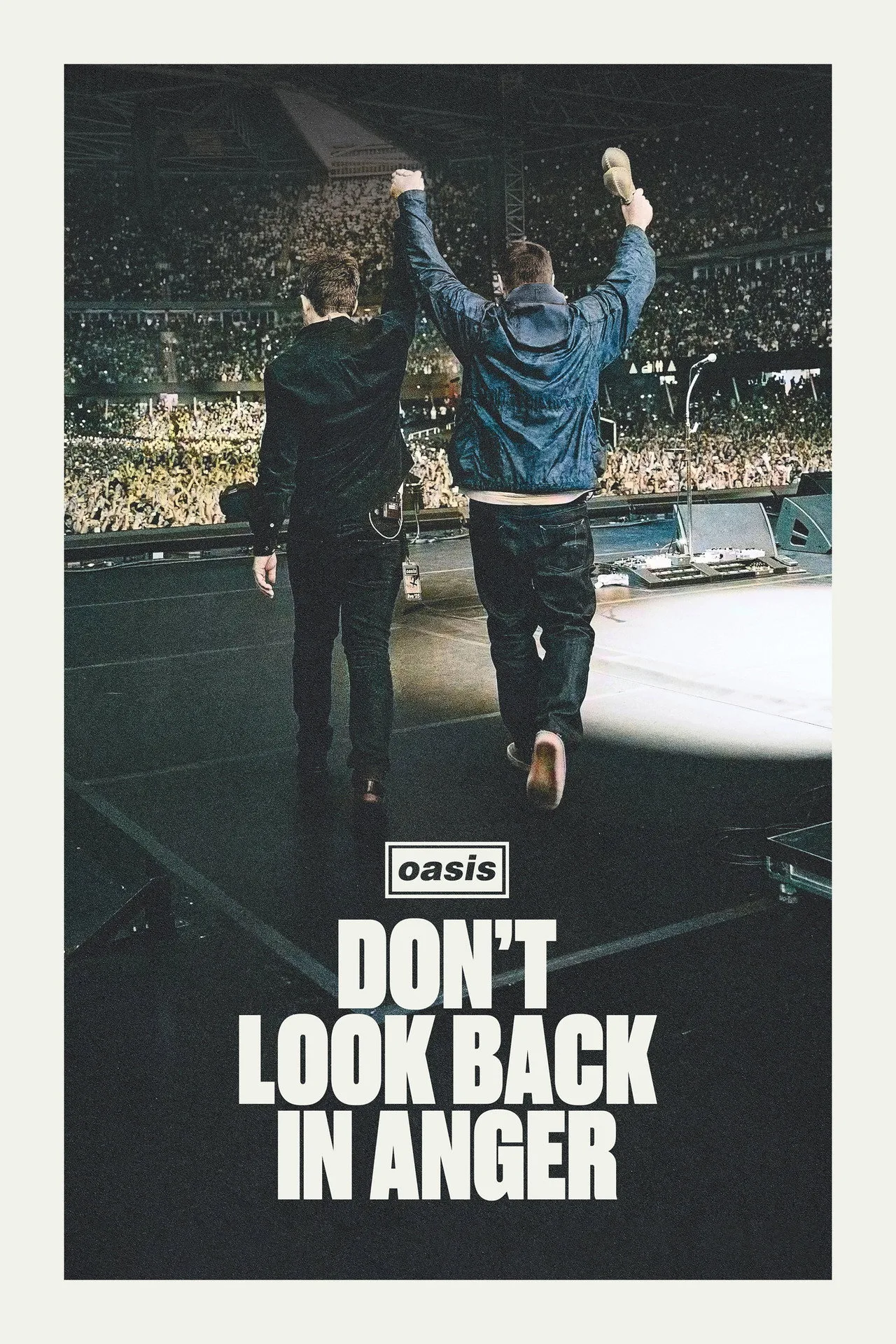

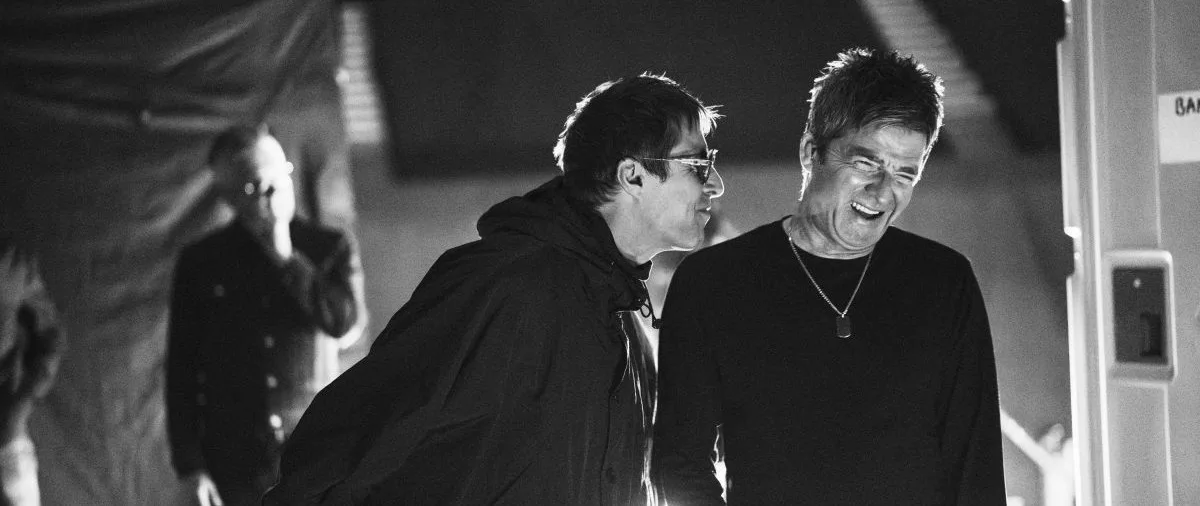
“Oasis: Don’t Look Back in Anger” is about the 2025 tour that followed the reunion of Oasis co-founders Liam and Noel Gallagher, after a backstage scuffle at the 2009 Rock en Seine festival in Paris ended the band. It’s hard to describe how much it meant to fans that the brothers finally put aside their differences, reassembled the band, and mapped out an international series of concerts. Imagine John Lennon miraculously surviving beyond 1980, and the Beatles reuniting in 1987 and going on tour. The time between the breakup and the reunion was long enough for many fans to have children and raise them on Oasis, which only mythologized the band further and made every concert a multigenerational bonding event.
The tour was so successful and satisfying for the band and its followers, that all the makers of this documentary had to do was show what happened, pack seven or eight kickass numbers into the running time, and call it a day. But they went further. Much further. This is one of the best music documentaries ever made because, while it gives us a little bit of the story of the brothers and the band, it’s not really about any of that. As directed by Will Lovelace and Dylan Southern and written by film and TV screenwriter Steven Knight (a credit that acknowledges contributions to the movie’s concept, themes, and structure), the Oasis reunion tour is a way of drawing us into the movie’s true subjects: what music means to people, and the practical value and personal importance of art in everyday life.
There are a couple of fan comments to the effect that the elapsed time since the breakup has been globally miserable for nearly everyone, and the reunion felt like a precious interlude of peace and happiness, an answer to the prayer, “Please, just this once, can you let us have something good?” So, an oasis of Oasis. Liam tells one crowd that the tour manifested that same sense of purpose, organically, as they traveled and played. He says he eventually realized the tour was not about Oasis. “It’s about us,” he says. The “us” refers to the collective organism that is born when artists and their audience are united during a performance, creating a union that is beyond words, and is not to be understood, but felt.
The filmmakers have made a movie that is repertorial, philosophical, and spiritual, all at once. Much of this comes through in the editing, which has what might be called a zoom-lens aesthetic. The editing zooms in very close to the material, usually by focusing on one band member or individual fan. Then it pulls back, then even further back, giving us a portrait of a family, a friendship, a neighborhood, or a city, and then goes still further back, until we’re looking at the filmic equivalent of a mural depicting a great mass of people. Then it starts zooming in closer, slowly, gracefully, until it alights again on a single life. The cycle continues as if it were a natural process, like the cycles of the sun or moon.
One section focuses on the brothers’ appeal as Irish lads growing up working-class in Manchester. Another examines the healing role that their music played after the terrorist bombing of an Ariana Grande concert. There’s a segment about how Barcelona soccer fandom and Oasis fandom have merged, and another on the Gallagher brothers’ cultural Irishness and their embrace within Ireland itself.
The shifts in storytelling perspective are so subtle as to escape notice as you’re watching the movie. They seem driven by gut feelings about tone and rhythm, evoking the intuitive processes by which musicians decide what to do moment to moment onstage. Sometimes the movie zooms in very tight on one of the brothers or their bandmates, or focuses on one specific fan in a certain country (England, Ireland, Japan, and Spain, to name a few) and tells the story behind their decision to see Oasis during the reunion tour.
Liam, as always, remains a provocative, at times combative interview subject. Noel plays a complementary role that’s part mirror, part interpreter, and part lion tamer. There’s almost no detail about what caused the split or the overall differences that made their relationship so contentious, which, given the title, is exactly as it should be. What we get instead are lovely moments of the lads expressing genuine love and respect for each other as artists and people. A highlight is Noel’s description of Liam’s ritual of placing a tambourine on his head so it suggests the half-halo behind a saint’s head in a religious painting. “If I did that, I’d look like an utter cunt,” Noel says. “But when he does it, it’s the greatest thing I’ve ever seen.”
One of the more remarkable aspects of this movie is its affectionate chronicle of Liam experiencing a series of revelations on tour. He realizes that Oasis and its listeners have merged in celebration of good feelings and good times, and that this phenomenon is an illustration of why their work, indeed every artist’s work, is important. “You want to be writing songs that people take and stick into their lives and go ‘It’s mine now,’” he says. He insists that every song has to be as brilliantly performed as possible and “treated with the utmost respect” because the world is a dark place now “and people are havin’ a shit time.”
That’s an understatement, as we see in the God’s eye mosaics of crowds swaying as one, and in shots of couples kissing, friends embracing, and small children dancing (including an adorable little toddler in a ballerina costume who bounces up and down like she’s on a trampoline). Fathers and mothers bring their songs and daughters. A middle aged man in a matching blue Oasis shirt and fishing cap weeps at the thought of even trying to express what the band has meant to him.
The sight of fans unabashedly and cathartically expressing joy (which sometimes entails overcoming a lifetime of conditioning that told them they weren’t supposed to let people see them being this vulnerable in public) seems to have humbled Gallagher, and, to a certain extent, intimidated him. As the tour began, he got nervous backstage about his responsibility to give everyone the best night of their lives. The solution? “Just put your feckin’ big boy pants on and feckin’ go for it.”
For the rest of my life, I’ll think about a moment where the camera stays on a teenage boy after the concert has finished and people are leaving. His eyes are wet, and his face is puffy, but it was obviously a good cry, because he looks dazed with joy, then seems to go deep into himself, staring in wonder at nothing in particular, as if he’s barely begun to process the magnitude of what happened to him, and within him. Then he looks up at the sky, beaming with joy. There are lots of shots in this movie of fans looking up in astonished gratitude, as if they were part of a miracle. And in a way, they were.
This is what art can do. This is why art matters.
Film of the feckin’ year.
This review was filed from the world premiere at the Venice Film Festival. It opens in IMAX on September 11, 2026.