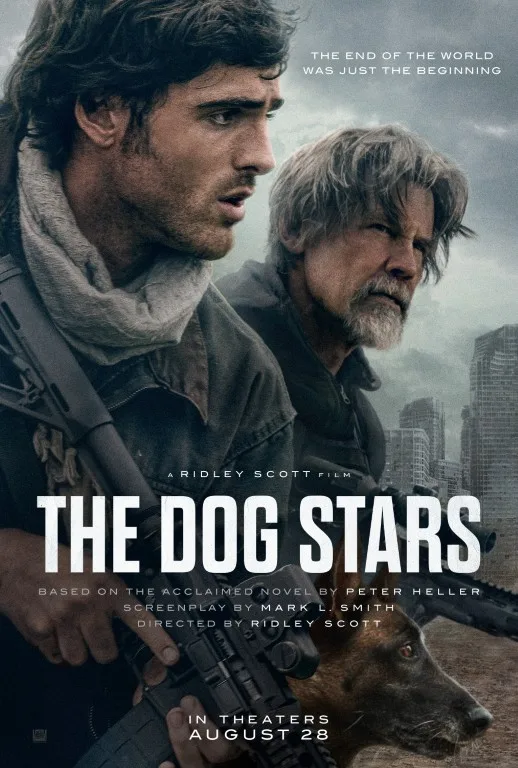

It probably takes more effort to make a boring post-apocalyptic survivalist action film than to make a good one. If that’s the case, then Ridley Scott must’ve been working overtime on “The Dog Stars.” This wasteland narrative is the most tedious film of Scott’s career.
That assertion comes with the knowledge of Scott’s recent shaky output. “Gladiator II” proved to be a forgettable sequel with jumbled politics and even worse graphics. “Napoleon” rendered one of history’s most memorable figures into a bland, uninteresting character. Those films make one yearn for the pleasurable camp excess of “House of Gucci.” That film might’ve been flawed, but it at least wasn’t afraid to have fun. “The Dog Stars,” a messy adaptation of Peter Heller’s same-titled novel, continues Scott’s late-stage slide into mediocrity. It’s without cohesion, world building, or a point.
“The Dog Stars” is a paint-by-numbers brand of post-apocalyptic thriller, featuring all of the tropes without any of the psychological tension that allows those features to embed in the psyche. Scott’s additional visual acumen uplifts this soporific picture with a couple of briefly memorable set pieces. He also thoughtfully allows desolate vistas to carve the souls of his isolated characters. But these protagonists are all symbols and signifiers for a message that Scott doesn’t quite have a handle on.
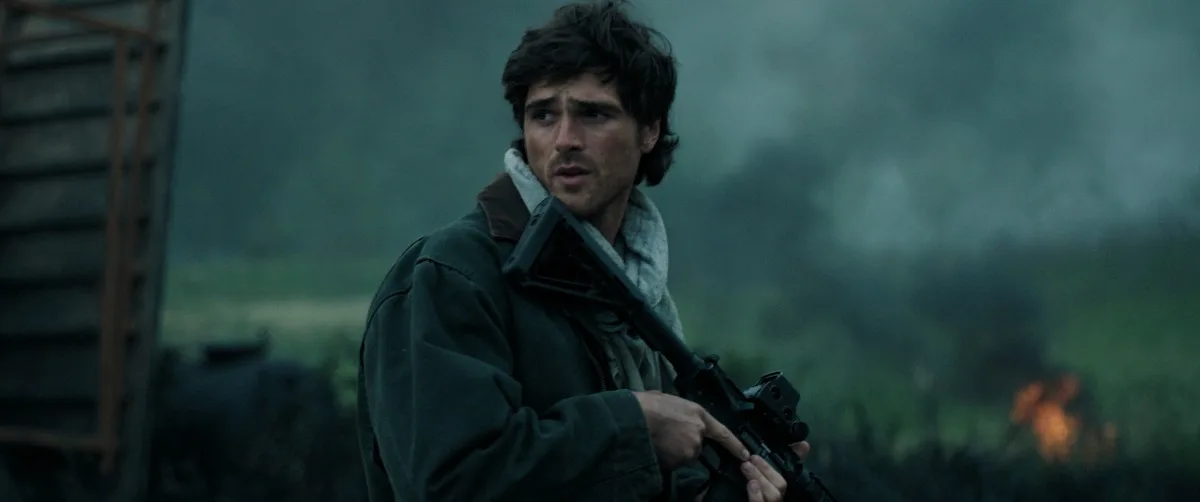
In this Colorado-set film, Hig (Jacob Elordi), a forlorn engineer, works a secluded, mostly disused airfield with his dog Jasper. Man and canine often fly together on a yellow Cessna from their Erie hideout to Denver to commandeer medicine for a nearby Mennonite colony run by Aaron (Benedict Wong), food and fuel for Hig’s militaristic partner Bangley (Josh Brolin), and for Hig to mourn the memory of his deceased wife at their former quaint home.
In these opening moments, Scott attempts some swift visual world building. Upturned cars say there was some uprising; a close-up of a withered Christmas tree denotes when the world might’ve crumbled; gurneys and IVs in municipal buildings suggest a kind of virus-afflicted society. But that’s about the extent of the film’s curiosity. The name of the virus, how and who it infected, how quickly it spread and whether it was contained to America remain obscured. While most post-apocalyptic movies thrive by withholding information from the viewer, that only works if the questions raised are more interesting than the answers. And, for a time, “The Dog Stars” appears willing to push potentially compelling themes forward before abandoning them altogether.
The wobbly screenplay penned by Mark L. Smith (“The Revenant”) unsuccessfully attempts to critique our present world through its primary protagonists: Hig and Bangley. Worn down by scavenging and defending the airstrip against equally desperate people, Hig thinks there’s salvation in community, like the Mennonites have, and wants to chase a radio call he’s heard that’s emanating from Grand Junction. Bangley, conversely, calls outsiders “roaches” and prefers to keep a well-stocked armory rather than engage with otherness—especially as rumor spreads of a new feral band of survivors causing destruction in Denver. In the dichotomy between Hig and Bangley is the appearance of an interrogation of isolationism and xenophobia, but that thematic heft dissolves quickly when Hig leaves Bangley to pursue the Grand Junction signal.
Not content with solely making a dull post-apocalyptic actioner, Scott uses Hig’s sojourn to offer an equally limp romance. While traveling to Grand Junction, Hig’s plane breaks down, causing him to land near a ranch owned by the distrustful Pops (Guy Pearce) and an inquiring Cima (Margaret Qualley). Like Hig, the latter also knows loss. Her husband died during the world’s downfall. And yet, despite grief supposedly emotionally holding both back, we learn more about Pops’ memory concerning the pancakes in Grand Junction than about either Hig or Cima’s deceased partners. We only see Hig’s wife in his memories, forever pregnant and happy but without any commentary from him on how they met, what he loves about her and what misses about her.
Hig and Cima’s courtship isn’t much more interesting. They lament how much they miss traffic and music; they’re broad observations that don’t actually deepen the world building or these characters’ internal conflicts. At one point, when Cima wishes she could hear music again, Hig pulls out a jerry-rigged music player and headphones and plays her the least plausible needle drop in any movie, maybe, ever. The scene serves as a reminder that “The Dog Stars” takes more care in product placements—shouting out McDonalds, Taco Bell, and Coca-Cola—than storytelling. Soon after that, the film unspools, undermining its anti-otherness interests by depicting a hoard of goons approaching Pops’ ranch with the same visual and aural language applied to Indigenous warriors attacking white western settlements (the creaky sound design includes whoops and hollers).
Barring the inclusion of Wong, “The Dog Stars” has a decidedly white vision of a post-apocalyptic world. It appears no or very few Hispanics or Black people survived the end days. That conception makes the ending’s reach for community, as long as it’s religious and mostly white, oddly hegemonic. Those designs aren’t necessarily a massive red flag, they’re just made all the more glaring because the movie isn’t good enough to paper over them.
The star-studded cast comes close to holding this together: Elordi is earnest, Qualley possesses a witty charm, Pearce adds a rich inner life to Pops, and Brolin appears to be having plenty of fun—but there isn’t an engine on the script level driving any of what they’re doing forward. Even the apocalyptic gangs, who are nameless and faceless, barely provide an actual threat. So even when Scott unleashes sharpened set pieces, like Brolin becoming a one-man death squad against a pack of tattooed hooligans—who, to be clear, look quite silly—they lack any punch because these are merely bodies to be piled up rather than a consequential element.
Instead, one spends the entirety of “The Dog Stars” and its drawn out melancholic yearnings and its spikes of absurdity wondering what the point of this movie is. It’s certainly not to entertain, and it’s not really a message picture either. It merely exists. But in this tangled world, and on a cinematic landscape producing far engaging thoughts and thrills, that’s simply not enough—making “The Dogs Stars” look quite dim.