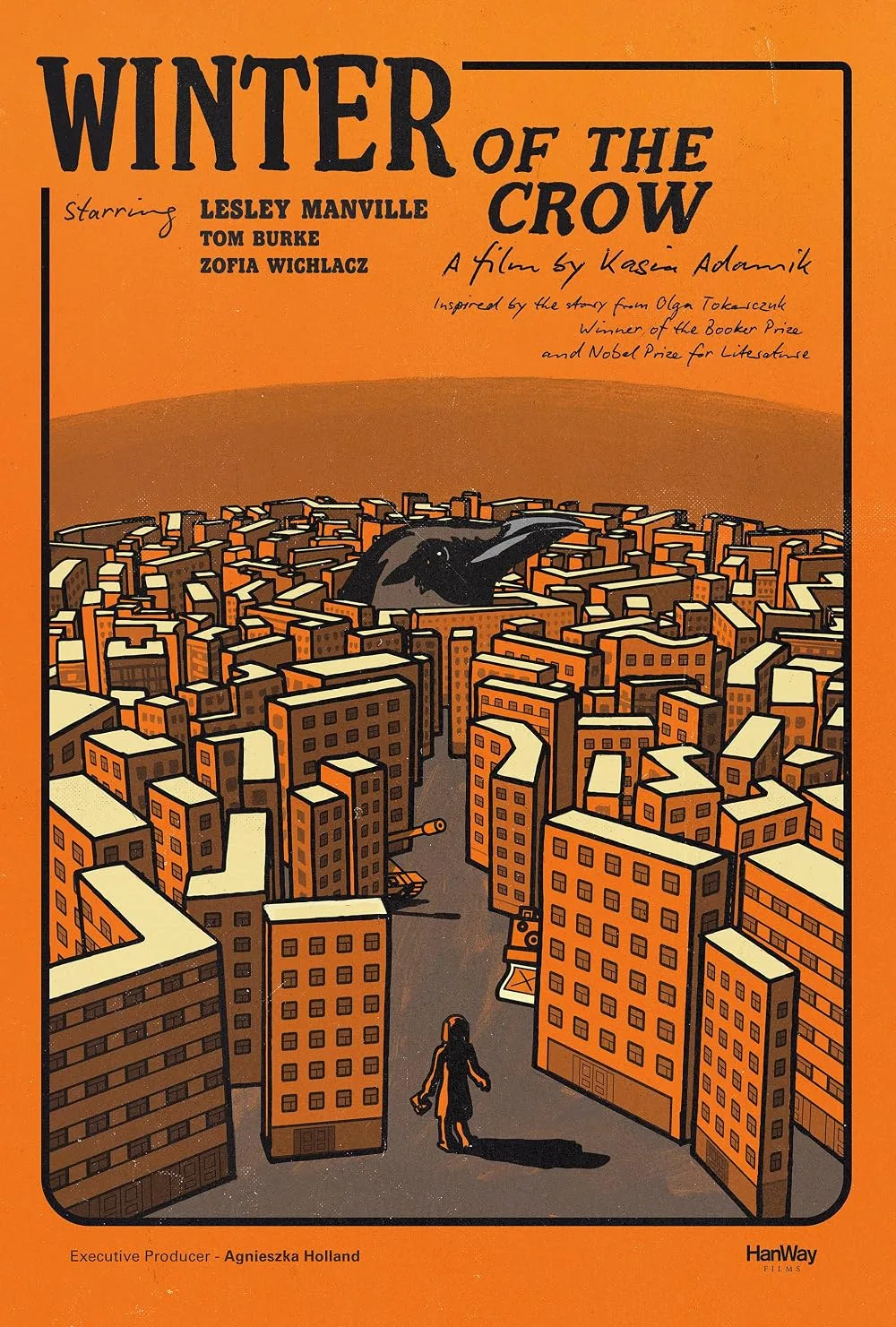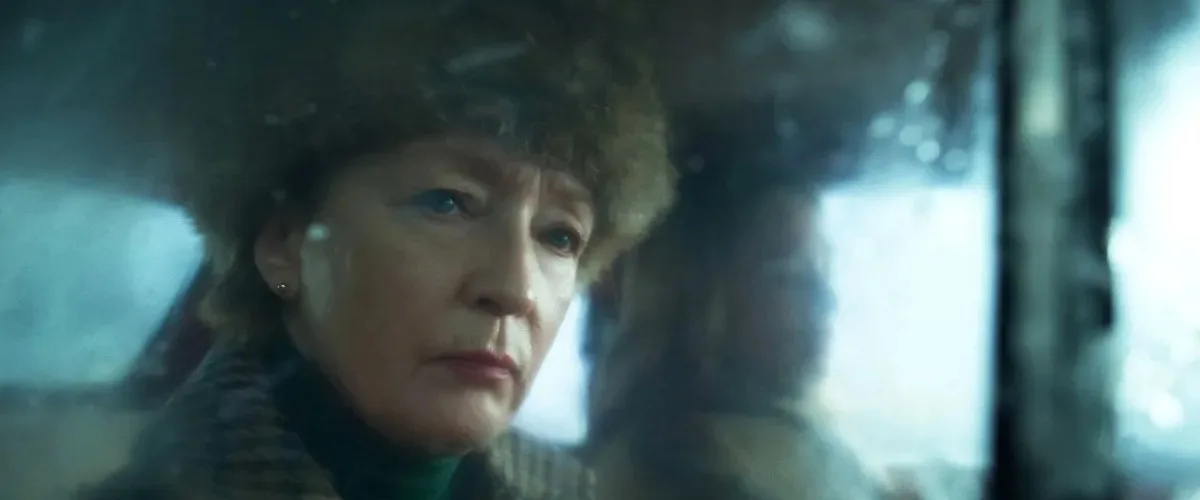
Moving with dreamlike intrigue and a gloomy tone, Kasia Adamik’s “Winter of the Crow,” which premiered last year at the Toronto International Film Festival, is buoyed by a remarkable performance from Lesley Manville, who plays the frank, withering Dr. Joan Andrews. A famed psychiatric professor, Andrews is invited to speak at a conference in Warsaw, Poland, in 1981, where she not only witnesses the cruelties of a country under martial law but also watches student activists fight to save the soul of their cold nation.
Adapted by Sandra Buchta from Nobel Prize laureate Olga Tokarczuk’s short story “Professor Andrews Goes to Warsaw,” “Winter of the Crow” sometimes labors to fill in its source material for the big screen. Nevertheless, an acute sense of time, place, and anxiety emerges amid the grey, bleak undertones of this harrowing picture, and it gains greater resonance through a committed Manville. Her intensity as an actor shouldn’t come as a shock. The Academy Award-nominated actress possesses more sterling performances than most could fathom, from “Topsy-Turvy” to “Phantom Thread.” In this dense role as the temperamental professor, she’s familiarly, yet no less compellingly, flinty and defiant.
In most films, Andrews would be a fascinating side character, one whose flattened politics and personal eccentricities would cause you to imagine her entire backstory in relation to a far more Quixotic protagonist. Here, the roles are reversed. The inscrutable Andrews is our lead: glum, demanding, and thoroughly unlikable. Near the beginning of the film, for instance, she chastises her assistant for thinking about leaving. Andrews has budgetary fights to win, and she supposedly can’t afford to consider the feelings of her most loyal followers. It’s a myopic way to move through the world, an unflinching path that becomes a detour when she arrives in Poland.
Andrews, as she tells a mysterious woman sitting by her on a plane, is visiting her first Communist country. Immediately on the ground, Andrews finds a wintry country in turmoil: People are homeless; the working class waits in lines to decide whether they want their carp dead or alive; secret police and militarized forces roam the streets. Her conference doesn’t go as planned when the students who invited her to speak use the event to denounce the nation’s authoritarian regime.
One student in particular, Andrews’ primary liaison, the rebellious Alina (Zofia Wichłacz), attempts to calm an irate Andrews. All the professor can think about is her reputation—a worthy concern but one that pales in comparison to what’s at stake in Poland—and Alina becomes disenchanted with a thinker she once admired. Alina, nevertheless, finds accommodations for Andrews while she leaves for the night with the professor’s passport to pick up Andrews’ luggage from the airport. When a weary Andrews wakes after a long night’s sleep, she discovers the grim reality of the country she’s visiting: it is now under martial law.
A linguistic tension pervades “Winter of the Crow” by virtue of Andrews not knowing Polish. When she discovers the phone line’s been cut and the secret police are now looking for her, she stumbles around the desolate snow-covered streets of Warsaw seeking help from the British Ambassador (Tom Burke) by speaking English to a local populace who don’t understand her.
That disconnect is fitting because Andrews doesn’t comprehend their worries and hardships either. She can only piece things together by examining puzzlingly evocative dreams, which often feature crows, or by viewing the fuzzy Polaroid photos she’s taken of herself, Alina, and the limp body of a young student thrown from a window by the men pursuing her. Manville translates these distressing forms of communication through her expressive eyes—they dart with the fury of a woman twisting thin threads together in her mind—and her steady relationship with an anxious camera that leans on oblique angles and voyeuristic movements to film her.
Sometimes the need to explain the levels of espionage Andrews swims through can undercut the film’s pensive tone, making one wish we could better understand the many forms of resistance Alina and her brave cohort undertake. To a point, that haziness, which recalls the film’s murky photographic compositions, appears logical: Andrews doesn’t know what she doesn’t know about Alina’s plan, and Adamik does more showing than telling. But knowing that intentionality doesn’t make the perceived distance from the film’s political heart any less frustrating.
Still, a sterling Manville and a keen sense of doom give “Winter of the Crow” the vigor it needs to feel fulfilling and true.