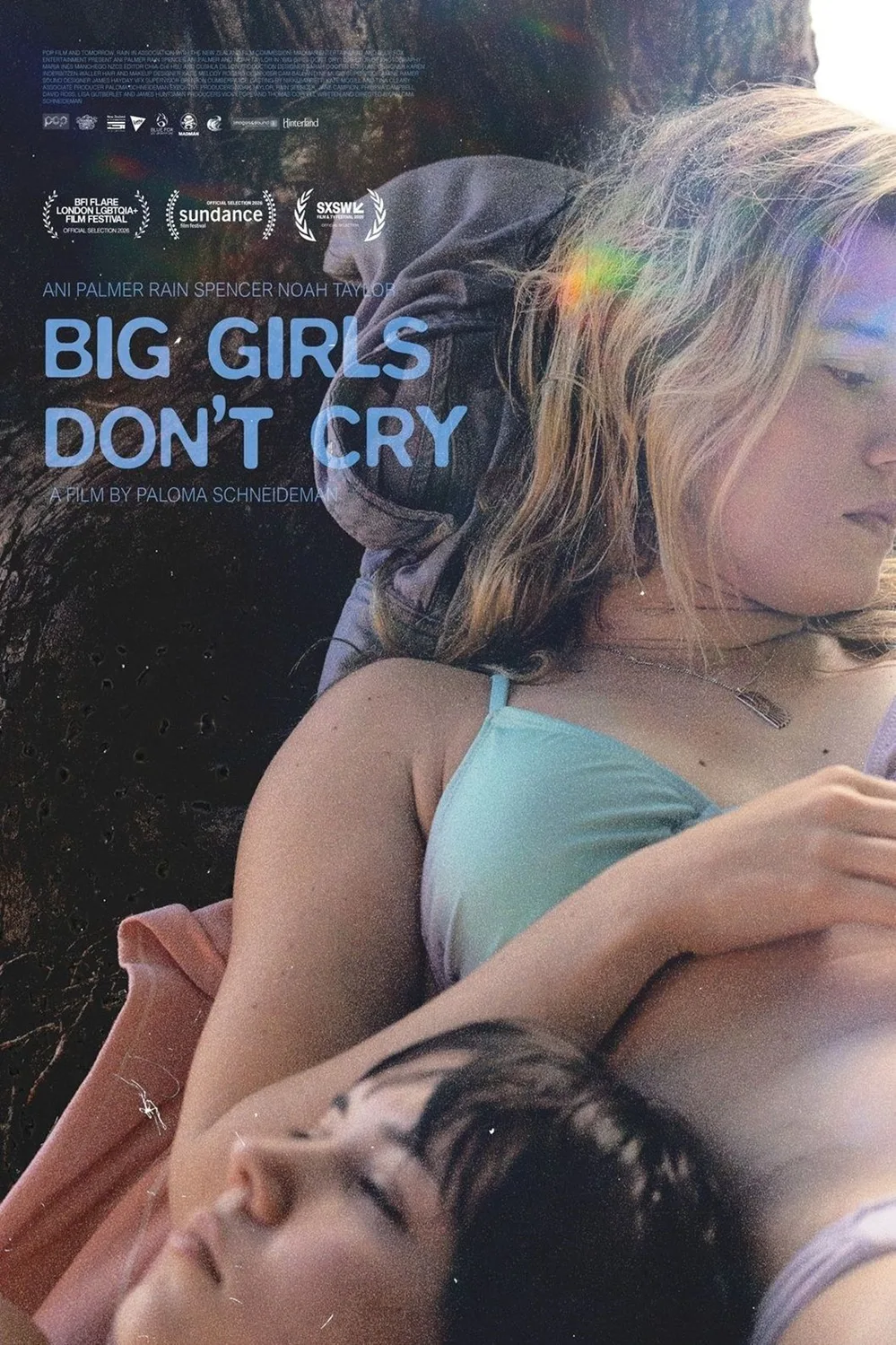

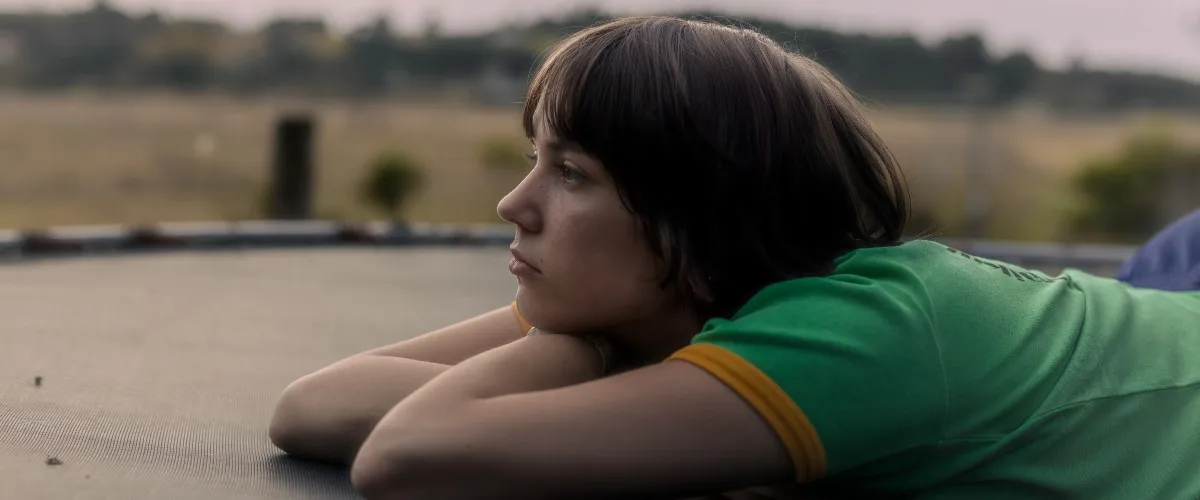
Near the end of Paloma Schneideman’s debut feature “Big Girls Don’t Cry,” Sid (Ani Palmer) walks home after a New Year’s Eve party that was both good and bad, fulfilling and heartbreaking, but ultimately left her riveted in loneliness. She sees her dad Leo (Noah Taylor) up ahead. Sid’s face scrunches up with sobs, and she begins calling out for him, but he can’t hear her.
Like much of the rest of the film, this scene isn’t monumentally complex in its psychological argument or discovery, but that doesn’t make it any less poignant or precious. Instead, it’s one of the film’s most devastating moments because of its raking familiarity: Sid calls out for comfort, to be seen, to be held, but nobody turns to her. “Big Girls Don’t Cry” is a bit like a teenage girl in this sense: unambitious but certainly, undeniably, and vibrantly courageous.
It is 2006 in a rural town in New Zealand, and Sid is fourteen years old, spending her summer break swimming in the creek or at her best friend Tia’s (Ngataitangirua Hita) house, hacking into Tia’s older brother’s MSN account and talking to uber popular girl Lana (Beatrix Rain Wolfe), a glamorous blonde who takes the same bus as Sid and Tia. The two girls have been lifelong friends, but they’re drifting apart as their interests diverge.
Sid’s sexuality is awakening, and like most kids about to get their first period, she is vibrating with the faltering and foolhardy desire to experience it all. Thankfully, and not, Sid’s curiosity is fed by the Internet. Sid ricochets from chatroom to chatroom on Omegle, stalks Lana’s Myspace-like page, and continues to log into Tia’s brother’s MSN. Tia, meanwhile, is uninterested, so Sid, impatient, leaves her behind without thinking when Lana invites her to hang out.
Freya (Rain Spencer) enters Sid’s charged world as a college friend of Sid’s sister, Adele (Tara Canton). Leo is too busy working as a gardener and licking his wounds from his failed career as an artist to take any parental interest in Sid, and Adele is too maternal to Sid to really meet her where she is. Freya sees Sid in a way no one else does—she reads Sid’s report card, teaches her how to swipe mascara onto her lashes, and shows her how to smoke weed. She takes care of Sid when she’s drunk, and Sid becomes enamored with her the way she is enamored with Lana.
Schneideman, who also wrote the screenplay, keeps Sid’s psyche in focus with precision and care; her lens always feels as though it’s standing with Sid, rather than watching her. Schneideman’s tender gaze understands that even though Sid is a distinct girl, her own person, she is also like so many of us. No great tragedy befalls Sid; some might say nothing much happens here, but that feels apt for a story about teenage girlhood.
Sid’s summer is transformative simply because she begins to discover her unique self, as many girls do. Coming of age is a universal experience, but it doesn’t come with a guidebook, meaning that every experience—every embarrassment, every lie about sexual experience, every intimacy and sadness—is a first, and it resounds and stings. Everything is monumental.
“Big Girls Don’t Cry” isn’t dire or melodramatic like “Euphoria”; it’s rooted in realism, but also in love for Sid and all teenage girls. Like every kid, Sid is sometimes annoying, cruel, and stupid, but she’s also human. Palmer carries the young girl with tremendous sensitivity and understanding, stretching into the character with an at times eager, at other times hesitant, assuredness.
The character is rendered from the inside out, meaning that we understand her. In her wide eyes, we feel her desire to be seen; in her furrowed brows, we see her sadness and fear; and in her jutting lower lip, we see her defiance. And one of this film’s greatest gifts is the budding and abiding courage Schneideman has backed into Sid: the girl keeps moving forward despite every setback, every embarrassment, and every blunder.
Sid’s cry into the roar of her father’s lawn mower feels like a cry into an unfeeling ocean, into a world where everyone seems to know their place but you. And even as everyone around Sid might be fumbling to get stable footing within an uncertain life, Sid feels like she is the only one unsure. This feeling of being alone in confusion, this feeling that is so ubiquitous but that is still so leaden and isolating: Schneidman expresses it so beautifully and delicately with “Big Girls Don’t Cry” that one marvels that this could be the filmmaker’s feature debut.
It wouldn’t be a spoiler to say that in the end, Leo does eventually turn around and see Sid. It wouldn’t be a spoiler because, like every coming-of-age film, “Big Girls Don’t Cry” is about a formative moment: Sid keeps going because that’s what we’ve all done and have to do. For this reason, this sweet, hopeful film can’t be ignored.