Warning: May contain minor spoilers for the film’s ending.
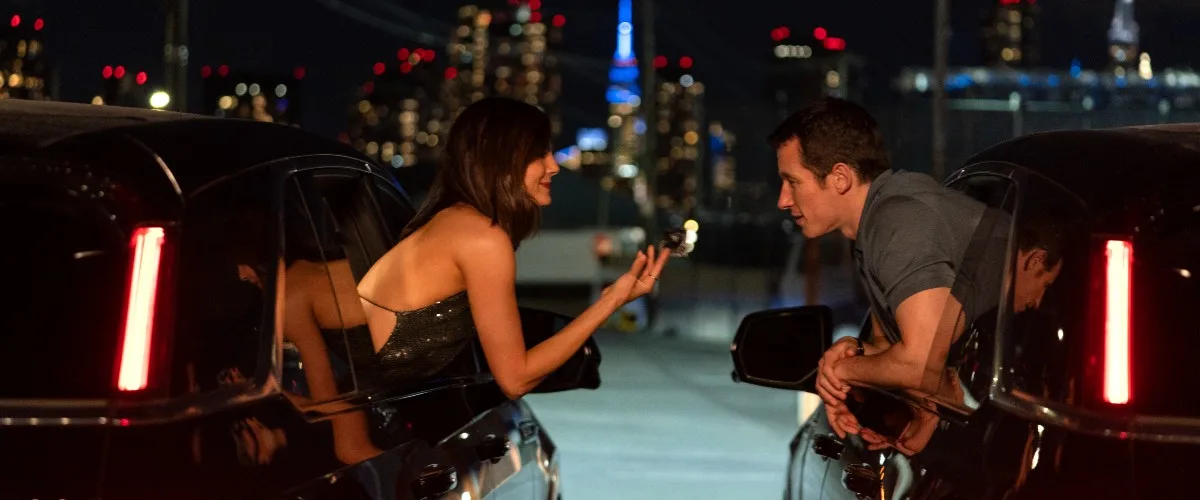
“One Night Only,” director-producer Will Gluck‘s latest romantic comedy, is everything that’s troubling about the current conservative capitalist hellscape that is the United States of America writ large. Set three years after the U.S. Congress has enacted a mandate that extra-marital sex is only legal one night a year (August 7th, though why that date is never explained), the film centers on two hapless millennials—Allie (Monica Barbaro) and Owen (Callum Turner)—who are looking for more than just a hook-up while every other sex-crazed single around them goes at it like rabbits (Gluck’s limp idea of a city gone sex-crazed is less Hieronymus Bosch fever dream than it is ersatz Skinamax.)
Allie is a shy singer who makes a living belting out jingles for pharmaceutical products that sound like pop songs. Owen owns his own pizza joint. She’s on her own after her best friend (King Princess) meets a literal prince while in line for the bathroom, while Owen’s girlfriend (Maya Hawke, stuck in a thankless nothing of a role) says she wants to sleep with someone else this year. The two will, of course, meet-cute, over and over and over, as the night progresses.
Unfortunately, Travis Braun’s script is nothing but an edgy premise—think Jac Schaeffer’s “TiMER” (2009) mixed with “The Purge” (2013)—that exists solely to take milquetoast characters from one slapstick set up to another. It makes nods to the very real horrors of today, like tech bro-backed surveillance capitalism, rampant Big Pharma advertisements, and fascist police and politicians controlling our bodies, without ever taking the time to interrogate any of the sources that have led to our current political climate.
Good satire is rooted in the understanding and interrogation of systems, of the root causes of its satirical target. This can’t be achieved through quippy, outdated pop culture zingers and a handful of references to the country’s partisan political tension and “single issue voters,” all of which have the sole aim of making you laugh but don’t bother to make you think. Political satire cannot stand up if it doesn’t have a spine.
It’s a film all about sex that has no sense of eros between its central star-crossed would-be lovers, and only features the barest of nudity (the buttocks of a few different men running naked). That’s progress, I guess, since an earlier iteration of this film made in the ’80s or ’90s would have just been a flurry of tit shots. (Though apparently, we are still cursed with a woman forced to wear 6” stiletto heels for twelve hours as if her feet wouldn’t be bleeding and broken by dawn.)
Romance, too, is depicted in deeply conservative, heteronormative terms—casual sex is looked down on, open relationships only lead to guilt, etc. Oh, but don’t you worry, it’s got plenty of allegedly sex-positive product placement for Durex condoms and KY Jelly (as well as for CitiBikes and Dunkin, because what’s New York City without its big corporations clogging the streets).
Sex workers are thrown under the bus, shown only as thieves who fleece men in the woods at night, while queer sexuality is relegated to a few scenes with Allie’s roommate (a woefully underused Quintessa Swindell) and a handful of pans past blurry same-sex extras making out in the background. “This night is for the straights,” Swindell’s character says to Allie, before saying that queer people have worked around straight laws for centuries.
This is supposed to be a nod to queer resilience, but largely comes off as straightwashing the history of anti-LGBTQ legislation in this country that led to raids of queer clubs and incarceration of queer people in the not-too-distant past (let alone the current barrage of new anti-LGBTQ legislation currently in the works and on the books). It’s also ignorant of the long and fraught fight for the normalization of age-of-consent laws, which, by the way, did not happen in all states in this very country until 2003. Yes, that’s not even thirty years ago.
By the end, our intrepid protagonists have not had sex with anyone, because this is a film about Romance with a Capital R (and I guess sex is not part of romance!) and for that very same reason they ultimately embrace the fascist state of things. They aren’t the only ones who refuse to fight back. No one in this cursed film is protesting this mandate beyond “repeal” signs in various windows and some creative graffiti (like Lady Liberty in a chastity belt). The few activists we do see—one of Allie’s dates who’s on parole for fucking fourteen times in an eight-day period and an old man who refuses to wear love gloves—are used for jokes, and then are thrown into the clink and resolutely forgotten.
And perhaps that’s the point of the movie; that we’re already this deep into a fascist state of emergency, yet only a few people can actually be bothered to do anything about it beyond putting signs in their window. But the satire needs to be sharper (and smarter) for the movie not to fold in on itself. And if we are supposed to believe that the film is making some subversive statement about the state of sex and bodily autonomy in this country, it cannot end with its leads embracing their chains. That’s just warmed-over conservatism running around in sheep’s clothing.
You might ask, does a rom-com fail just because it refuses to actually engage with its political premise? Maybe not. But if the central romance falls flat, the jokes aren’t funny, and the desperate celebrity cameos grate like nails on a chalkboard, it does fail even at being “just a rom-com.”
In one sequence where Owen and Allie can’t manage to pull $200 out of a bodega ATM in order to buy the lone condom left in all of Manhattan, one of them finds a postcard with Deborah Kerr and Cary Grant in “An Affair To Remember” (1957) on it that reads: New York is For Lovers. One can only hope that the ghosts of Kerr, Grant, Leo McCarey, and hell, even Nora Ephron, haunt the makers of this putrid, regressive film that thinks justifying embracing fascism is okay if it’s in the name of love.
If this is what it takes to get a rom-com greenlit these days, maybe we should just let them die. Death with dignity is surely a better fate for the genre than fascist capitulation.