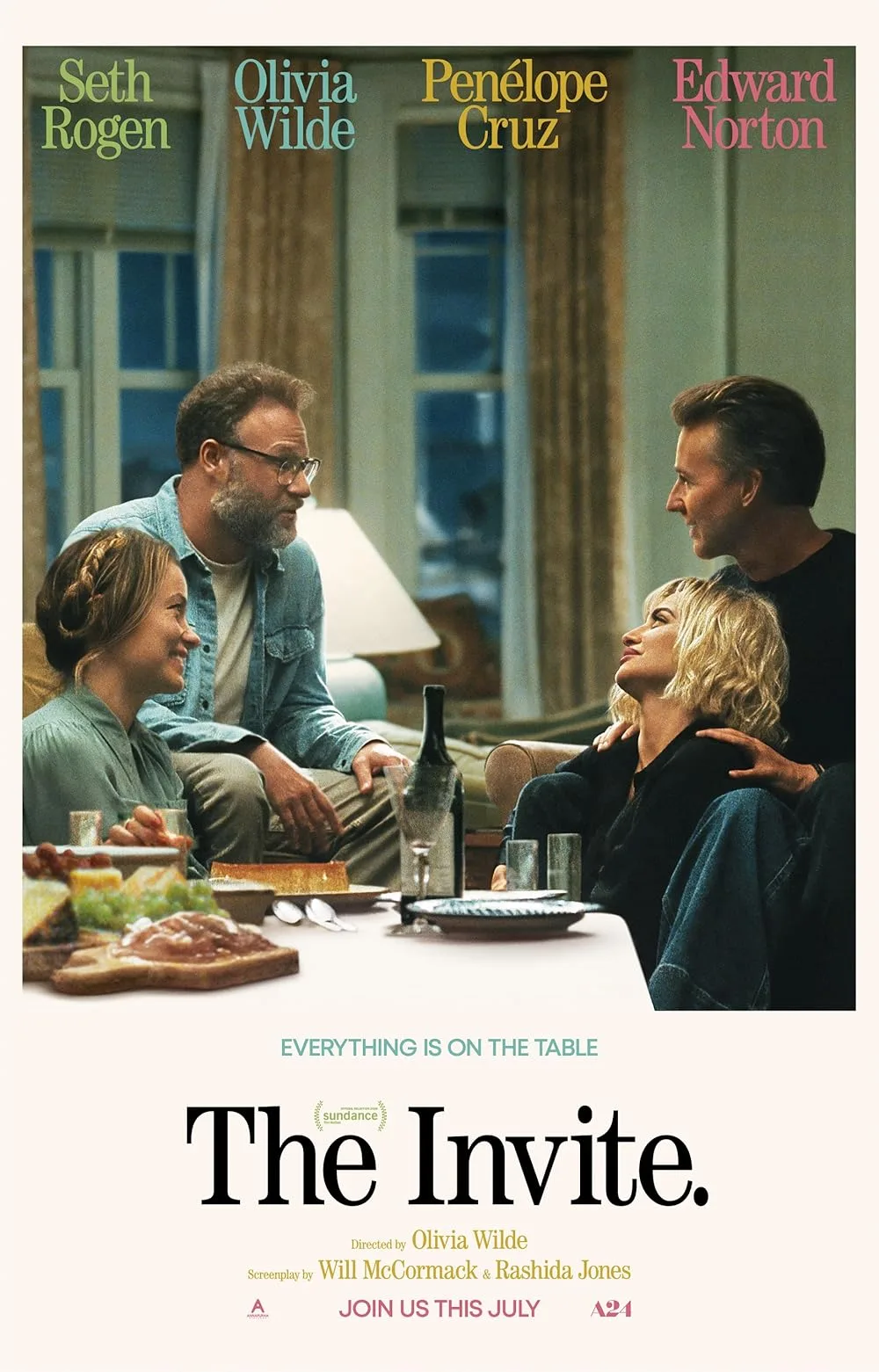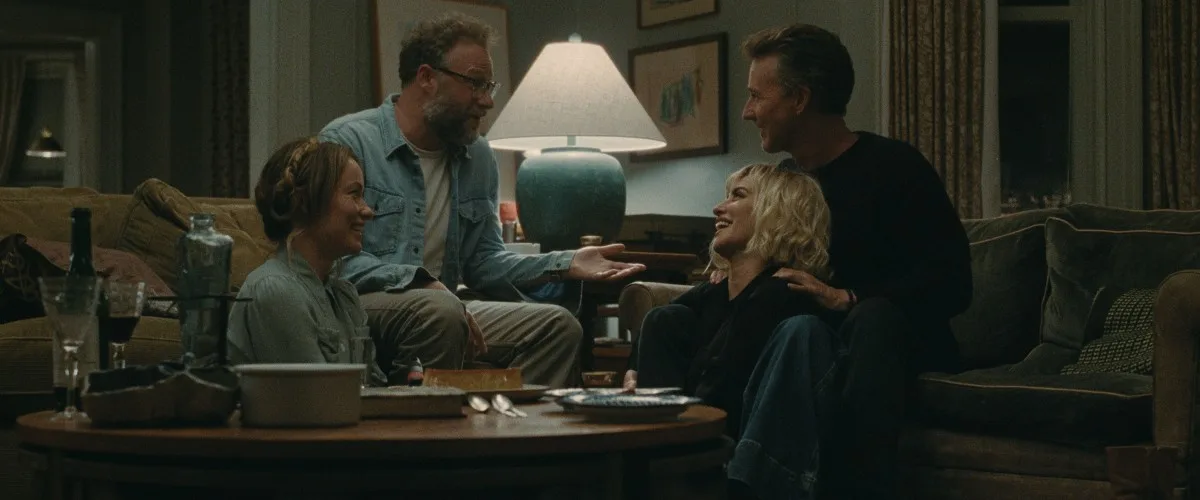
“The Invite” is a farce about an unhappy bourgeois married couple who host a dinner in their apartment for the upstairs couple whose sex noises keep them up at night. That seems a counterintuitive thing to do. But the downstairs wife, Angela (Olivia Wilde), has been functionally trapped at home for years while her husband Joe (Seth Rogen), once a promising musician, works long hours as a band teacher; she’s so frustrated that such an act seems very much in character for her. It’s also a coded attack on Joe, who was informed of the dinner date exactly once, and protests that Angela should’ve known better than to assume he was listening.
The upstairs couple, Pína (Penélope Cruz) and Hawk (Edward Norton), are bohemian extroverts who have rejected bourgeois morality and built their lives around freedom and pleasure. The noises that Joe and Angela keep hearing were produced partly by Pína and Hawk and partly by the partners they invite over. The tension inside Joe and Angela’s apartment was already thick before these two knocked on their door. Once they’re inside, inspecting mementos and asking impertinent questions, you know it’s a matter of time before they’ll ask Joe and Angela to complete an erotic quadrangle.
“Will they or won’t they” is the comic engine driving the script by actor-writers Will McCormack and Rashida Jones. Luckily, “The Invite” goes further and deeper than the snickering, cartoonish “naughty” sitcoms that have long been staples on British and American television, instead aiming for something more in line with foreign-language arthouse films that can critique and laugh at sex without turning puritanical. Unsurprisingly, given the geographically tight parameters, “The Invite” started out as a stage play, Spanish writer Cesc Gay’s Els veïns de dalt / Los vecinos de arriba. It was previously adapted into the 2020 Spanish film “The People Upstairs” and a same-titled 2025 Korean film. It’s the dramatic equivalent of a sturdy little house that a realtor describes as having “strong bones.” It can be completely redone but still be recognizable as that house.
None of which is meant to downplay the efforts of McCormack and Jones, who have contributed to projects as wide-ranging as “Celeste and Jesse Forever,” “Black Mirror,” “Toy Story 4,” and the Netflix documentary on sex workers, “Hot Girls Wanted.” Together with Wilde, who also directed, they’ve made an American film that feels vaguely international—and not just because one of the leads is Cruz, a longtime collaborator of filmmaker Pedro Almodóvar (though his sexy comedies are much more colorful, thank goodness; this one settles for a standard drab American indie look).
Wilde’s debut “Booksmart” was a lot of fun—a goofy, raunchy, female-centered answer to horny teenage boy sagas like “Superbad” and “American Pie.” She stumbled with her follow-up, “Don’t Worry Darling,” a satirical psychological horror film that started strong but imploded as it went along, turning into a subpar “Twilight Zone” episode. “The Invite” is a return to form of sorts, in that each directorial choice, good and bad, is obviously the product of a filmmaker with a strong idea of what the film is about and what sort of tone it should have from scene to scene.
That said, “The Invite” is far from faultless. It’s downright irritating in its first half, which is over-directed to such an extreme that you may briefly wonder if Wilde and cinematographer Adam Newport-Berra (who shot Rogen’s brilliant series “The Studio” for Apple TV) are trying to parody one of those try-hard, wear-your-themes-like-monogrammed-ballcaps indie dramas that get programmed at film festival programs because one of the semi-famous actors promised to show up for a Q&A.
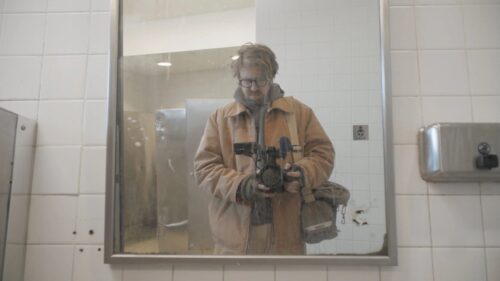
A premise that’s already edgy, slightly ominous, and oppressively claustrophobic—innately, because the characters all have secrets, and the action is set in one space—is made precious and then redundant by the filmmakers, who stage a lot of the action within vertically or horizontally off-centered compositions, squish the actors into the edges of the frame, and use reflective surfaces to create split screen imagery that’s nifty but says nothing. A few shots seem to have been taken by a spy camera through a mouse hole. Devonté Hynes, of Lightspeed Champion and Blood Orange, applies the same overkill to his string-driven score, which grabs onto the dominant feeling of a scene and amplifies it until additional emotional shadings are drowned out. One comically tense dialogue scene is scored with flurries of jabbing, screeching strings, like in a horror movie.
Once the movie calms down–roughly at the halfway mark–the actors are left to handle most of the important storytelling choices. Correspondingly, the visual and musical compositions step back and only chime in when there’s something to add. It’s rare to encounter a film that seems determined to be so wrongheaded that you seriously think about walking out, but then pivots and settles into a mode that repairs our broken trust in the artists’ judgment. That’s “The Invite.” The last half-hour is the best work Wilde has yet done as a director. The final shot is perfect, getting the story’s larger point across organically and with feeling. And all four lead performances are excellent, each taking you on a different trip.
Pína’s Socrates-meets-Hugh Hefner hectoring of Joe and Angela slowly ebbs until you realize she’s hiding from herself too, in a way; Cruz shows us that the character is deep into middle age but is still driven by a rebellious teenager’s urge to scandalize and shock, but also that Pina can’t see herself as clearly as we do, and might crumble if she got a clear view. Wilde shows us Angela’s desire to shatter the confines of her life. Whenever the talk turns overtly sexual, her eyes widen with a mix of fear, curiosity, and carnal hunger.
Norton’s Hawk is another entry in his gallery of characters who present themselves as overgrown Boy Scouts (literally, in the case of “Moonrise Kingdom”) but cling to rituals, traditions, and uniforms to keep their delicately constructed self-images from falling apart. He delivers two marvelous monologues in this film, one deeply sad and the other profound, and nails them both, convincing you that Hawk, an ex-firefighter who remade himself as a street corner answer to Henry Miller, could actually exist. (Perhaps he already does: both Steve Buscemi and the playwright and screenwriter John Patrick Shanley were firefighters.) Norton has a certain way of delivering dialogue to both male and female characters that makes you wonder whether he’s flirting or that’s just how he talks.
As for Rogen, well, he’s an international treasure. You probably already knew that. But if you didn’t, the mix of self-loathing, regret, nostalgia, and hardbitten realism that he brings to Joe will make it plain. It was obvious from his breakthrough role on “Freaks and Geeks” that he was an original, often riotously funny performer, but in mature roles like the ones he played in “Steve Jobs,” “The Fabelmans,” and “An American Pickle” (in dual roles), he proved he’s got soul, too. He’s on track to age into a first-rank comic character actor in the mold of Walter Matthau, Jack Warden, or his “Fabelmans” costar Judd Hirsch. When Joe is unexpectedly injured and rendered almost immobile as he groans, curses, and whines, Rogen’s physicality is wondrous to see. He’s a human illustration of Mel Brooks’ line, “Tragedy is when I cut my finger; comedy is when you walk into an open sewer and die.”
Best of all, “The Invite” is a worldly movie that never seems to judge any character’s foibles and contradictions, much less to prompt the audience to approve of one couple’s way of life and disapprove of the other’s. It sees them and sees through them. It starts out trying way too hard to impress us, then settles into an easygoing, authoritative groove where you forget you’re being told a story and feel like you’re just watching people exist.