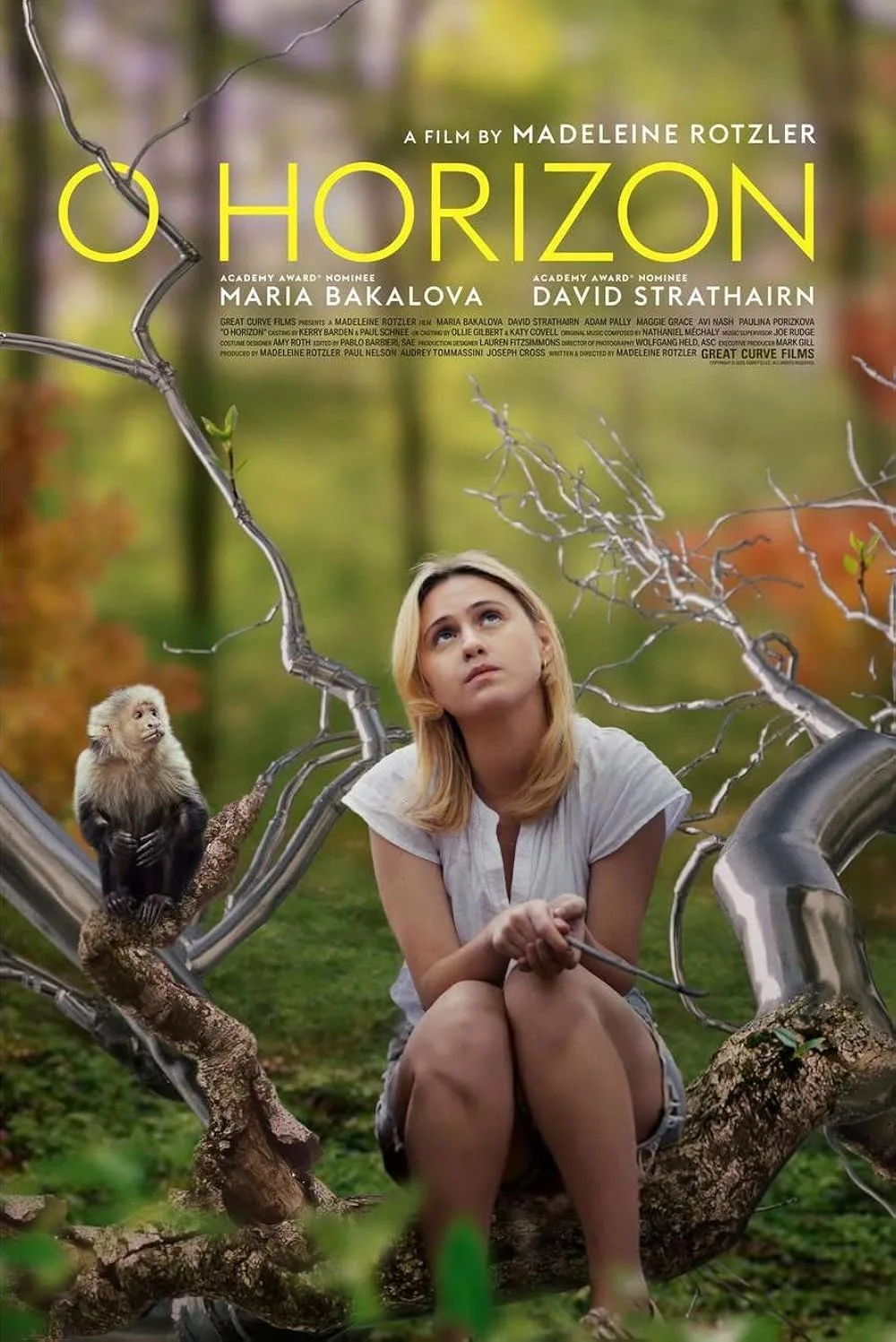
The most interesting character in “O Horizon” appears in only two brief scenes. You keep waiting for him to come back to liven things up. He strolls in from a different movie. A better movie. Written and directed by Madeleine Rotzler, the film is a general wash of generalized muted feeling, where nothing coheres because nothing sharpens into focus.
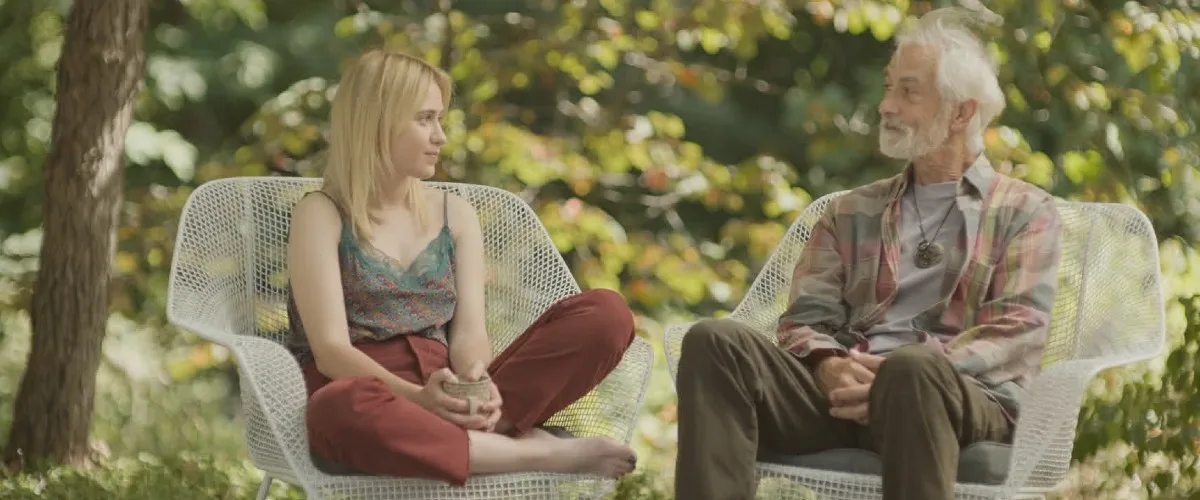
Abby (Maria Bakalova) is a neuroscientist who recently lost her father (David Strathairn). She’s retreated from social life and spends her time when she’s not working wandering around in a daze. As presented, it’s a general idea of grief. Strathairn, seen only in flashback or heard on the phone, is a warm and vital presence, making it clear why Abby misses him so much.
Abby works in a lab, mapping the brain activity of a depressed monkey named Dory. She presents Dory with virtual stimuli, and the dopamine hit appears on the white screen as a rainbow explosion. When Dory realizes his experience was not real, that he has been tricked, the colors on the screen turn black. Abby’s colors are black, too, in case you didn’t get the symbolism.
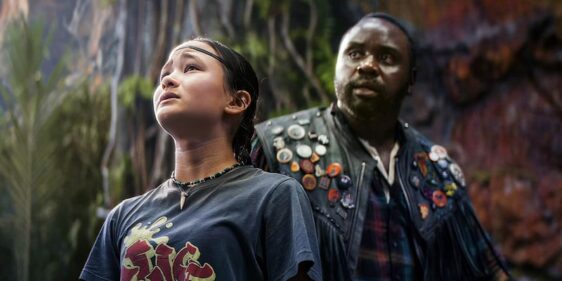
From there, she visits a company called Seeking a Friend, located in an anonymous storefront. Seeking a Friend is a one-man operation, that man being Sam (Adam Pally), the aforementioned sole interesting character. Seeking a Friend is an app where you can upload a person’s text messages and voicemails, and the person’s essence is then recreated as a perfect facsimile. You can call your dead father; your dead father can call you. Abby is soon doing just that.
It’s almost as good as the real thing. If you get the dopamine hit, who cares if the stimulus is not-real?
Abby strolls through a dazzling and somehow unreal New York City, the whole film moving in a slow-motion daze. Her apartment is straight out of a luxury magazine, complete with a glass-walled greenhouse in the middle of the main room. Do newbie neuroscientists make that kind of money? Sam’s office, quirky and humorous, is unlike every other interior in “O Horizon.” It feels like a person actually lives and works there.
Bakalova, nominated for an Oscar for “Borat Subsequent Moviefilm,” has been very good before, showing a gift for comedy and specific characterization. “O Horizon” doesn’t allow her to shine. Abby is not a character. She is in an extended emotional state, moving in a sad, slow-motion daze. That’s pretty much it.
Normally, a director’s family tree would have little to no bearing on a review. But it is necessary here. Rotzler’s birth name is Sackler. She is the daughter of the late Jonathan Sackler, joint owner of Purdue Pharma, the family business. As everyone should know by now, Purdue developed OxyContin and marketed it aggressively to hospitals and doctors, claiming it was not addictive. The resulting epidemic remains a national catastrophe. While Madeleine Sackler never worked for the family business, she has not only benefited from her family’s wealth but has also been cagey in answering questions about her family, her money, and how they connect to her films. “Oxy money” is dirty money.
Sackler is probably most well-known for making two films in a maximum security prison: HBO’s “O.G.,” starring Jeffrey Wright, and the Emmy-nominated documentary “It’s A Hard Truth Ain’t it,” both released in 2018. Prisons are filled with people who are incarcerated because of opioids, and Wright himself expressed discomfort about the film and Sackler’s connection with Purdue Pharma. People working on “O Horizon” were also uncomfortable, and one crew member quit. (The situation was detailed in Artnet.)
In an article for The Guardian, photographer Nan Goldin, who became addicted to opioids after being prescribed OxyContin, said, “[Madeleine Sackler] presents herself as a social activist, but she has been enriched through the addiction of hundreds of thousands of people.” Having seen “All the Beauty and the Bloodshed,” Laura Poitras’ brilliant documentary about Goldin’s life and career, the photographer’s words hold great authority.
Knowledge of Madeleine Rotzler’s (Sackler’s) background is not irrelevant to “O Horizon,” with its soft-lens view of A.I., its dopamine-drenched monkey’s brain, its idealized father. Abby will eventually give up the “crutch” of her computer-generated father’s voice. It won’t be so easy for the hundreds of thousands of people addicted to OxyContin.