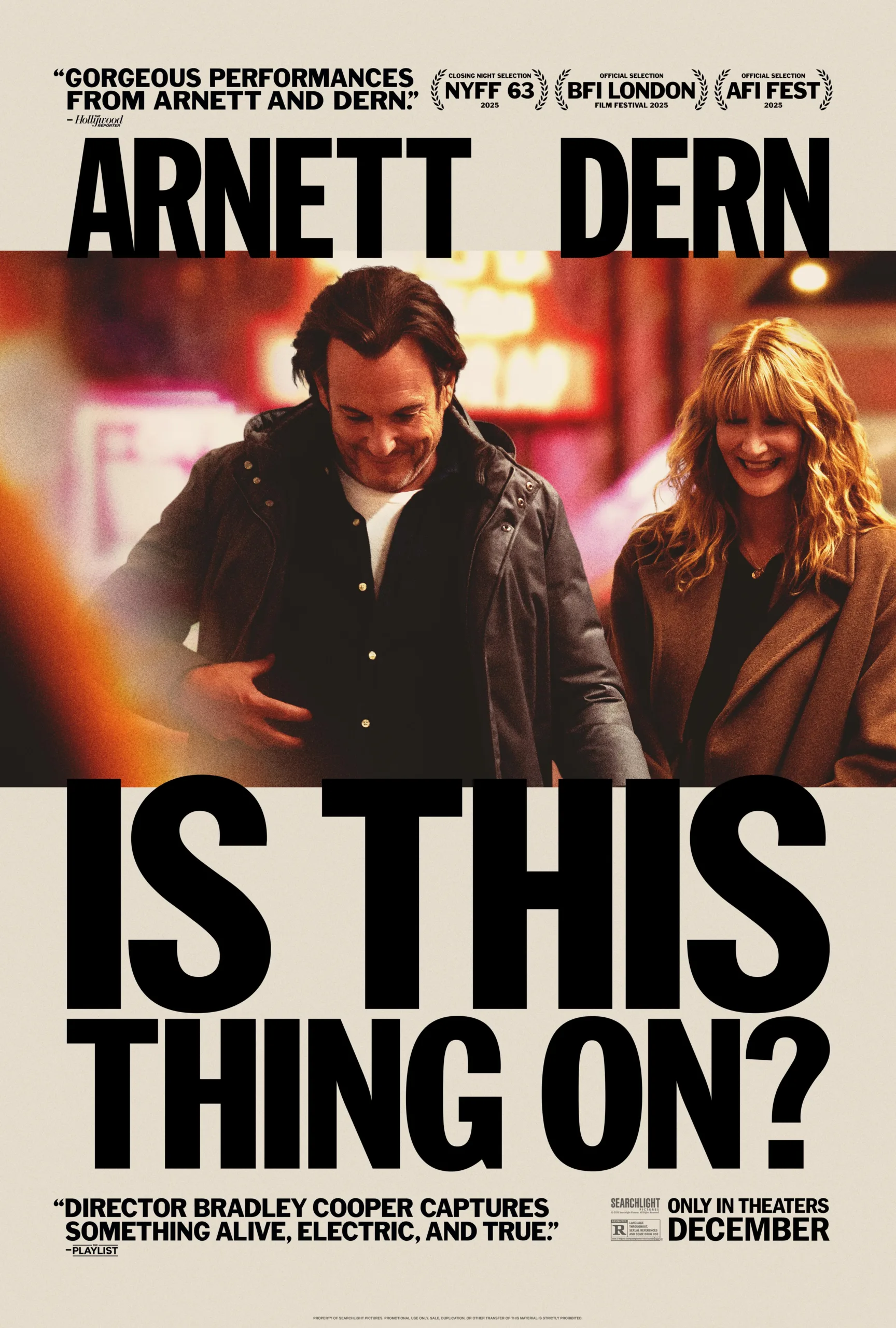
Bradley Cooper‘s “Is This Thing On?” stars Will Arnett and Laura Dern as Alex and Tess Novak, a married couple with kids that gets a divorce deep into their forties. It has all the elements you expect to see in a divorce movie, including the couple failing miserably to hide their relationship status from their kids and friends; scenes where each partner talks through problems with their best kooky best friend; and a sequence capturing the mix of anxiety and excitement a newly single person feels when they realize they’re on the verge of having sex with somebody new, and the rush of annoyance and jealousy their ex feels when they learn of it.
Luckily, this is the kind of movie that makes familiar story elements feel fresh by creating believably complex characters and putting them in situations that are at once universal and extremely specific. For instance, we get the classic divorce movie scene where one of the exes suddenly has a chance to meet up with somebody who could help their career and asks their former partner to watch the kids for the night with zero notice, and even though the former partner has a date that night, they say yes, then secretly subcontract childcare to the grandparents. The twist here is, the second partner’s date is not with a person. It’s at a place: a comedy club.
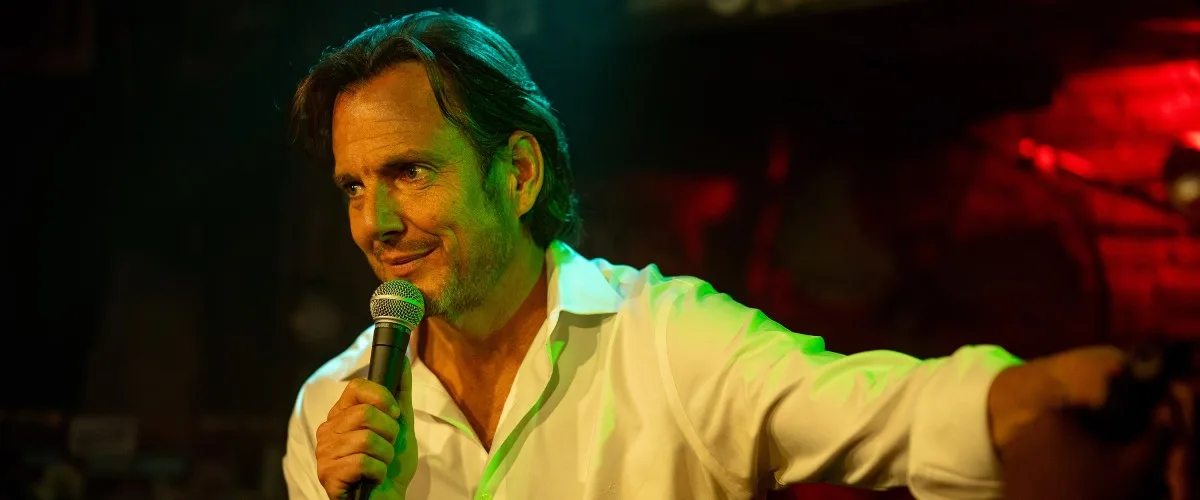
Alex is vaguely “in finance.” His first open mic night happens because he’s wandering around depressed in New York’s West Village and impulsively decides to see some standup comedy at a club, but doesn’t have enough to pay the cash-only cover charge. So he impulsively adds his name to the list of amateur performers so he can get in free. His first performance is terrible. The material amounts to, “Hi, I’m getting a divorce, and it sucks,” and his pauses are long enough to bake a pie in. But he gets off one decent line, and has a rough, unaffected quality that catches the audience’s fancy. There’s a consensus among the other comics in the house that he’s not a lost cause. So he comes back for another go-round with more confidence and does marginally better. Soon he’s rehearsing jokes in his bedroom and scrawling ideas in on loose sheets of paper that he keeps in a Trapper Keeper notebook.
Tess, meanwhile, is charting her own course. She was once a good enough volleyball player to make the women’s Olympic team, but gave it up to be a wife and mother in the suburbs. She’s been bitter about that sacrifice ever since, even though she’s never dare admit it to anyone, including herself. She decides to take up coaching, investigates some new leads and calls up old connections. She even asks her old friend Laird, a coach, for advice. Peyton Manning, former NFL quarterback turned sports TV personality, plays Laird. Earnest and committed but not entirely natural, Manning is the weak link in the main cast. But the main cast is so formidable that he has nothing to be ashamed of.
Christine Ebersole and Ciaran Hinds are Alex’s parents, Marilyn and Jan. The former is blunt to the point of causing blunt force trauma, but knows when to put the wiseass matriarch routine away and be a rock for her son. Jan is a soft-spoken guy with big heart who has retreated into his hobbies but radiates goodwill towards everyone he meets. Cooper plays Alex’s best friend, an actor known as Balls (yes, that’s the name). He’s cheerful even when troubled, and seems stoned even when he isn’t. Andra Day plays his wife Christine, who will launch into a two-minute, free-ranging monologue, then smile sweetly and tell her audience, “I’m glad we talked!”
Two more pals of the Novaks, the married couple Stephen and Geoffrey, are played by Sean Hayes and his real-life husband Scott Icenogle. It might be a slight shock to realize you’re seeing Sean Hayes in what amounts to an indie Hollywood drama where we’re allowed to see the lines and blemishes on people’s faces. It’s nearly as jarring as seeing Andrew Dice Clay playing the heroine’s father in Cooper’s 2018 version of “A Star is Born” and taking a second to accept that he’s humbly submitted to the demands of the film. Hayes rarely gets to act in projects like this, and as standup comics would say, he kills. This group’s interactions are 100% credible as the behavior of old friends who sincerely love each other, but whose attempts to keep the old gang together are getting harder the older they get, and who find themselves expending increasing amounts of energy pretending the fissures between them aren’t widening.
Directed, co-produced co-written, co-starring, and partly shot by Cooper (who will probably do all those jobs on the next movie, plus catering), “Is This Thing On?” is the best of the three films Cooper has directed, mainly because it’s the one that seems to care the least about impressing us. Which is to say that, although it’s as technically accomplished as Cooper’s “A Star is Born” and “Maestro,” it subsumes its considerable craft—including Matthew Libatique’s warm but unpretty and documentary-rough imagery, and Charlie Green’s subtly unpredictable editing, and the actors’ expert control of tone—beneath layers of minutely observed behavior. The result is a stealthily special movie, the kind you might write off as “light” entertainment until you realize a few weeks later that you’re still thinking about it.
Consider Cooper’s performance as Balls. Even though he’s playing a supporting role in his own movie this time instead of the lead, it’s not any kind of demotion, because Alex is one of those melancholy, reactive heroes who starts out beaten-down and depressed and slowly comes to life, while Balls is a magnificent doofus who would walk off with the film if Cooper the director didn’t stop him. Balls makes his entrance at a party tripping and falling on the way into his own apartment, spilling a carton of oat milk so spectacularly that it’s as if there was a tiny bomb in it. He grows ostentatious variations of a beard and mustache “for a part.” He overestimates his tolerance for edibles so badly that he turns ordinary conversations into a middle-aged hipster version of “Who’s on first?”
And yet, Balls never comes across as a try-hard eccentric played by an actor who’s trying to do a self-promoting, chameleonic, tour-de-force scene-stealing kind of thing. Balls just seems like a real person, uniquely weird but genuine—a soulful jester. Whenever he shows up, you can feel Alex’s spirits lift. There’s a scene where Alex is sitting along on a beach at night and Balls seems to emerge from the darkness as if summoned, grinning because he knows he just made a grand entrance and is tickled that Alex knows it, too.
Cooper stages a lot of scenes as long takes without any cuts, including a closeup of Alex dissociating during a hangout with friends, and Alex’s first journey to the comedy club stage, which tracks him from a ground-level bar down a steep, narrow stairwell lined with people, into the basement performance space and onto the stage, then gives us a couple minutes of Alex’s awkward attempts to connect with the crowd before cutting to different angle. Here, as in the whole film, the sound mixing is superb. Often you hear certain elements recede or grow depending on where Alex is, which enhances the “you are there” feeling. Maybe a third of the scenes in the movie are this meticulously choreographed for both actors and crew, but not in such a way that you think “nice shot” or “great sound.”
The style owes more to various flavors of neorealism, which prized immediacy and embraced roughness. The descent to the stage and other long-take, one-shot scenes might remind 21st century European cinema buffs of the Dardenne brothers’ documentary-adjacent way of filming real people struggling to survive, even though the screenplay is plainly an example of what’s called “champagne cinema”—i.e., stories about people who don’t have any real money worries, and are going through crises most people would be lucky to deal with, like changing careers. A major difference between this champagne problem movie and most others is that it’s just capturing the world depicted in the script as believably as it can, and not trying to pretend that it’s typical.
For all of its many fine qualities, “Is This Thing On?” isn’t the flawless masterpiece that Cooper seems determined to will into creation. There are lines that blatantly explain things that did not need to be explained because the acting and filmmaking made them clear already. And there are some story developments that the movie seems to think are surprising that aren’t. Dern is characteristically excellent as Tess, especially in the second half when the script throws narrative curveballs at the main couple and they’re both thrilled to be taken by surprise; but her half of the story can’t help being overshadowed by Alex’s half, because while hers is aspirational, Alex’s is active. We’re watching a person fall in love with a new pursuit and putt in a lot of work to get better at it, and the improvements and successes are dramatized rather than (mostly) talked about.
But these are small complaints compared to what has been accomplished. You believe nearly everything presented to you, including that the audiences in the clubs would be laughing at the all the comics’ jokes if they weren’t paid extras, and that Alex and Tess had something truly special before their marriage decayed (when they laugh at each other’s goofy little riffs, it doesn’t feel like a performance of laughter, but footage of two people cracking each other up).
It would be fascinating to see Cooper drill down on this mode of filmmaking, like Alex putting in the grunt work needed to become a good comedian. There’s no denying from his first two features that he’s ambitious in every way, and can comfortably operate in different technical and historical modes because he’s a model student. But he’s doing things in this movie that can’t be taught or learned. It’s not cinematic ventriloquism; it’s an authentic and unique voice, caught in the act of being born. The alchemical collision of the actors, the style, and the real-life settings result in a film so attentive to fluctuations in the characters’ emotions that watching them exist is exciting. You never know what these people will feel next or how they’ll express it, and the camera’s always in the perfect place to catch it.