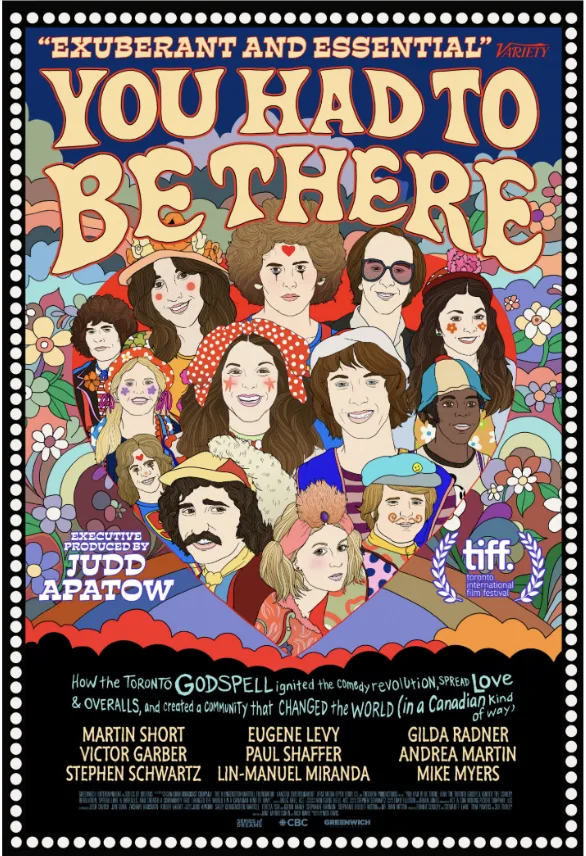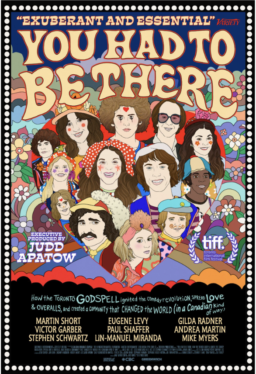

Nick Davis’ “You Had to Be There: How the Toronto Godspell Ignited the Comedy Revolution…” comes closest to fulfilling comedy fans’ ultimate time-machine fantasy.
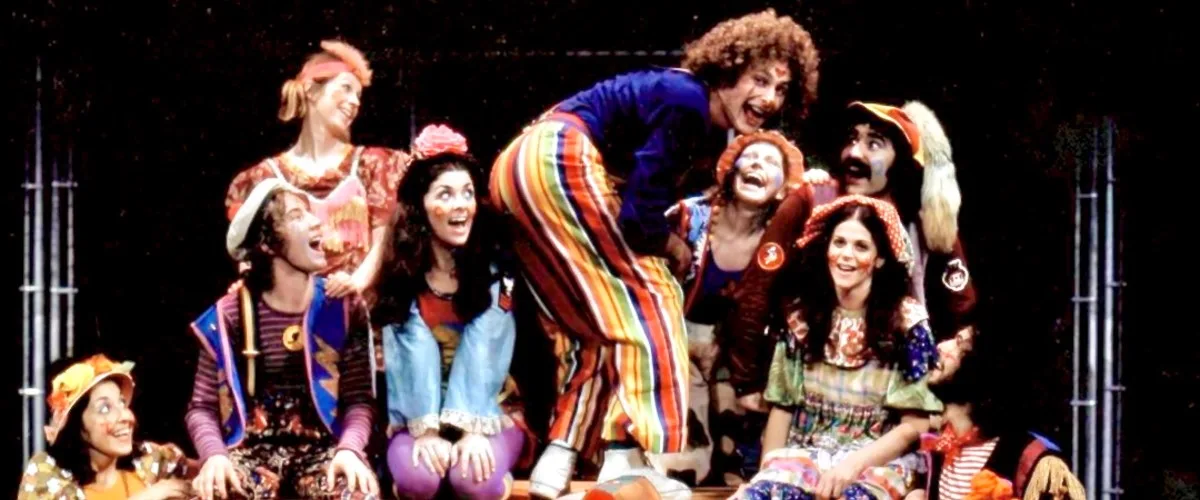
If one had such a machine, their first stop might well be Toronto in 1972 to attend the Royal Alexandra Theatre production of “Godspell.” Its legendary cast included Victor Garber, Eugene Levy, Andrea Martin, Gilda Radner, Martin Short and Dave Thomas, with future “Late Night with David Letterman” band leader Paul Shaffer as musical director.
In a talking head interview, Lin-Manuel Miranda compares this lightning-in-a-bottle aggregation of talent to the 1927 Yankees, but his analogy misses the mark. They were not all-stars. At this point in their fledgling careers, they were rookies, raw and green. They would become Hall of Famers, but at the time, show business didn’t seem like a viable career option. Martin Short initially studied to be a doctor. “Nobody from Hamilton, [Ontario, where Levy and Short grew up] became an actor,” Levy observes.
But with “Godspell,” they became “the ‘it’ kids of Toronto” and, as comedy historian Kliph Nesteroff puts it, the show was the root from which blossomed a mighty tree, whose branches bore such fruit as “SCTV” (arguably Canada’s greatest export) and “Saturday Night Live” (Radner was the first one cast). Who would have thought that such comic talent would come from a rock musical about the life of Jesus?
Written by John-Michael Tebelak with a Grammy-winning score by Stephen Schwartz, “Godspell” was based on the Gospel of St. Matthew. As with the rock opera “Jesus Christ Superstar” (but much more joyous and raucous), it was aimed at young audiences, with an overalls-clad Jesus leading his disciples.
Davis has wrought a miracle in capturing the high spirits of the Toronto production of “Godspell.” The show was never filmed, so he is without performance footage. “All we have to go on is the lore,” remarks comedian Gary Gulman.
Davis deftly weaves together delightful, poignant, at times heartbreaking reminiscences from surviving cast members, along with priceless audio of the show illegally recorded at the time by Short himself. Animated sequences with a touch of ‘70s “Schoolhouse Rock” are a quirky treat.
The director vividly sets the stage, showing how the right people in the right musical at the right moment ignited a comedy revolution. The ensemble members share their origin stories growing up in Toronto, which is described, in turns, as a big small town, staid, stuffy, and conservative. This may explain why the open auditions attracted hundreds of would-be players. Like a scene out of “The Producers,” Garber didn’t throw away his shot, earning a standing ovation from onlookers and prompting the creative team to exclaim, “That’s our Jesus.”
Comedy on American sitcoms was safe and formulaic, but a sea change was coming, as shown in youth-oriented shows like “Godspell.” The New York Times reviewer was less than reverent toward the original production (“I thought the whole premise rather nauseating,” he wrote), but it became a phenomenon, spawning a hit song (“Day by Day”) and a feature film (with Garber, the only one cast from the Toronto production). It remains a community theater staple.
What is particularly joyous about “You Had to Be There” is the primal glee of watching wonderful, talented, and creative people find themselves and each other while putting on a show. More Short-recorded audio captures Friday night cast parties that came to be known as “Friday Night Services.” Unlike fleeting “Hollywood friendships,” one notes, the sincere close bonds that formed between the cast members remain to this day. Over the years, Short remarks, they have become his extended family, literally in some cases. Andrea Martin, for example, is married to the brother of Short’s late wife, Nancy Dolman, an understudy in the production with whom he fell madly in love while he and Radner were on a break.
Late in the documentary, cast members react in real time to surprising, previously unseen footage Davis unearthed. They are rocked by the youthful exuberance and energy the show required. Viewers also gain access to a 2025 reunion where—in addition to a dandy masturbation joke courtesy of Short—they sing songs from the play with Shaffer accompanying on piano. If you can make it through these without tearing up, you are made of sterner stuff than me.
This legendary company of “Godspell” is spoken of in reverent tones in the comedy community. Throughout “You Had to Be There,” acolytes such as “SNL’s” James Austin Green and Heidi Gardner, along with Janeane Garofalo and Mike Myers, speak to the enduring influence and impact of this production and its players.
Thanks to Davis, you no longer have to have been there.