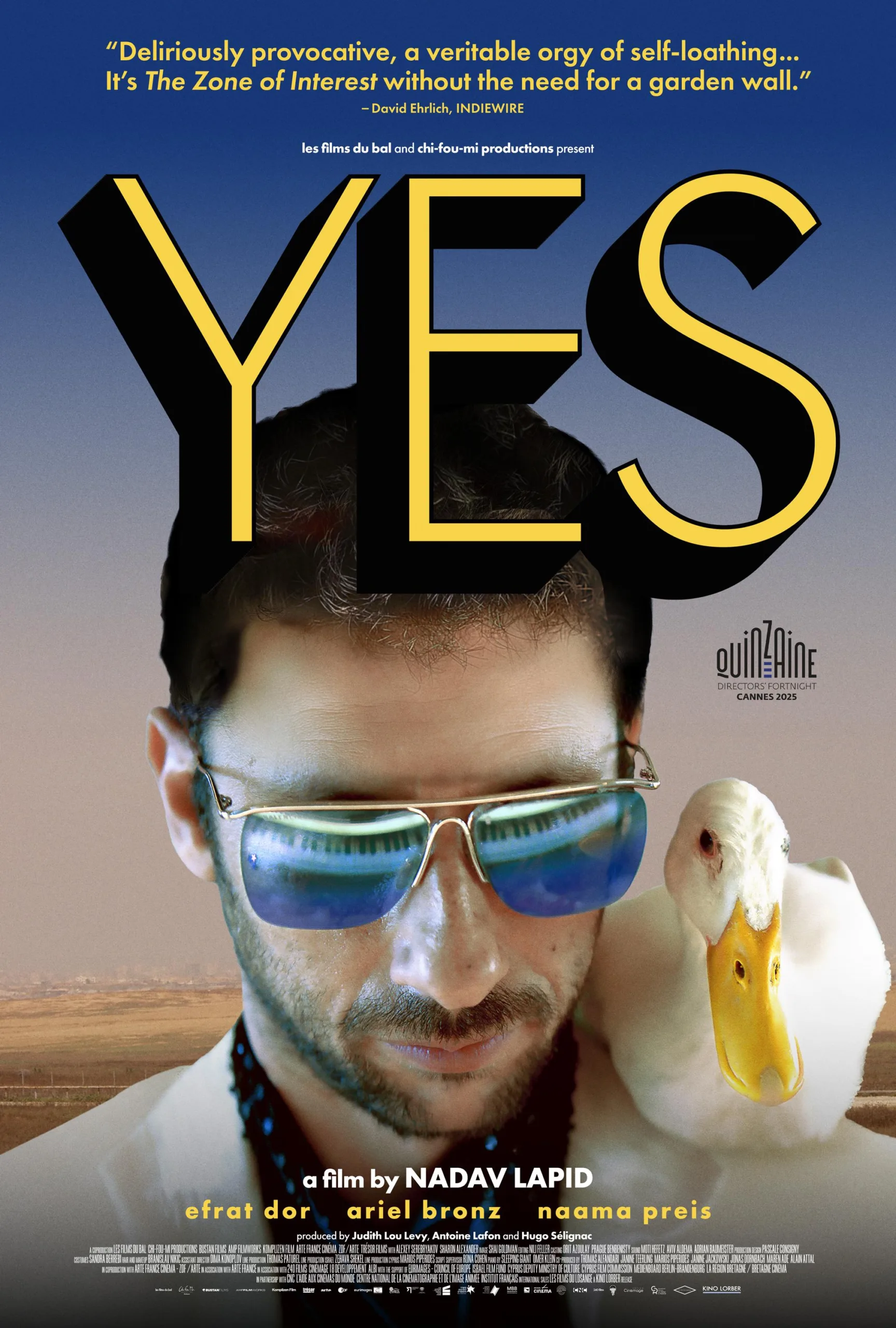


Nadav Lapid’s “Yes!” is about married entertainers performing for the rich and powerful in Tel Aviv while a genocide unfolds 40 miles away and feeling bad about it, but not bad enough to quit doing it. The film has been described elsewhere as a satire, but despite its trips into cuckoo comedy and some devices so cheerfully self-aware that they’d fit into a Looney Tunes or Three Stooges short, the movie is too earnest to wear the satire label comfortably. Like most of the director’s work—including “Ahed’s Knee”—it has many expressionistic and dreamlike elements, and weaves a loose, fairly simple story around wild situations that are mainly about questioning Israel’s self-image, prodding it, sometimes tearing at it.
The main characters are a pianist-comedian known as Y (Ariel Bronz) and his dancer-choreographer wife, Yasmine (Efrat Dor). They share a small Tel Aviv apartment with their infant son, Noah, and eke out a living mainly by performing for powerful Israelis and foreigners at parties where drugs, skin, and indifference to suffering are all on display.
Then a Russian oligarch identified in the credits only as Big Billionaire (Aleksei Serebryakov) connects with Y and offers him a huge sum to write the new anthem, a jingoistic bit of self-affirmation praising the Israeli Defense Force and validating the mistreatment of Palestinians in Gaza as a necessary for self-defense. The anthem that Y ends up writing is actually a pre-existing song, 2023’s “The Song of the Victory Generation,” a jingoistic exhortation to mass murder that rewrites the lyrics to Haim Gouri and Sasha Argov’s “Hareut,” a poem set to music honoring soldiers who were killed during Israel’s founding.
Both Y and his wife are thirty-somethings who live like college students who probably won’t graduate. They stay out all night after gigs, and join in decadent scenarios (Yasmine even snorts coke lines off two pairs of buttocks), then return home wasted. They both know such a lifestyle is neither sustainable nor conducive to good parenting. They’d love to give it up for a quieter existence, one where they aren’t constantly anxious about money. So Y says yes to the anthem assignment, then impulsively dyes his hair blonde. Radically changing one’s appearance, of course, is a way for fictional and real people alike to announce to the world that they’ve changed, or give themselves permission to change at some future date.
The first half of the movie makes Y and Yasmine seem so tightly bonded and politically aligned that they could be autonomous halves of the same organism. Y’s commission introduces real tension into the relationship, shattering their connection. “Do you know what this song will do for us?” Y pleads. “Noah will grow up in a palace!” Yasmine used to smile sweetly at her husband. Now her resting face is a go-to-hell look.
The film mostly avoids charges of being a self-satisfied but empty spectacle by regularly returning to a big question: can you consider yourself a moral person while participating in immoral acts? The question has been dealt with in countless works of art. A notable difference here, particularly in the context of films about Israeli identity post-Oct. 7, is that the filmmaker doesn’t have any sympathy for complicity, no matter what the context. That point-of-view is consistent and unyielding. It’s expressed not just in the couple’s arguments but in omniscient narration that chimes in occasionally with a sardonic quip or a cutting observation, such as noting the irony that a nation founded by survivors of a genocide would perpetrate one. The scene between Y and Big Billionaire is the serpent approaching Eve in the Garden of Eden. Y sells his soul, then tries to justify the choice as necessary for the family’s survival (i.e., their comfort).
It’s not surprising to learn that this director studied philosophy at university. Lapid’s movies often choose a straightforward, didactic approach that would soon become tedious if the filmmaking weren’t kinetic and adventurous. At a time when too many filmmakers are buckling under survival pressures and adopting the Netflix technique of constantly reminding people of what’s happening in the plot, so that viewers half-watching while scrolling their phones don’t get lost, it’s refreshing to see a movie that asks viewers to concentrate and listen, formulate opinions on every choice, and accept that not everything in the movie will be to their liking.
There are also moments in where you can’t be sure what’s real and what is, for lack of a better phrase, a visual figure of speech—hyperbole or metaphor expressed through a sight gag. After a discussion of whether the public cares about specific ethical issues, two characters look directly into the camera, their playfully reproachful faces saying, “Well, you don’t! When a character describes a new skyscraper that’s to be built on seized land, we see the building erupt from the ground and rise hundreds of feet into the air.
The immersive score (by Sleeping Giants and Omer Klein) and the lively editing (by Nili Feller) would give “Yes!” a powerful musicality even if it weren’t packed with musical interludes of various sorts—so many that it’s constantly on the edge of turning into a full-on sung-through musical. It opens with a long dance sequence at a gathering of the filthy rich, with Y and Yasmine performing a semi-improvised act that takes them from a stage down into the audience and then into a swimming pool, and involves clowning with the guests, swallowing and expelling tiny plastic balls, faking a death, even fellating a dildo for laughs. It’s as if party clowns specializing in children’s birthday parties had been hired for a bacchanal.
Things grow more visually euphonious from there. The couple’s theme song is the Elvis Presley version of “Love Me Tender,” like Sailor and Lulu in David Lynch’s “Wild At Heart,” but in place of Sailor’s snakeskin jacket (just like Marlon Brando’s in “The Fugitive Kind”), Y has snakeskin boots (a reference to a reference to a reference); the song is performed as a duet, then solo. The opening ends with a glimpse of a painting by Berlin-born George Grosz, who, per Encyclopedia Britannica, “…savagely [attacked] militarism, war profiteering, the gulf between rich and poor, social decadence, and Nazism.” Grosz’s warped, grotesque portraits connect “Yes!” to Bob Fosse’s “Cabaret,” a film full of human faces made Grosz-like (or just gross) by masks, fish-eye lenses, and funhouse-mirror reflections: a story of militarized bigotry trampling creatives, progressives, and the dispossessed—and, of course, a musical.
A pivotal sequence finds Y reconnecting with a childhood friend and onetime lover named Leah (Naama Preis), whose pre-Oct. 7 job translating texts for businesspeople was derailed into a gig translating for the IDF. She’s become radicalized in the opposite direction from Y and Yasmine. Y absorbs Leah’s reactionary sentiments by spending time with her and mirroring her self-pitying, nationalistic talking points. As he and Leah drive through occupied territory remembering days gone by, Leah recounts her experience of the Hamas attacks against Israelis, racing through a list of witnessed atrocities—shootings, rapes, dismemberments, necrophilia—until she runs out of breath and breaks down in rage and despair: a spoken-word aria from hell. It’s the capper on Preis’s tour-de-force performance. And it sets up another haunting musical moment, one that links love and loyalty to patriarchy and nationalism: a montage of the duo driving past signifiers of dictatorship (fences topped with razor wire; monolithic border walls; a flatbed truck carrying a tank) while the car radio plays “Stand by Your Man.” This is all presaged with a long, brilliantly staged piano duet by Y and Leah in which their intuitive recall of how to play a beloved song (their “Love Me Tender,” perhaps) foretells Y reconnecting with the obedient boy he used to be.
“Yes” runs 150 minutes and doesn’t always fill the running time with material that feels urgently necessary. It’s rambling, disconnected, even navel-gazing at times. But it’s always exciting to watch—sometimes to a fault, with Shaï Goldman’s camera whipping from side to side and careening through rooms and hallways to accentuate the characters’ emotions or put us in their anxious, guilt-ridden minds. There’s a branch of 21st international art cinema that works within an oddly specific mode: kinetic, visceral, with the look and sound of a top-of-the-line Hollywood production, and a confrontational attitude leavened by bleak humor. “Yes!” exemplifies it. It’s worth seeing and arguing about. Even if you end up hating it, there are moments you’ll never forget.