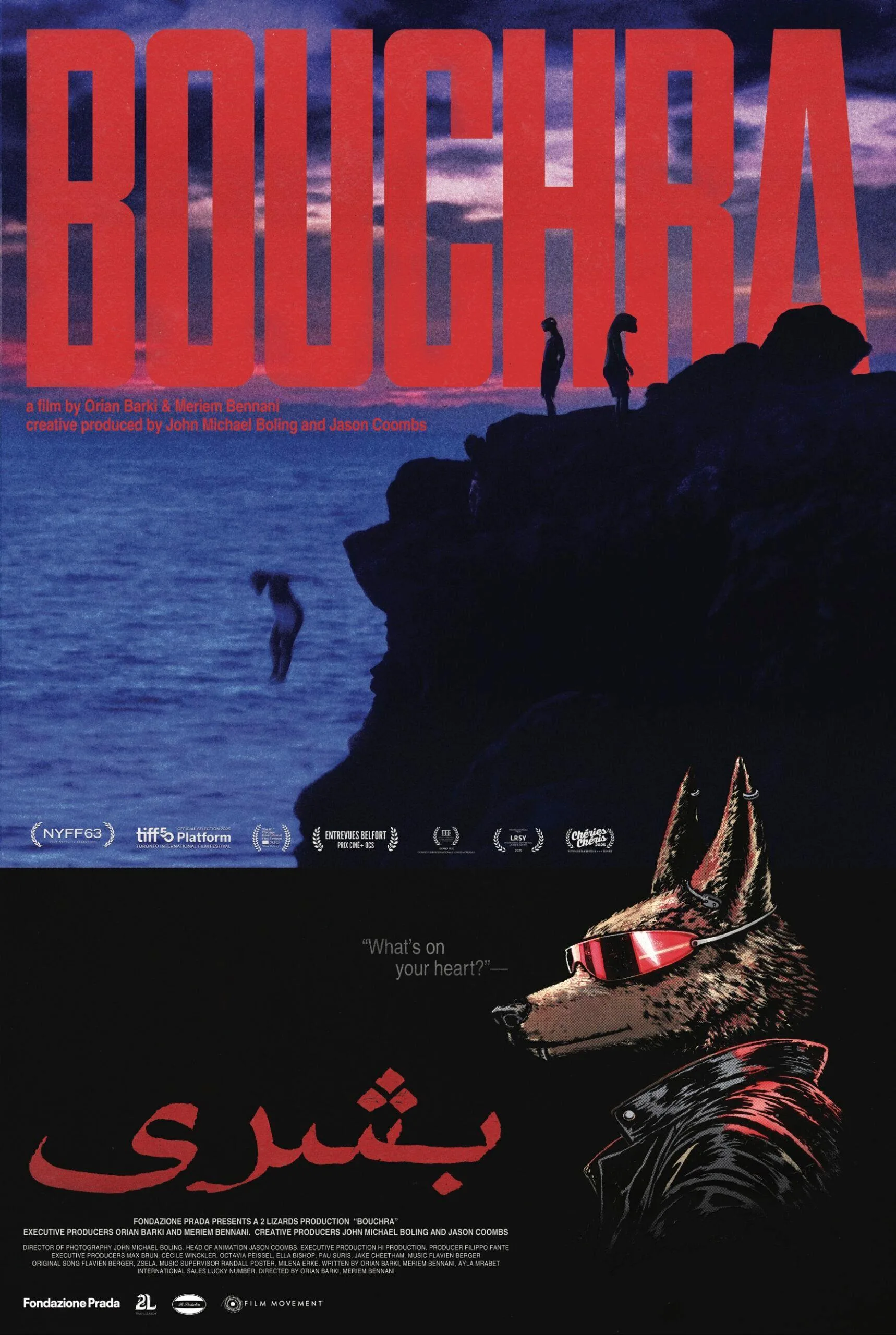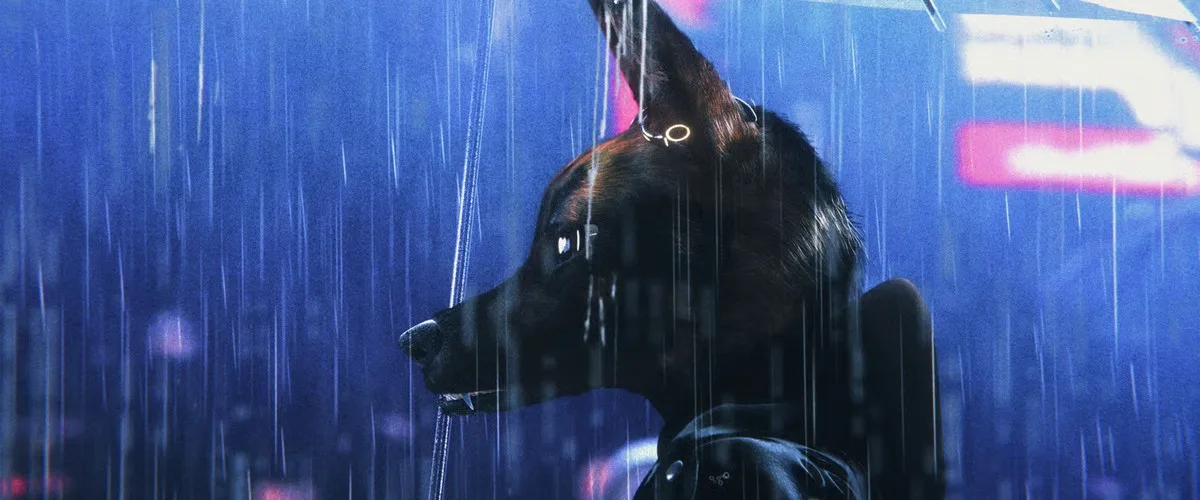
Orian Barki & Meriem Bennani’s “Bouchra” opens on a lovingly rendered shot of the New York City subway, pushing in slowly on a jackal’s face through one of the train’s windows. It’s a simple moment, but a perfect setting of the stage, as one will spend the next hour and a half watching Bouchra (played by Bennani herself) wander through life and conversations with family and friends, and as she tries to finish her first film. We are at once kept at a distance, largely by the remove of reality being presented through animation, and also offered a glimpse into the deeply personal story of Bouchra.
As “Bouchra” goes on, it feels like a true work of docufiction, of a piece with Barki & Bennani’s “2 Lizards” series (still watchable on Instagram), in which the duo reflected on life during the early COVID pandemic. There are conversations about possible gigs, flirtations around town, casual familial gatherings, and, of course, the kind of moody wandering every film about self-reflection needs. But there’s more specificity here, honing in on Bouchra’s relationship with her mother, who still lives in Casablanca, Morocco, and the unresolved conflict that exists between them about her sexuality and self-expression.
That emotional throughline is key to both “Bouchra” and the film-within-a-film being made (itself clearly just “Bouchra”), as Bennani and her digital avatar question what exactly belongs in the film. It goes hand-in-hand with the way Bouchra has to self-censor and is unable to communicate with her mother and family about her queerness and her life outside the dull repetitive conversations about work and friends. This queerness is, by contrast, shown to us in beautiful ways by the filmmakers, not just in impressively erotic foreplay between these anthropomorphic animals, but in the wide-eyed and lingering gaze of a jackal, the way two kinds of fur brush against each other, and close-ups on the little details of lust (like the way a tongue glides over a snaggle tooth).
One of its most delightful showcases of sexuality actually comes by breaking away from showing, as Barki & Bennani cut away from sex to showcase storyboards of these moments drawn on index cards. It’s at once a chance for the filmmakers to have a little fun (playfully drawing animals ass up and glancing backward with sound effects like “BWOING” written on the cards) and a way to emphasize the manufactured aspects of “Bouchra.” This is, after all, a film about making a film, and thus the boundaries between fiction and reality must be questioned, both in the text itself and on a formal level.
The sheer intimacy with which everything in the film is presented, even with the relative remove of anthropomorphizing all the characters, is what makes it sing; the unrealness emphasizes the real narratives and emotions behind those digital facades. That divide between real and unreal continues throughout, even down to the “cameras coming down” at one point and the filmmakers animating the “behind the scenes” of actors and their inspirations meeting. Even when one of the character models comes across as stiff, it’s a testament to Barki & Bennani’s work as filmmakers and animators that they manage to convey such sincere emotion.
Its cinematic inspirations seem relatively easy to parse, mostly in the way cinematographer John Michel Boling and Jason Coombs design these compositions and landscapes. Gone is the lo-fi camcorder aesthetic of “2 Lizards,” traded in for clean Blender renderings and the hazy beauty of neon lights at night that were a staple of Wong Kar-wai’s earlier films (which, admittedly, sometimes make distinct character features and designs feel swallowed up by the darkness as opposed to the crystal clarity of daytime scenes). Completing the moody atmosphere is Flavien Berger’s score, whose music makes any given scene feel far dreamier (and sometimes sexier) than it has any right to be.
Thematically and narratively, “Bouchra” is reminiscent of Chantal Akerman’s work—both her pieces of self-reflection and those dealing with her mother and the thorny relationship they share—though perhaps with a warmer, more optimistic view of fraught familial tension than any of those. (In part, by offering the audience a catharsis that Akerman would likely never have.) It isn’t just that these performances reflect real-life relationships and openly engage with the traditional expectations of certain cultures, but that they are directed so intimately as to feel more like a document of real events than a recreation of them. The formal playfulness of the digital era also helps lighten the mood, with the camera even once becoming the POV of a smartphone with animal faces staring straight down at it as the keyboard and text messages light up.
For all the ways it hits the beats of traditional queer and diaspora narratives, “Bouchra” never comes across as reductive in its portrayal of the relationship between mother and daughter or the dynamics within divergent cultures. Barki & Bennani are smart and sensitive in how they represent these real humans and their perspectives, resulting not just in something that feels lived-in but in a work that feels true to life despite its intentional design. In the metanarrative of “Bouchra,” as in life itself, everything is about navigating the fractures in our worlds. Even when we have a longstanding connection, be it through blood or friendship, distance and a lack of communication may hinder our ability to truly connect. There’s something beautiful about watching a filmmaker wrestle with all those things so openly.