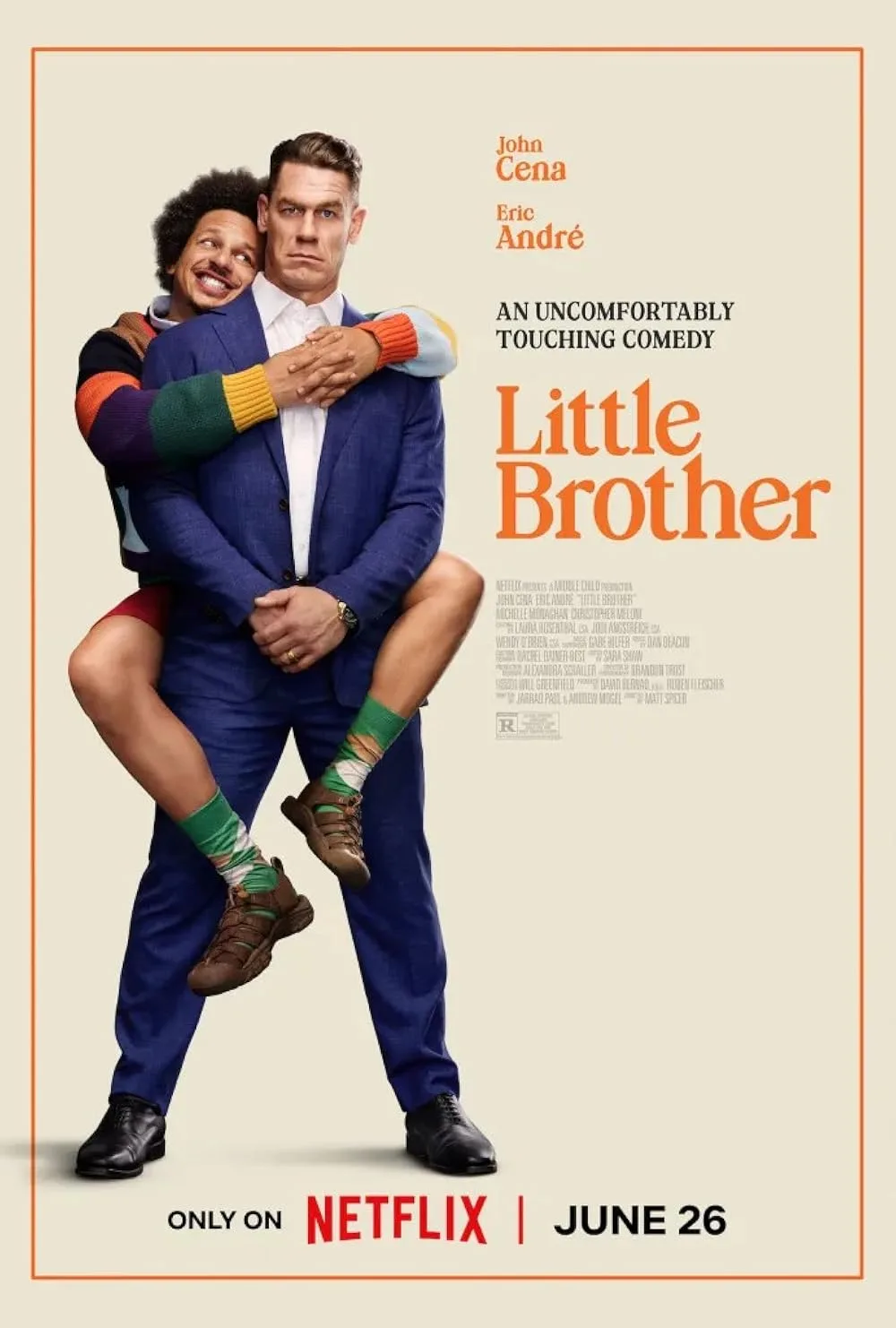

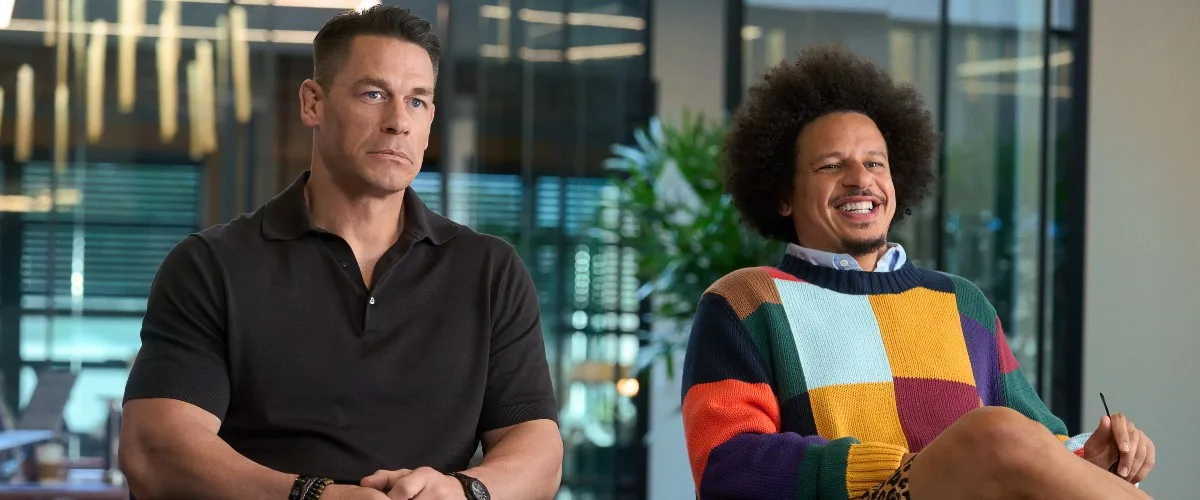
The latest John Cena star vehicle is one of his best: “Little Brother,” a profane, bawdy, slapstick-infused comedy with a few sentimental moments that might make you misty-eyed even if you think you’re immune to such manipulations. Director Matt Spicer and co-screenwriters Jarrad Paul and Andrew Mogel know what kind of movie they’re making here, and not only embrace it, but elevate it. It’s no classic—it fails to develop many of its most promising themes and ends just when it’s really starting to cook—but it’s clever, sincere, and genuinely funny, and will be endlessly rewatchable to anyone that clicks with it.
Cena plays a semi-famous guy named Rudd Landy, who built a real estate empire despite his humble origins. He’s about to debut as a contestant on a cutthroat unscripted competitive “reality” show about real estate titled “NYC Hustlers.” Rudd’s wife, Deirdre (Michelle Monaghan), and their two teenage sons (Bryce Ghesier and Pilot Bunch) are emotional casualties of Rudd’s obsessive pursuit of fortune and fame, as is his dutiful assistant, Mia (Sherry Cola), who monitors his email and social media profile. So yes, Rudd is a rich man who needs to be humbled and taught that there’s more to life than money—a movie cliche that’s foolproof in the right hands, and that falls under the category of “escapism.”
There’s a personal component to Rudd’s obsession: He got rich to gain the respect of his older brother Josh (Chris Meloni), a far more famous real estate mogul who has made Rudd feel like garbage by outshining him in every area of life ever since they were kids. He’s still doing it. When the two are seated together at a nonprofit fundraising auction hosted and organized by Deirdre, Josh tacitly insults Rudd’s real estate clout by casually dropping the fact that he’s about to put his palatial $16m mansion on the market but isn’t listing it with his brother. Then he hijacks the evening by contributing ten times Rudd’s donation to Deirdre’s charity.
Rudd’s unhappy but stable life is upended by Marcus Pinchel (Eric André), an orphan who was briefly mentored by Rudd in the Big Brothers and Sisters program three decades earlier. Our story begins with Marcus busting out of a mental healthcare facility where he shares a room with a man who believes he’s married to a large rock with googly eyes. (To be fair, he’s a gentle, attentive husband.) The first section of the movie cross-cuts between Rudd’s privileged existence and Marcus’ attempts to reunite with his onetime big bro while surviving day-to-day as an unhoused American. Marcus perseveres by keeping a positive mental attitude while sleeping in his car (with an eye mask on; he’s not uncivilized, for goodness’ sake) and bathing in sprinkler mist on a golf course (he tells a couple of golfers who are staring at him in shock, “Go ahead, you can play through!”).
Marcus wheedles his way into the Landys’ lives by presenting himself as Rudd’s brother, which, as Rudd points out, is really stretching the definition of that word. Deirdre is one of those trophy wives who seems as if she’s trying to atone for her privilege by throwing herself into situations where she can feel like a selfless rescuer, such as fostering the least-wanted animals at a shelter (their current foster dog has wheels where its back legs were) and promoting her non-profit. The movie’s depiction of the latter is a gleeful smackdown of the idea that private charities can alleviate suffering in a country that no longer has any real governmental safety net. It’s called Mattress Miracles, has the slogan “Homeless, not Sleepless,” and chalks up a big win when Paris Hilton (as herself) Skypes into the fundraiser to announce she’s donating 100,000 mattresses.
This is a cheerfully silly R-rated movie, expertly done. That’s the space where both Cena and Andre shine most brightly. Monaghan, Meloni, and other key players more than hold their own. There’s elaborately crafted smutty dialogue, as when Marcus euphemistically recommends ”going Joey Chestnutt on [a] cinnamon ring” and forming “a human centipede of commonality.” There’s scatalogical humor galore, the highlight/lowlight of which is Marcus publicly relieving himself in a manner I’ve never seen in my five decades of movie watching. There’s even an unexpectedly frank (though obscured) public sex act, ending in a closeup of Cena’s shocked and awed face that should launch a thousand memes.
But as you’ve already deduced, this weird little movie is also about something—actually, several things. One is the psychic damage visited upon nice people by bullies of one kind or another (the Landys’ sons are already replicating the Rudd-Josh dynamic). Another is progressive populism, which is part New Deal and part Great Society, and connects “Big Brother” to Preston Sturges and Hal Ashby, as well as recent practitioners like Cena’s regular collaborator James Gunn (“Suicide Squad,” “Peacemaker”) that believe empathy is the glue that binds the inhabitants of civilized countries.
Last but not least, there’s the baked-in inequities of the United States, present and past, racial and economic. While Rudd and Josh seem to have grown up middle-class, or at least not rich, Josh has turned himself into a gladhanding, obnoxious caricature of a New Money mogul, and his kid brother has been dragging around a metric ton of insecurity over not matching up to the definitions of success burned into his mind since birth. Their opposites are people like Marcus, a living trifecta of social demerits (poor, homeless, Black) who is so bereft of advantage that he must be imprisoned or hospitalized to experience shelter. But he remains hopeful and cheerful even after he’s run over by a garbage truck (which is how the Landys learn of his existence; in traction at the hospital, Marcus named Rudd as his only family contact).
The movie doesn’t shy away from positioning the Big Brothers and Sisters programs as a free-floating metaphor for social services that were invented to reduce inequality, or at least soften its sting, but have been reduced, cut, or sabotaged. The most successful “influencers” in this movie—not just Rudd’s producers and fellow contestants on the TV show, but Josh, too, in his way—function here as evidence of a brutal economic system that rewards inherited wealth, favoritism and corruption, treats both public and private lives as “content,” and turns hustling into the only job that’s open to all.
“Little Brother” doesn’t properly follow through on any of this, mind you. In fact, it tends to forget about the most promising avenues it opens. There’s a half-assed catfishing subplot about Mia falling for Marcus remotely, after having broken her employer’s “no replies to email requests from strangers” policy and written to Marcus in character as Rudd, which is what caused Marcus to believe Rudd wanted to reconnect with him in the first place. And while subtexts are highlighted enough to be noticed, they aren’t developed carefully enough to really sink in. But the movie’s sensitivity to inequality and cruelty should be noted somewhere, and it might as well be here.
There are many good slapstick movies with humanistic views of life. They use outrageous physical and verbal comedy as a way to get audiences involved in the struggles of people they might avoid in real life. Some of the best star Cena’s buddy Will Ferrell as man-boys who suffer from some form of arrested development and spread chaos everywhere they go, but are good at heart and do a lot of good for other people, even those coded as enemies.
Rudd and Marcus both fall under this heading, even though they exist on different ends of the economic spectrum. Both are little brothers seeking approval and affection from a big brother. The big brother is indifferent to the little brother’s suffering when he’s not actively avoiding situations that force him to witness it and accept his role helping to perpetuate it. Sometimes he makes the little brother’s life worse. Still, the little brother keeps his chin up and hopes things will get better. A line that’s aimed at Rudd applies equally to Marcus, and most of humanity: “You’ve been wronged by so many people, but you still have so much love to give.”