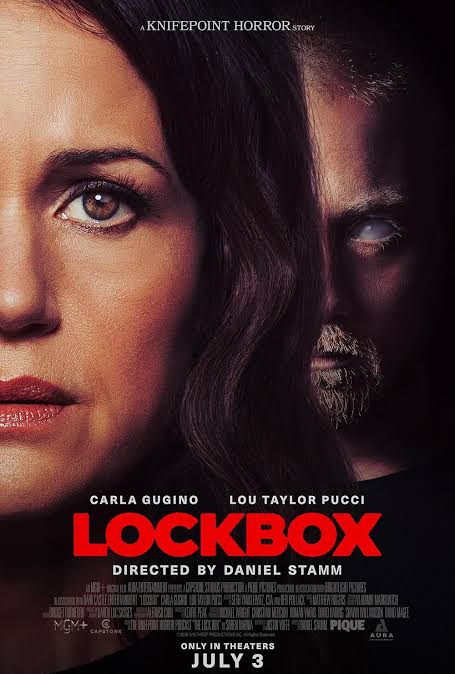
I’m mildly surprised, and maybe relieved, that as of yet no sorehead preaching the imminent Death of Cinema has held up this film and complained “And NOW they’re making MOVIES out of PODCASTS!” For indeed, “Lockbox,” also known as “Winthrop,” derives from an episode of the “Knifepoint Horror” podcast. Scripted by Soren Narnia and Justin Yoffe and directed by Daniel Stamm, who’s also responsible for “The Last Exorcism” and “Prey For The Devil,” “Lockbox” teeters uncomfortably between psychological horror and supernatural hoo-hah for much of its running time and finally settles on the hoo-hah. Which is just as well, as the movie’s treatment of actual mental illness ranges from indifferent-to-crass and is always at least borderline offensive.
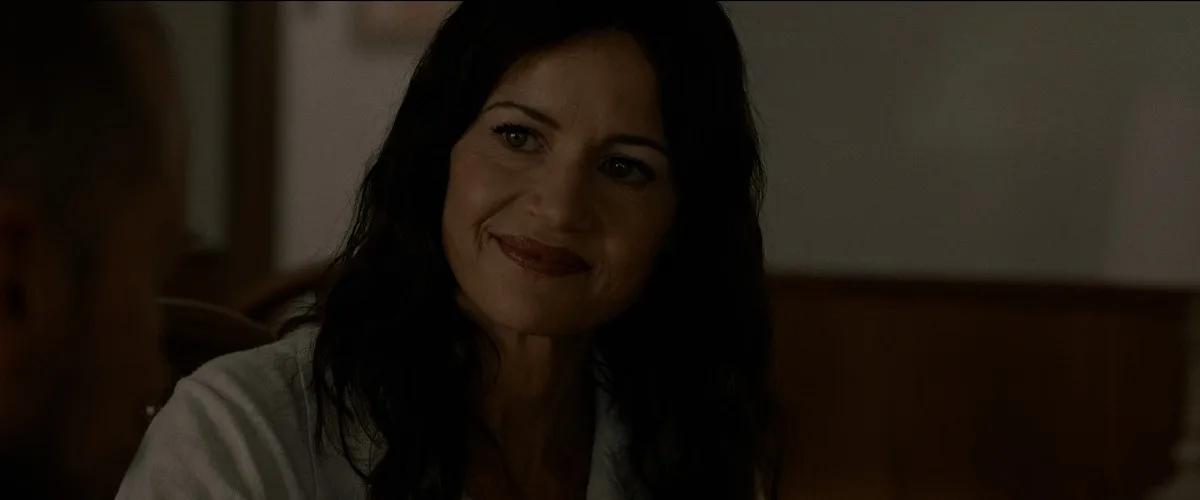
After unsettling images of a careening van with a young, wheelchair-bound boy inside provide jolts that are meant to reassure the viewer that this is indeed an ostensible “scary movie,” Carla Gugino, whose work in genre pictures including the terrific “Gerald’s Game” tells us she absolutely deserves better than this, says in voiceover that “I will tell you all that happens in hopes it will never happen again,” as if we viewers have any say in it. Upon inheriting a family home, Gugino’s character Ellen seeks to once again find herself; she’s been a children’s book author and a designer, and now she’s a caretaker. Not just of property but of her now-adult cousin Winthrop. What she mainly remembers of Winthrop as a kid was that he could “eat his weight in spaghetti.” He’s “a little different, but a good boy,” she’s told.
Winthrop, played by Lou Taylor Pucci, a veteran of a couple of sensitive Mike Mills dramas as well as several gnarly genre films, including the 2013 reboot of “Evil Dead,” is a tightly wound fellow to be sure. He’s secretive and has a short fuse. When Ellen catches a glimpse of him half-naked in one of the house’s bathrooms, she sees a severe burn going up the length of his right leg. He’s an army veteran, so she assumes it’s a combat wound. Its actual origin underscores some unsettling things about the character.
The family dynamic is further roiled by the introduction of eccentric neighbor Vahna, played with tornado-like energy by Katherine Isabelle. She homes in on Winthrop with a “You were a victim of childhood abuse??? Hey, I was a victim of childhood abuse!!!” energy. He doesn’t take to that very well. Soon enough, terrible crimes are committed, Winthrop is in jail, and actor Jason McKinnon is overacting up a storm as a district attorney. Jail is an environment in which Winthrop fails to thrive—there’s a stunningly violent scene in which he commits a bloody assault on a guard delivering his meal to him. Or does he?
It’s at this point in the narrative—which, to Stamm’s credit, he manages with a brio that can border on the manic—that things start getting out of hand. A Dylan line is quoted (of course it’s “if my thought dreams could be seen”), Winthrop starts demanding to be told the whereabouts of a character we’ve not been introduced to, and one character says, completely straight-faced, “And that’s when she told me about the Porta John man.” A priest teams up with a doctor, and they determine that Winthrop is in the thrall of what they call “a SORT of demonic possession.” And the demon can’t just be expelled; it has to be put into another host.
Attentive viewers will not be surprised by the boy’s reappearance in the wheelchair. “Weird, exploitative, weird,” read my notes for this section. And that’s an apt summing up of the movie. I like lurid horror pictures as much as the next guy, but it’s got to be the right kind of lurid. This was not.