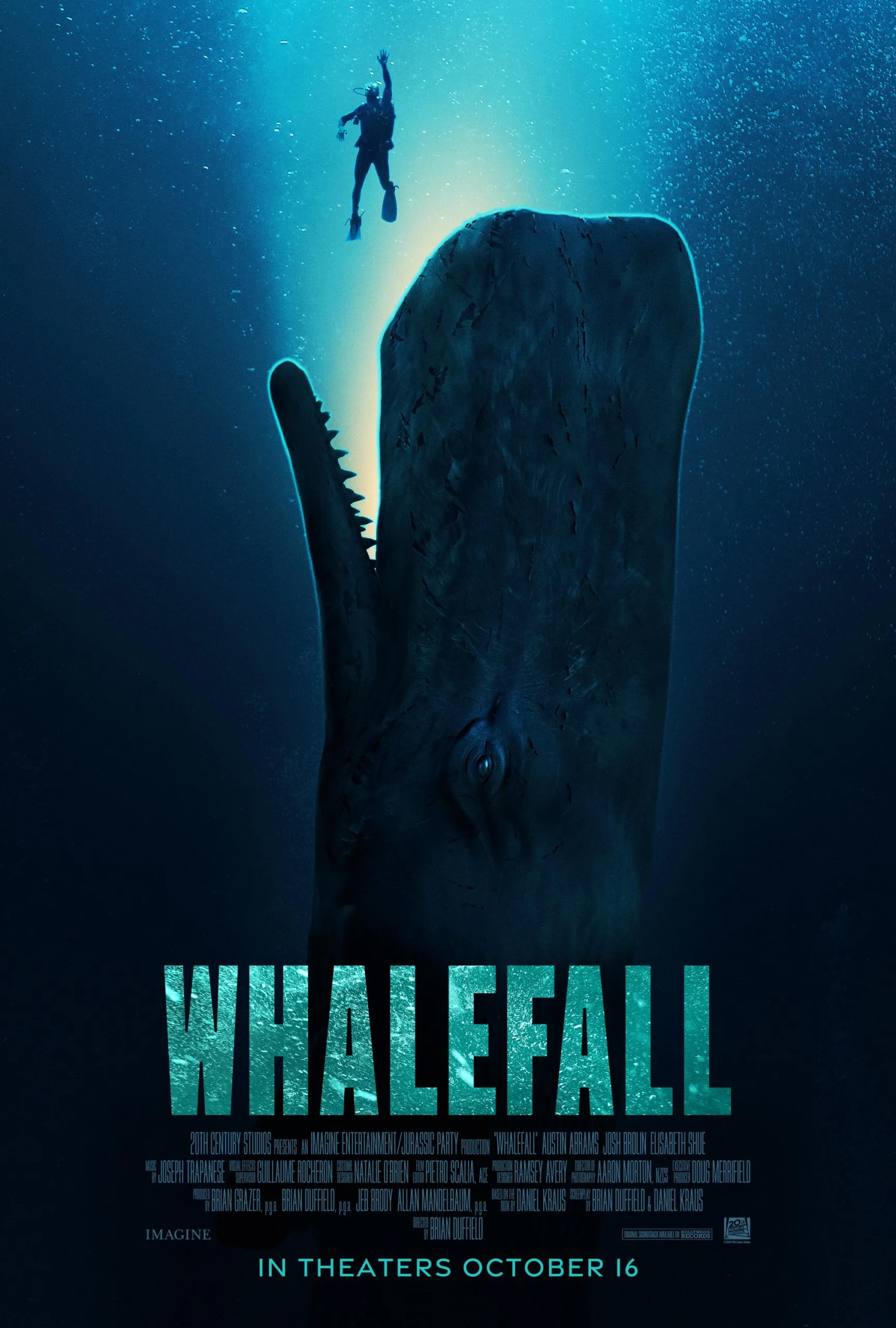

The survival thriller creature feature genre isn’t dead, but with “Whalefall,” director Brian Duffield injects it with such grueling, bewitching delights that it feels mightily resurrected. You would be forgiven for thinking the title refers only to the fact that, on screen, we see whales plunge, dive, and otherwise descend into the ocean in all sorts of terrifying and enthralling ways. Yet near the end of Duffield’s third feature, a gruff Josh Brolin, playing Mitt Gardiner, an emotionally volatile yet talented diver, gives the film’s true explanation.
In the scene, Mitt explains to his son, Jay (Austin Abrams)—whom he has spent the better part of the runtime emotionally, verbally, and physically abusing—that once a whale dies and its carcass lands on the sea floor, that act creates entire ecosystems and provides sustenance for all sorts of deep-sea creatures.
From death comes life, and Duffield and his collaborators have made something new out of familiar bones. Co-written with Daniel Kraus, who wrote the book of the same name, “Whalefall” hums with escalating claustrophobic spectacle. It isn’t afraid to play fast and loose with form and structure, creating a mind-bending joyride that drags you to uncharted cinematic depths.
What gives “Whalefall” its ductility, as it oscillates between thrills and gravitas, is that Duffield and Kraus never treat their characters’ absurd motivations as an excuse to mock their plight. After the first year of Mitt’s passing–who committed suicide by strapping weights to his body and jumping off a boat–Jay decides to go down to dive for his father’s remains, hoping to bring at least one bone back to his mother, Zara (Elisabeth Shue), and sisters Eva (Jane Levy) and Nan (Emily Rudd).
It is a foolish endeavor, even if it is rooted in understandable motivations, but the moment Jay touches down with his gear in the frigid waters off the Monterey Bay coast (leaving behind his gloves), his journey takes on an existentially relatable tenor. Duffield and Kraus know that processing grief is not just nonlinear but can be nonsensical, and that sometimes the only way to drown out the frequencies of internal pain is to throw yourself at something that takes you out of your body.
Without clarity, doing something dangerous can be a balm because at least it provides direction. For Jay, he is trying to appease the ghost of someone he never got closure with; his father’s drive, which once wounded him, instead refracted back onto him.
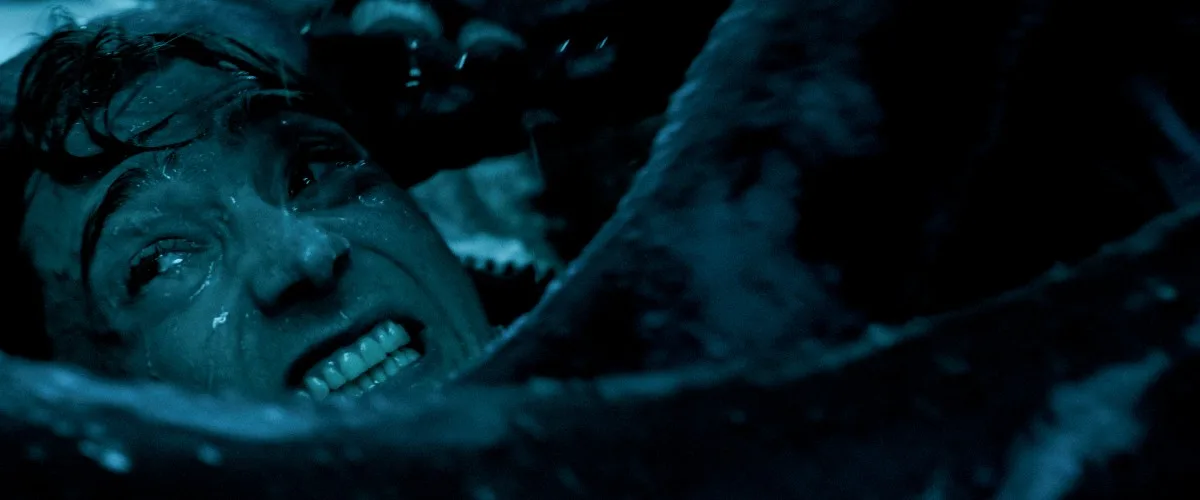
In a bit of cruel and cosmic irony, Jay’s search for peace only puts him into the literal jaws of a bigger storm: after grabbing what he thinks might be his father’s skull, he is gobbled up by a sperm whale, caught in the crossfire (cross devour?) of the mammal’s attempts to eat a giant squid. In the belly of the beast, production designer Ramsey Avery’s work shines. Using its singular setting creatively, the whale’s innards feel cavernous and expansive, like a pocket dimension of goop and gore.
Cinematographer Aaron Morton always frames Jay as though his surroundings are assaulting him. The whale’s tongue feels more like a sentient boulder to be scaled, while we see the whale and squid fight like extraterrestrial kaiju rather than anything earthbound. The aquatic brawls are some of the film’s most thrilling beats, such as a late-stage moment where the whale’s deep-sea skirmish with orcas evokes the Millennium Falcon dogfighting TIE Fighters in “The Empire Strikes Back.” Sequences like these are further amplified by the stellar sound department, which makes it all feel otherworldly.
Abrams anchors the film with frantic bursts of wheezing and very little dialogue (this is the second film this year where, en route to deliver something important, he contends with tentacled horrors). As Duffield keeps the hits coming to our plucky protagonist, it reframes any small bit of respite as a major victory; when Jay finds that a squid beak is lodged in his hand, whose removal causes him to pass out, you are thankful it only causes major blood loss in lieu of taking the whole appendage off.
The film can be accused of losing steam in how it cuts back between Jay’s attempts to escape and the various lessons he’s learned from Mitt that might help him overcome his present trial. The film also takes bolder swings by the end, as Jay begins to hear his father’s voice in the guttural reverberations of the whale’s body.
Even these formal risks, even if they do not always land, work because “Whalefall” so completely immerses you in Jay’s deteriorating mental state, where it becomes hard to distinguish what is real from what is desired, what is imagined versus what is remembered. With each new obstacle he faces, whether it is stomach acid or a persistent cephalopod, it is less that Jay’s life flashes before his eyes and more like it is vomited onto him: chunks of memory, misremembered stories, conversations he wished ahead but never did, all merging into a kind of michegoss that entraps even as it reminds him there’s life outside of this stomach to fight for.
What makes “Whalefall” richer than it seems on the blubber is how Jay realizes that, as much as he wants to escape the whale, he still has lessons to learn from his consumption. There is a theological heft to Duffield’s–the child of missionaries–previous film, “No One Will Save You,” which merged the home invasion and alien abduction genres into a profound treatise on cults, proselytization, and salvation (for the uninitiated, Guillermo del Toro crafted a whole thread reading the film through a Catholic lens).
“Whalefall” ripples with a similar spiritual sensibility, and while comparisons to Jonah abound, Duffield’s presentation of the whale’s stomach as a kind of purgatory remains fascinating. A period exists between death and final judgment, between being swallowed and being digested, a period of waiting that he captures so well in Jay’s plight. Few ever get the clarity of near-death; even fewer get the chance to enact any change.
What might our purgatories teach us? Questions like these make “Whalefall” such a fascinating, subversive blockbuster. Even as its set pieces make your jaw drop, the film makes you pick it up all the same to chew on its gnarly revelations.