
I was slightly confounded by the latest from acclaimed filmmaker Olivier Assayas; its title subject is based on a real-life figure, a Russian “oligarch helper,” so to speak, named Vladislav Surkov—here called Vadim Baranov—as the credited source material for the film is an Italian novel by Giuliano di Empoli. In any event, Baranov is played by Paul Dano in a register so soft that, even though Nicolas Cantin’s sound mix is a model of clarity, one finds oneself leaning in to catch what’s being said.
Assayas’ cinematic tone matches that of its lead actor. This film, chronicling one of the great catastrophes of the late 20th and early 21st centuries, is purposefully low-key, delivering its bad news almost offhandedly. The picture sometimes plays as an amalgam of Soderbergh’s “Che” and Scorsese’s “Goodfellas,” only—and this is the crucial point—with the volume turned down from 10, or 11 for that matter, to about 4.
Baranov’s soft-spoken demeanor emits not shyness but a supreme confidence. “Most men of power get their aura from the position they hold,” Jeffrey Wright’s Rowland observes as the movie opens. “When they lose it, it’s like a plug has been pulled. Baranov was a different breed.” Wright’s character is a Western journalist who ventures into snow so blue it looks mentholated to reach the dacha in which Baranov has holed up. Rowland had initially come to Russia to pursue research on Yevgeny Zamyatin, author of the post-Bolshevik dystopian satire We.
What he finds instead is We come to vivid, oppressive life. And so he seeks out the spin doctor who helped make it so. A figure who consents to an interview with Wright’s journalist. Speaking as you might imagine a young John Houseman to sound, Baranov recounts his years by the side of Vladimir Putin, who was considered an improbable and unsuitable candidate to lead Russia; as we know, the ex-KGB man has remade his country in his own preferred image.
Baranov lays things out for Rowland with sardonic candor. He recalls that “the Soviet system was based on privilege, not cash.” He laughs at Gorbachev; the so-called “New Russians” in that ruler’s wake were cocaine-crazed greed heads. Baranov himself is, at this time, part of an artistic crew producing avant-garde-ish theater. “As if culture still had the power to exert any influence over the world,” he laughs.
He meets his alluring first and only romantic love, Kesenya, when she’s doing a punk-rock performance piece. As it happens, she believes in neither punk nor performance art but merely wants to distract the KGB. Alicia Vikander plays Kesenya, and she turns up two more times—the whole conception of her character, and Vikander’s performance, wickedly stands the Deborah Kerr turn in Powell and Pressburger’s “The Life And Death of Colonel Blimp” on its head—always disbelieving the role into which she’s cast herself, except for the final one, as Baranov’s wife.
“I want to be part of the times, not just a witness,” Baranov professes. This turns out to be less stirring than it might have been, especially when he has to literally tie Boris Yeltsin to a wooden chair to prevent him from falling on his face while giving a televised address. Once Baranov meets Vladimir Putin, a former KGB officer now languishing in the KGB’s successor agency, he sees in the bureaucrat an apt pupil. He admires Putin’s discipline; when the two dine at a swank eatery, Putin ignores the fancy bill of fare and orders a bowl of kasha. “Two,” Baranov says.
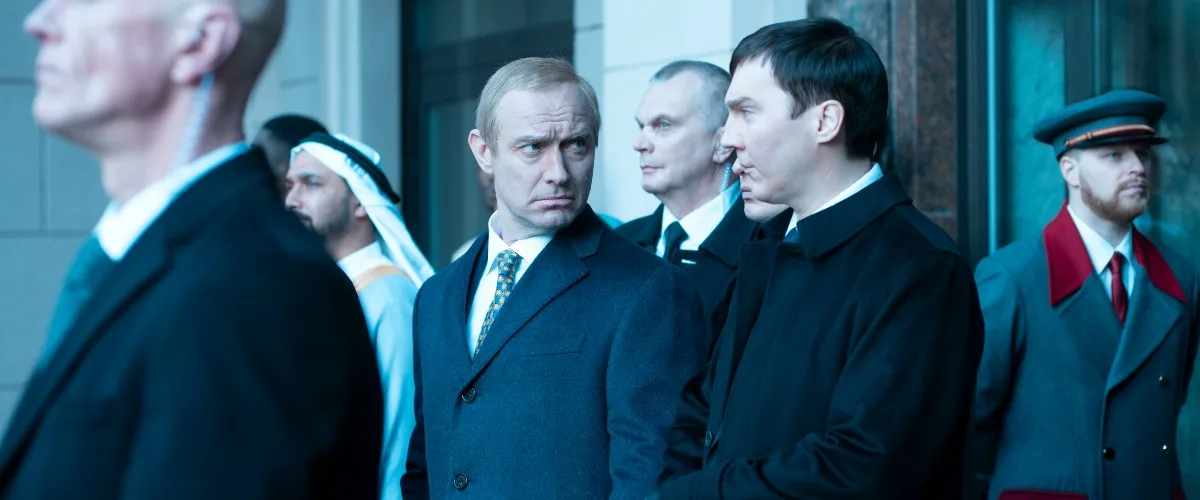
As played by Jude Law, Putin’s an operator whose wheels are always turning. While he can’t recreate the Soviet Union—or can’t he?—Putin is eager to both build and flex muscle. Donald Trump isn’t mentioned once in this film, but “The Wizard of the Kremlin” offers useful insight into Putin’s ideas about special relationships, so to speak.
Baranov has to throw several former comrades under a bus or two as he makes his way; the most moving and also most pathetic is played by Tom Sturridge. His scenario, which ends with him inadvertently backing himself into a diabolical corner, is but one of this film’s many chilling stories. Which is not to say that the picture lacks humor, as when Baranov announces to some late-arriving characters, “You aren’t just a biker gang. You’re true Russian patriots.”