
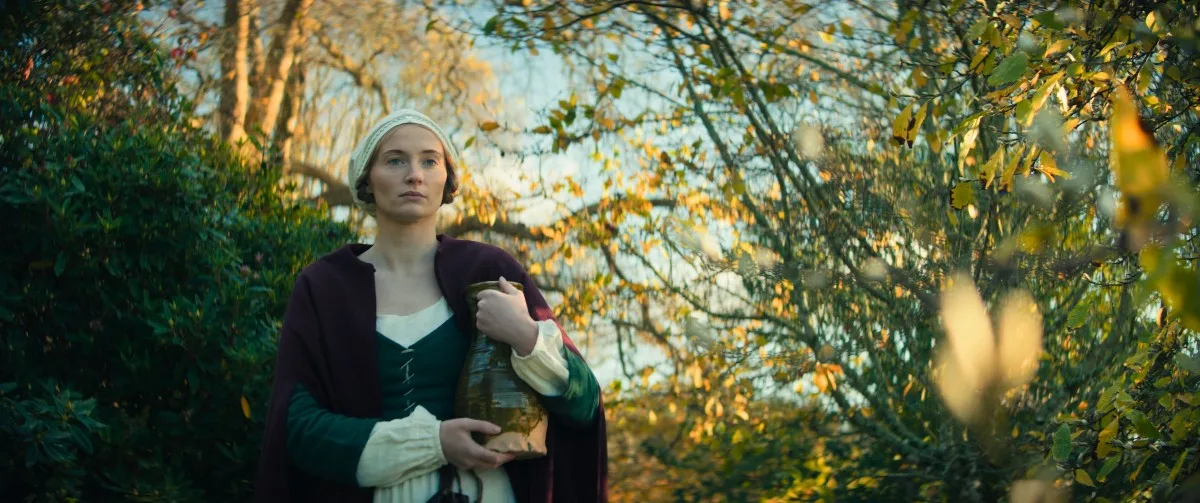
Inspired by the same Shinto-Buddhist noh-theatre tale as the 1964 Japanese classic “Onibaba,” Natasha Kermani‘s supernatural horror film “The Dreadful” is primarily an exercise in atmosphere. While she succeeds in crafting a tense world filled with the stench of death around every corner, largely thanks to the eerie work of cinematographer Julia Swain, her cast is not always up to the emotional burden the story places on them.
Set during an unnamed period of war in medieval England, possibly the Wars of the Roses, the film stars Sophie Turner as Anne, a young married woman who lives alone in the woods with her mother-in-law, Morwen (Marcia Gay Harden). The women are dirt poor and survive largely through trading whatever they might be able to grow on their spoilt land or find while foraging in the forest. It is not enough to survive, so Morwen turns to petty theft, from the rich folks who attend the same church, but also, unbeknownst to Anne, the dead bodies of sailors who wash up on their shores. Anne, meanwhile, is haunted by dreams of her beloved husband Seamus (Laurence O’Fuarain), who has been gone at war for far too long. These unsettling dreams begin to shift into waking nightmares: a man in full knight’s armor, riding a white horse, who seems to follow Anne wherever she goes.
The lives of these two women abruptly change with the return of Anne’s childhood friend Jago (Kit Harington), who brings with him horrible stories of war filled with blood and desecrations. Jago has, of course, been in love with Anne since they were children. In one of several on-the-nose creative choices, Kermani periodically provides us with spotty flashbacks of Anne, Jago, and Seamus as children playing during a sunny day on the beach, only for their mirth to end in a fight between the two boys over the girl. Jago says Seamus was murdered when the two tried to desert after being sick of seeing rivers of poor men’s blood split for a rich man’s war.
From this moment on, the film becomes a love triangle of sorts between Anne, Jago, and Morwen. Will Anne choose to believe that her husband is dead? Will she give in to her attraction to Jago? Will she abandon Morwen to live a life of abject poverty on her own? Although these are the central questions, this is no romantic fantasy. It is called “The Dreadful” after all, and the film is heavy with several varieties of dread. The existential dread of living merely to survive, and barely managing to even achieve that. The dread of being abandoned by your loved ones during your time of need. The dread of a world where religion rules by fear and the wars of the rich continually condemn the poor to death on battlefields far from their homes.
It’s a rich field in which to plant a story of shifting allegiances and desires; unfortunately, neither Turner nor Harrington can hold their own against the story’s emotional weight. At the beginning of the film, Anne is a woman in mourning whose meek demeanor stems from not only societal oppression and religiosity but also the direct manipulation of her mother-in-law, who continually uses fear to keep her in line. By the end, she has come into her own, having faced fear and temptation and rejected them. This is a strong arc for a character, but Turner largely plays Anne with the same one-note, wide-eyed expression throughout the film, unable to really show her internal growth externally. Harrington also has a tricky journey to chart, as he withholds the truth about Seamus, again to manipulate Anne. Yet, when the turn happens and the truth is revealed, he falls flat.
There are only two actors in the film who seem to know the right heightened frequency in which to tune their performances. First, there is Harden, who plays Morwen in full Grande Dame Guignol mode, hamming it up every chance she gets. Her Morwen can shift seamlessly from a woman of deep piety to one filled with abject bloodlust. She is in survivor mode and can reason away every unhinged choice she makes. She also manages to deliver one of the stupidest lines I’ve heard in a while with such venomous conviction that it almost transcends into greatness. Similarly, O’Fuarain taps into a well of deeply deranged mania when we do finally get to see what actually happened to Seamus during the war. The film soars when these two are chewing up the scenery, but slams to a grinding halt when it focuses for too long on Anne and Jago.
Along with uneven performances, Kermani often relies too heavily on modern horror tropes that are at odds with the foreboding atmosphere of her film, such as cheesy jump scares in flashback and dream sequences, and unnecessary sound cues during ghostly monologues that demand you be frightened rather than actually evoke a real fright. Jamal Green’s score often overpowers during the most intense scenes, again telling the viewer how to feel instead of making them feel it.
A morality play wrapped up in gothic horror tropes, “The Dreadful” is definitely committed to the bit, and its darkly medieval setting is a refreshing change of pace. I just wish it were a medieval tapestry that worked as a whole, rather than just in fits and starts.