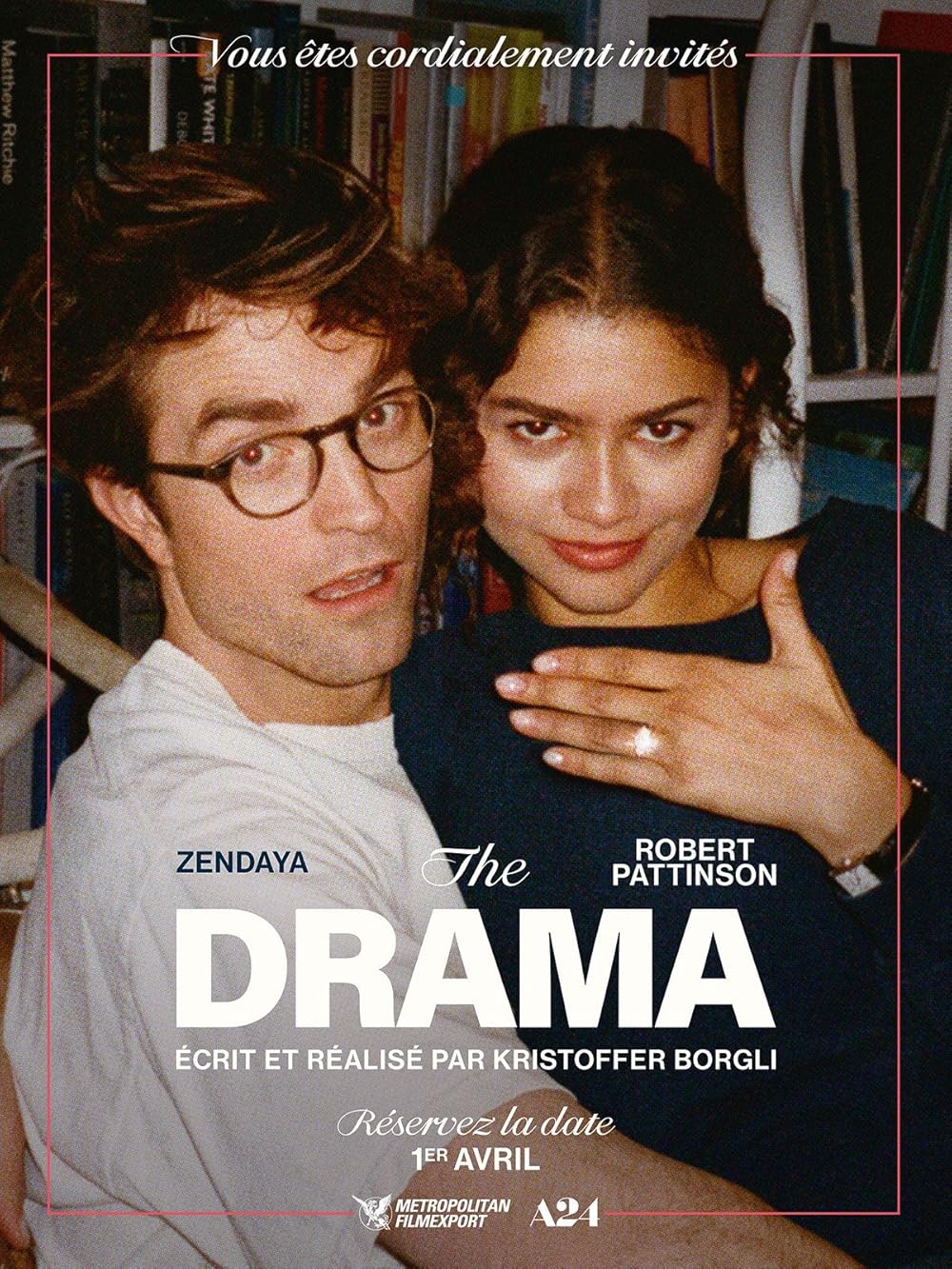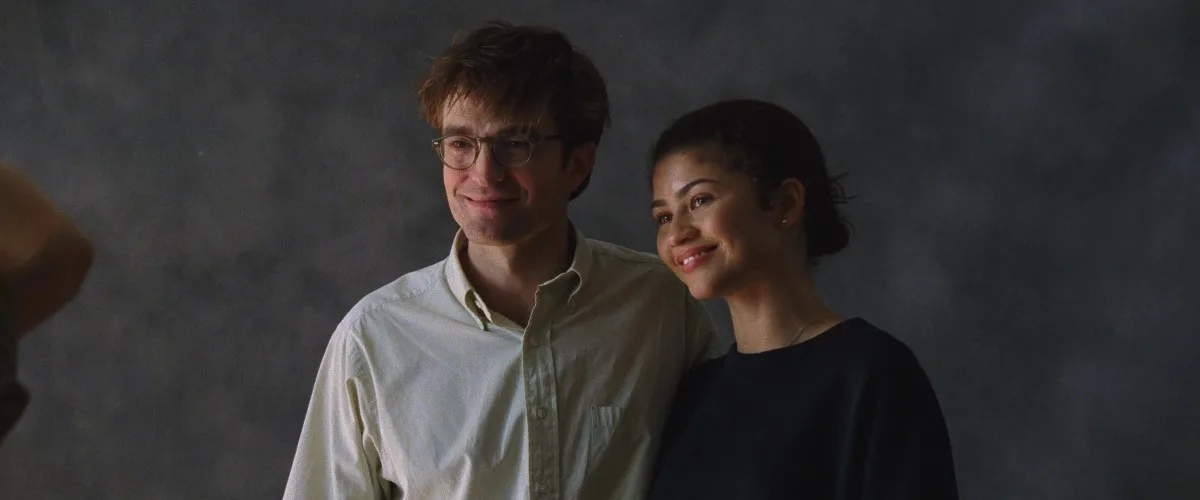
It’s far more difficult to tell the difference between love and infatuation than we’d like to admit. You only know it after some sizable time and a few daunting hardships. Romantic comedies have tested those fickle boundaries, often through malformed relationships that are destabilized by a farcical force. In writer/director Kristoffer Borgli’s “The Drama,” a darkly absurdist take on the genre, Emma (Zendaya) and Charlie (Robert Pattinson), who are engaged, instigate a disruption of their romantic bliss when Emma reveals her harrowing past to her shocked fiancé. The fallout from her revelation inspires a prickly story that, due to Borgli’s limited grasp of his charged themes, never reaches the aims it teases. Questions about true love, moral hypocrisies, and violence tied to the perpetrator’s race and sex narratively rot in an aesthetically overworked film.
“The Drama” is smugly juvenile. It’s also a major step down from Borgli’s previous film, the surrealist Nicolas Cage-led cancel culture comedy “Dream Scenario.” Unlike that film, “The Drama,” which is distributed by A24, isn’t necessarily trying to lampoon a hapless character who deserves our ire. It actually wants viewers to connect with its two stars. It hopes to humanize them as complex people meant for one another and to demonize those critical of them as self-righteous hypocrites. But what gives this glib, circuitous film the right to persecute the apathetic when it barely understands its own characters?
One can surmise Borgli’s limitations from the film’s opening meet-cute. For the first ten minutes, we witness Emma and Charlie’s first encounter as Charlie writes his wedding speech with his best friend, Mike (Mamoudou Athie). He recalls meeting her in a garish, informal coffee shop. She is reading; he, from across the room, stalks her. When she leaves her table, he quickly runs over and takes a picture of her book (a made up book called The Damage by the fake writer Harper Ellison, which has been teased by Borgli as his next project). After a quick online search for the novel, he approaches her, having “read” it. Charlie is clumsy and awkward, especially because he doesn’t immediately realize he’s speaking to Emma in her deaf ear. Nevertheless, a smitten Emma gives him another chance to retry his half-baked pick-up line. There isn’t much reason given beyond that for why Emma and Charlie are together. What specifically do they find charming about one another? What do they dislike about each other? What hopes do they have for the future together?
To be clear: the film can sense the hollowness of their relationship. They are, as the picture’s many characters say about other topics, about the vibes. During coffee, Emma explains to Mike’s wife, Rachel (Alana Haim), that until she was 28, she had never been in love. That disclosure opens up a question: Are Emma and Charlie truly devoted to one another, or is this merely a crush? While Emma tellingly can’t answer that question, the film tacitly attempts to respond by putting the couple through the emotional wringer when, during a night of wine drinking, Rachel dares Mike, Charlie, and Emma to reveal the worst thing they’d ever done. Mike, for example, admits to using a spouse as a human shield against an attacking dog; Rachel recounts locking a boy away in a closet; Charlie might’ve cyberbullied a kid when he was a teenager. Emma, on the other hand, admits to something so heinous that it immediately turns everyone against her. Without giving away the whole game, I’ll just say that when she was a teenager she stole her father’s rifle with the intentions of carrying out a deadly act.
The major weakness of Borgli’s film is how flatly he approaches Emma’s psychological, gendered, and racial complications. Zendaya, who’s operating in a different, demure register from her previously heightened work in “Euphoria” and “Challengers,” intuitively understands how perceptions about Black women can drastically alter how they’re viewed, particularly by white women, when they’re perceived as violent. Tellingly, the once friendly Rachel becomes venomous toward Emma while Charlie turns frightful. Does he still want to be married to Emma? As they approach their special day, the question looms larger and larger.
In this role, Zendaya listens more than she speaks. She communicates regret and fragility through the discreet way she holds her body, like a wounded bird caught in the midst of an ice storm, and the internal choices that move with assured agility across her face. Despite her prowess, we get the sense that Emma is either retroactively Black—a product of color-blind casting—or is plainly misconceived. Emma’s distressing Louisiana-set backstory should elicit further questions about the public presentation of Black women as either docile or dangerous, the exoticism of Black women to white men as an Other to be fixed, the knotty idea of a Black woman as a madwoman, and the South’s persistent racism.
Borgli can’t fathom the historical continuum these queries arise from, so he doesn’t approach them. His mealy-mouthed timidity in addressing genuinely controversial and provocative subjects, especially those that require a radical kind of empathy, not only renders his supposedly edgy provocations dull. It also makes one wonder if he’s at all interested in women as people.
Likewise, his aesthetic approach loses its vigor. A clattering of L-cuts often stops lines before they can finish, audibly demonstrating that these characters are uncommunicative. It’s a smart gambit until you realize nothing of substance will be uttered. Scattered instances of non-linear imagery punch us suddenly into the past and bend reality into dreamscapes that elucidate little about Emma or Charlie. In one cringey scene, particularly given the recent age-gap controversy surrounding Borgli, an adult Charlie lovingly caresses a teenage version of Emma. The harder Borgli tries to scramble “The Drama” into a surrealist Freudian comedy, the less one cares to wait around for the punchline. Even the initially appealing use of sound, layering separate conversations together and oscillating between Emma’s muffled deafness and Charlie’s seeming clarity, loses its charm when each provocation that it pulls into the mix gives one less to chew on.
Most glaringly, “The Drama” has zero bite when it comes to Charlie. Pattinson is so good at playing wretched, often emotionally arrested men that he can pretty much add depth to any one-note variation of that form. But apart from Charlie being sleazy, he lacks a coherent emotional journey. The angst he feels about Emma’s past doesn’t lead to a look inward or any seedier secrets about himself. His soul-searching is as facile as the director’s interest in exploring the charged subjects he presents. Charlie, like Mike and Rachel, exists solely as a device, whose personhood and rote dialogue are little more than cheap emotional puppetry masquerading as righteous, even-handed filmmaking. Because of Charlie’s shallowness and Emma’s broadness, the film’s ending can’t help but feel unearned, undramatic, and well, strictly about the vibes.