Amy Wang’s “Slanted” climaxes in the genre-common arena of the high school prom, but without the shock and catharsis of “Carrie” or the commiseration and resolution of “Mean Girls.” The film is likely to garner comparisons to both films, with the horror elements (however timidly employed) of the former, and the cliquey hyper-feminine social warfare of the latter. Its central plot device, however, will remind many of “The Substance,” as Wang’s film hinges on a drastic body-modification procedure that trades youth for race.
Joan (Shirley Chen) is the daughter of Chinese immigrants. When we first meet her, it’s in a flashback to her first day at an American school, when she was about six or seven years old. Between the boy who pulls at the corners of his eyes during the pledge of allegiance and the girls who scrunch their noses at the smell of her lunch, the seed of otherness is swiftly planted. And when she stumbles into prom at the local high school, she sees the queen crowned: white, blonde, and the winner of not only a “popularity contest,” as the principal states, but a poster child of “American values.”
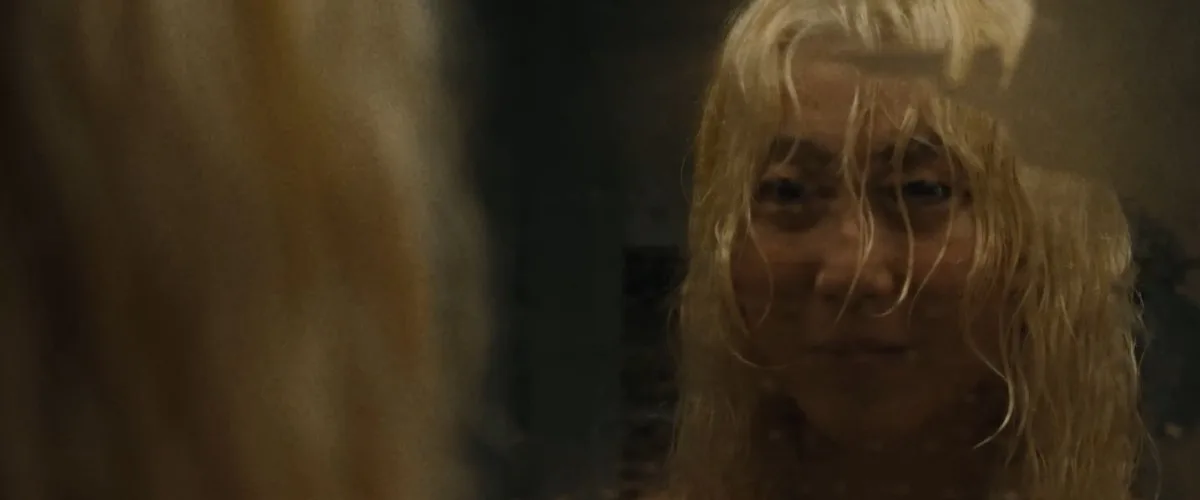
The insecurities born from that introduction (and acculturation) within her primary American social structure, school, continued to fester as she aged, and “Slanted” takes teen Joan as its primary protagonist. Obsessed with using clothespins to pinch her nose and phone filters to make her appear white, it’s clear that Joan is self-loathing. She gives her best friend her mother’s homemade lunches and dyes her hair blonde to be more like her proposed ideal. When the company Ethnos, creators of the “whiteifying” filter she uses, DMs her with an opportunity, she immediately bites: With a quick two-hour procedure, people of color can be irreversibly transformed into white bodies. And so, after tricking her mother into signing a parental consent form, Joan Huang is reborn as Jo Hunt (McKenna Grace).
Joan/Jo’s transformation brings both positive and disastrous consequences, socially and physically, but Wang’s satire is toothless, however relevant its themes may be. Joan’s plight is sympathetic, especially as a woman of color myself who grew up in a very white suburb, but the gummy mess that Wang throws at the wall just doesn’t stick. The film is most interesting when it dissects the role of American identity as it relates to the diaspora, rather than the simple phenotypic changes of whiteness.
“Slanted” is simply too easy. Of course, there’s merit in a teen girl’s faith that aesthetics will change everything, but the cultural aftermath is what’s most interesting here, and Wang only side eyes it. Of course, for Joan/Jo to walk the world as a white girl, privileges are afforded off the sight of her alone, but what can’t be undone are the nearly two decades of cultural identity and context that inform her emotional placement in the world.
Her relationship with her parents inhabits this space, but from her ditching making dumplings with her mom to shaming her father’s working-class job to insisting on speaking English at home, her surface-level angst overwhelms in-depth characterization. There’s absolute validity to the reality of these rejections in a first-generation coming-of-age story, but they aren’t delivered in any thoughtful or emotional way. Instead, the film prioritizes Joan/Jo’s budding friendship with popular mean girl influencer Olivia (Amelie Zilber) and how mobilizing that relationship could lead to her coveted prom queen title.
Perhaps it would be a different film if Wang were to dote as fondly on cultural themes as she does on beauty and “friendship,” but it’d be a stronger one. The thesis is spoken but not rendered. There are American nationalist whispers throughout the film, like a billboard of white models holding beverages that were brewed in the “best country in the world.” But none of these faint echoes pair with textual support that allows them to resonate.
The whole film is quite meek in its approach, timidly dipping its toes into camp, satire, cultural criticism, and body horror, but never fully embracing any of them. “Slanted” is shy, and its inability to assert itself waters down the important conversation about immigrant and first-generation identity, as well as takes the wind out of its own sails when it comes to the fun stuff. Joan’s procedure mirrors the body transfer of “Get Out” from the creepy, tone-deaf white man leading it, to the inverse of a Sunken Place: a dastardly karaoke sing-along about the joys of being white. But the difference is, it’s neither eerie nor darkly funny, just kind of plain and befuddling, even lazy. And this lack of texture plagues the entire film.
There are notes of dialogue in “Slanted” that reassure the viewer that there is intelligent intent here. The surgeon at Ethnos is thrilled to see “more young people” choosing to switch. It’s haunting to think about the repercussions of a population of teens and young adults (shy of frontal lobe maturation) making permanent decisions that serve white supremacy rather than personal agency, contributing to the problem that digs at their communities rather than living despite them. And as popularity increases, the elders of color in the community will dwindle. Wang drops these hints effectively. There’s also a too-little-too-late monologue from Joan’s father about the malleability of American identity that would’ve better served as a site of exploration rather than thrown-away dialogue.
Wang’s “Slanted” acknowledges that whiteness accomplishes quite a bit in American society, and how proximity to those with privilege can get you far as well, but always at a cost of dignity, pride, and identity. But of course, we already knew that. Regrettably botched, despite its bold concept at its core, “Slanted” is too simple to make a statement.