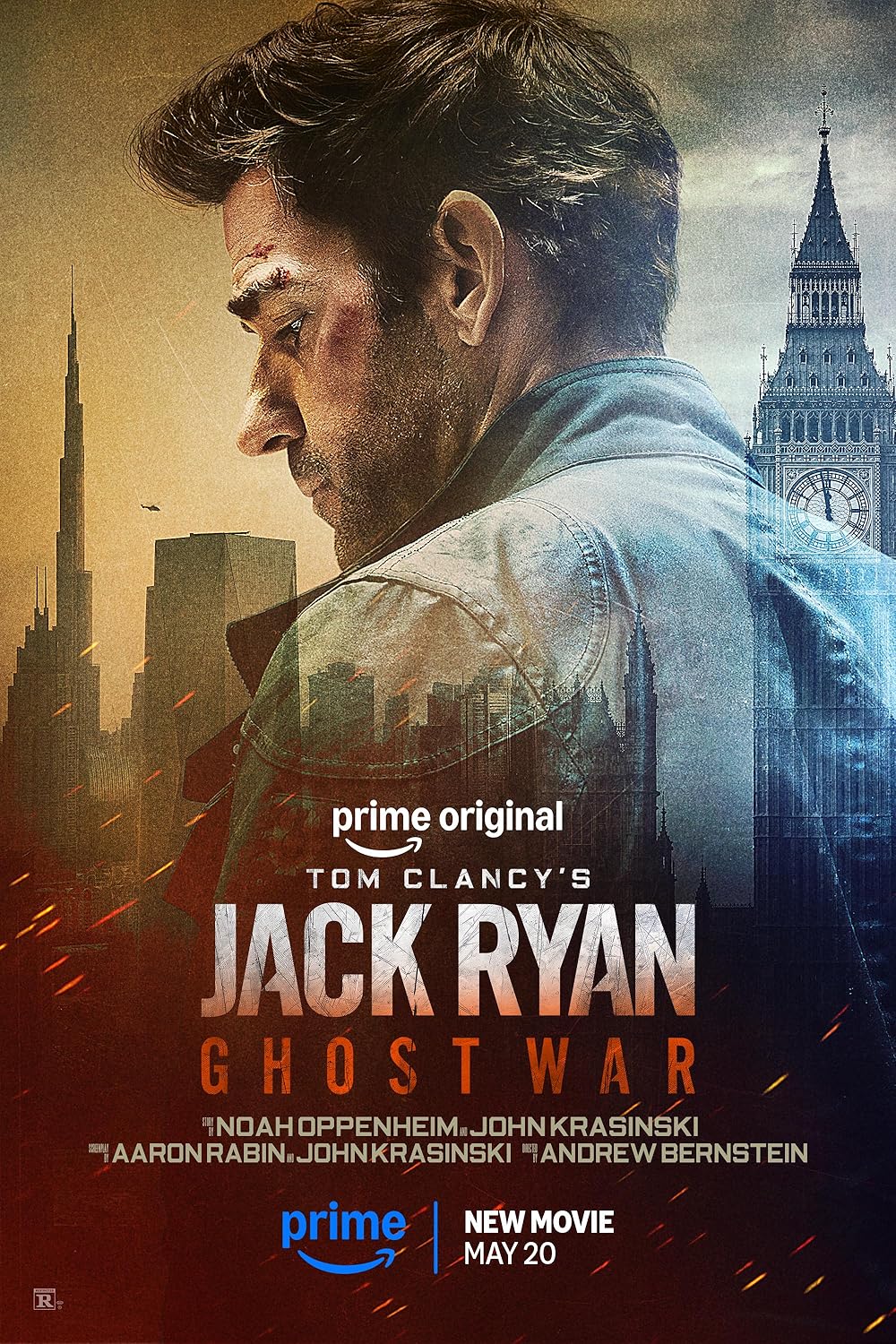
“Jack Ryan: Ghost War” is a tale of nostalgia and regret, about a group of men who all lost the same great love, one that once gave their lives purpose: the War on Terror.
That era might seem a strange object for the unabashed longing showcased in “Ghost War.” But it’s not hugely different from the ’80s movie fixation on figuratively or literally re-fighting the Vietnam War so the US could emerge victorious, or the Cold War nostalgia showcased in movies made after that—including 1990’s “The Hunt for Red October,” which marked the first film appearance of Ryan, Tom Clancy’s CIA analyst who always ended up doing a heckuva lot more than analyzing.
This one is presumably an attempt to restart Amazon’s “Jack Ryan” series (2018-2023) as a more manageable franchise of occasional stand-alone movies. John Krasinski, aka Jim on the American version of “The Office,” inherited the role previously played by Alec Baldwin, Harrison Ford, and Ben Affleck. He is also a skilled Hollywood striver who leveraged his clout from the series into a second career as an auteur (the “Quiet Place” films, “If“). He’s billed as an executive producer and co-screenwriter here, which might explain why it doubles down on the portrayal of Ryan as a white-collar desk jockey who can jump from level to level in an unfinished building while picking off baddies with an automatic rifle, and comes into this mission from the Wall Street job he’d taken after leaving the world of black ops.
The trigger is a one-time job to be carried out in Dubai, where Ryan is headed on business. Ryan reluctantly agrees to participate, mainly because he’s asked by his old friend and boss, James Greer (Wendell Pierce, also of the series), and by his former colleague, Mike November (Michael Kelly, ditto), a security contractor who was once a CIA station chief. It seems like a simple “drop”: Jack, unobtrusively, makes contact with a former MI6 agent named Nigel Cooke (Douglas Hodge) in Dubai one night and receives a super-important package that’s supposed to end up on Greer’s desk.
Things get complicated when Cooke is shot dead while handing Ryan a cigarette package. Jack and Mike chase the killer, but are thwarted when a sniper shoots him dead. The duo is taken into custody by MI-6 agent Emma Marlow (Sienna Miller), a tough loner whose physical skills seem nearly superhuman.
The sniper is a disillusioned former MI6 agent named Liam Crown (actor and jazz musician Max Beesley), who was shown tanking one of Cooke’s operations during the movie’s opening. Crown and Greer have an association from way back in the day: they created a super-secret Black Ops unit called Project Starling to hunt down and kill terrorists without getting entangled in, you know, laws and stuff. We’ve seen characters like Crown before in films, TV shows, and video games, so the motivation isn’t surprising. As if to literalize the notion of forcing history to repeat itself, Crown is obsessed with carrying out a terrorist attack that US and UK intelligence foiled twenty years earlier.
What is somewhat surprising, in a welcome way, is the toll this takes on Greer and the amount of screen time devoted to his mixed feelings about having participated in something so disturbing. During the course of the film, which is directed by Andrew Bernstein in a visually unmemorable, by-the-book manner characteristic of many big-budget action shows, Greer muses on the line separating civilization from savagery and where he stands in relation to it.
He even launches into a mini-monologue during a heated argument with Ryan that sounds like a paraphrase of the courtroom rant delivered by Jack Nicholson’s sadistic Marine colonel in “A Few Good Men,” the one about how civilization is guarded by men with guns. That speech is itself inspired by a declaration, often misattributed to George Orwell and Winston Churchill, that people in a democracy can sleep peacefully in their beds at night only because rough men stand ready to do justice on their behalf.
Pierce, one of the greatest character actors of the modern era, plays Greer’s internal crisis with the same intensity he brought to Willy Loman in “Death of a Salesman.” He makes Greer into more than just a type, and the only one who goes through any meaningful personal journey—albeit one that’s resolved in a franchise-friendly ideological stalemate that lets Greer and the other major characters continue doing what they were already doing, thus setting up more movies.
However wobbly the presentation, Greer’s kinda-crisis is preferable to the frankly incredible idealism of Ryan, who was in the CIA for many years but here seems shocked to learn that his boss helped create a secret Frankenstein’s monster within an existing military structure, even though the mainstream news media post-9/11 (when Ryan was in his twenties) regularly reported on elements within the government that were already doing the very sorts of things Ryan doesn’t approve of.
This aspect of Ryan has always been patently absurd, at least in the film-and-TV incarnation. The previous peak of ridiculousness was 1994’s “Clear and Present Danger,” in which Ryan (played by Harrison Ford) confronted the president in the Oval Office about a secret operation with similarities to the real-life Iran-Contra affair, concluding, “How dare you, sir!” It’s impossible to work for the CIA without knowing about at least some of the very bad things they’ve done and finding a way to justify them so that employment can continue. It’s like applying for work as a firefighter without knowing that fire is involved.
It’s much more fascinating and disturbing to follow characters like the ones in “The Americans” and in most of Graham Greene and John Le Carré’s fiction, who understand and accept the moral contradictions baked into their profession and tend to internalize any psychological and spiritual damage it inflicts on them, so that they can keep doing it.
Krasinski continues to make Ryan a tall, good-looking nothingburger who keeps saying he doesn’t want to be an action hero and isn’t made for the role, but can turn into Jason Bourne on a moment’s notice. He appears to have spent his CIA career unaware of much of the agency’s history. Miller is a standard-issue Badass Woman (TM) whose secret we figure out instantly; she flirts with Ryan a little, but her main love is MI6, which has given her life purpose, though not a recognizably human set of traits to play with.
“Jack Ryan: Ghost War” is funded by Amazon, the home of the streaming series, and presented under the banner of MGM Theatrical, which once merged with United Artists, the original home of James Bond. That means there will probably be a point in the near future when Jack Ryan and James Bond are embarking on new adventures at the same time, perhaps even chasing and shooting their way through the same glamorous locations. Maybe there will be a crossover.
Both properties are lucrative, but nowhere near as lucrative as renting server and cloud space to the US Government, the military especially. Amazon makes hundreds of millions of dollars a year doing that, and is currently involved in a $50 billion project to build AI infrastructure for the US military. Somehow, all of that seems to explain why Jack’s first civilian job after briefly leaving the CIA was working for a hedge fund. If you don’t already know what hedge funds do, it’s worth your time to do a bit of reading.