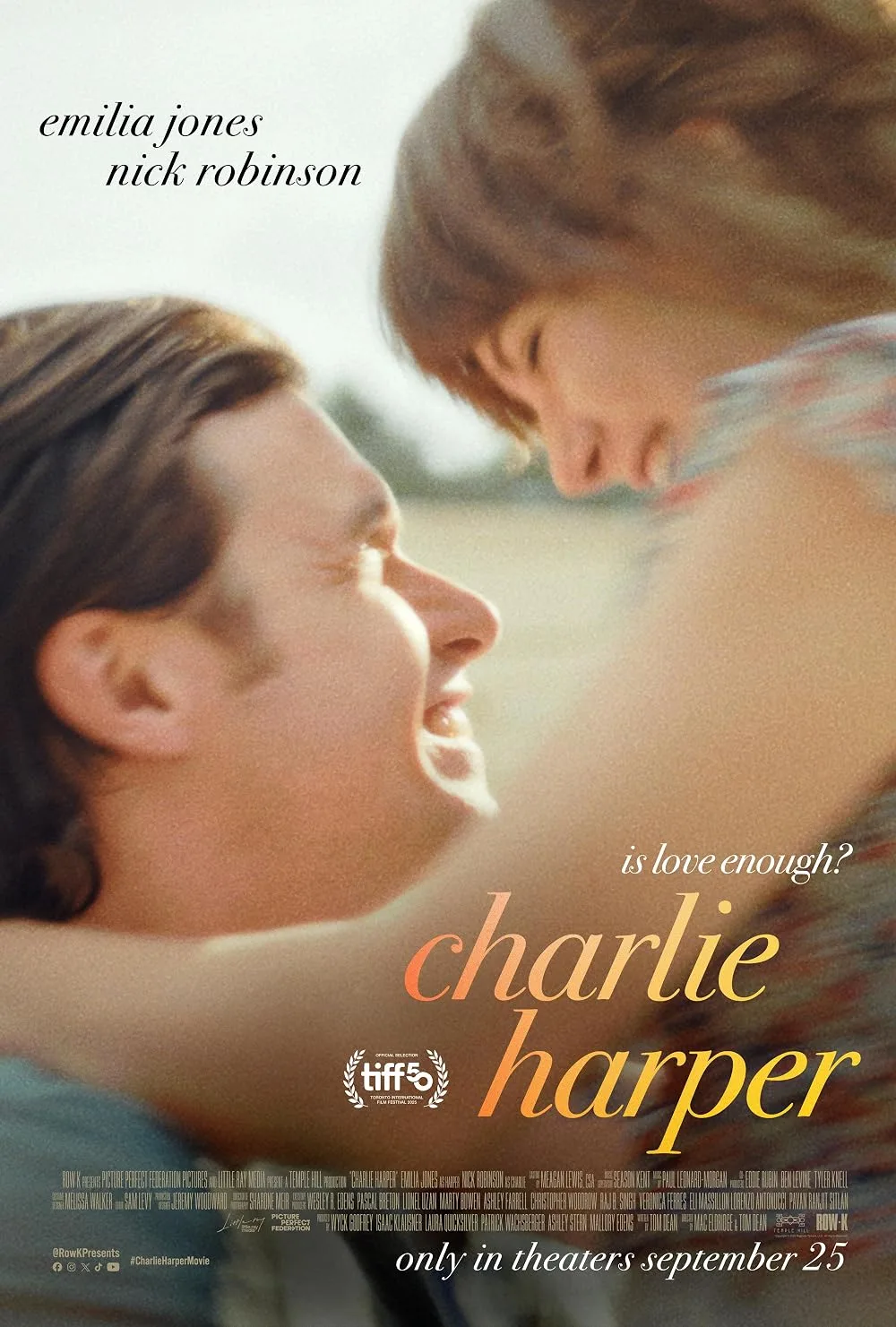

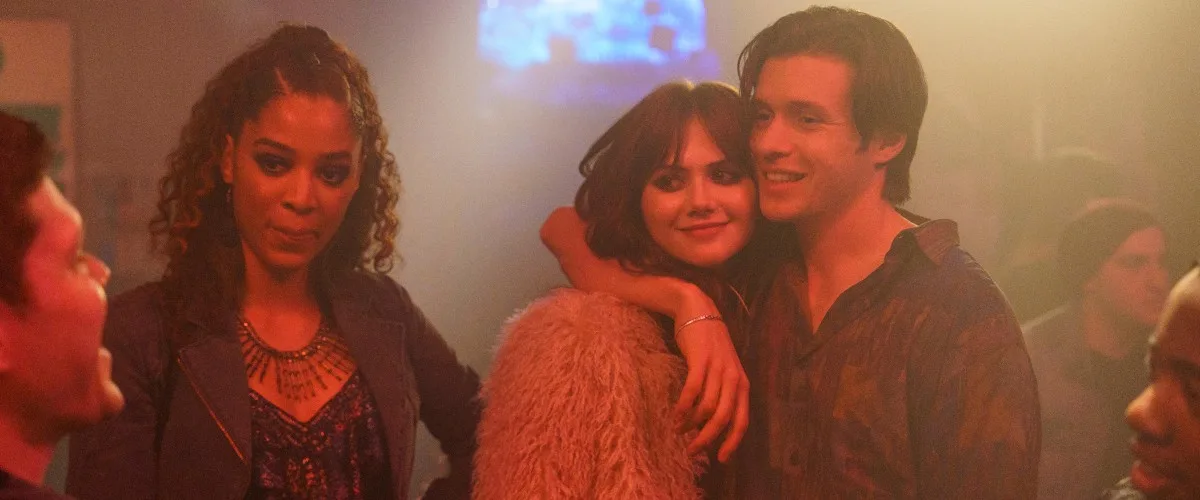
“Are you a nostalgic person?” a young woman, Harper (Emilia Jones), asks someone off-screen. “Yes,” they answer, “what about you?” She says she is as well, but wonders what purpose it serves. The same could be asked about Mac Eldridge and Tom Dean’s interminable millennial romance, “Charlie Harper,” the film in which this exchange takes place.
Harper is a chef living in New Orleans. She is not talking to Charlie (Nick Robinson), although for the rest of the film we will be subjected to her memories of their tumultuous relationship. We’ll also be subjected to Charlie’s version of these events. They are not all that dissimilar, because screenwriter Tom Dean doesn’t seem to know how to write distinct characters with interiority or personalities beyond hackneyed clichés.
Like Derek Cianfrance’s elegiac romance “Blue Valentine,” Eldridge and Dean’s film uses a non-linear structure as a way of recreating how memory works, starting with Harper and Charlie’s most recent memories of each other, then weaving in and out of the most euphoric or most painful memories before winding its way to their first high school flirtation. This is the moment they fell for each other, when new emotions like romantic love are felt most acutely.
The film zigs and zags through time, using pop culture nods (Limewire song downloads, Obama’s election night speech, the early years of Tinder dates, and finally a Bernie Sanders political mailer to shorthand what year we’re in) before ending back at the beginning, repeating the film’s cold open. This structure is clearly meant to elicit more emotion from the audience with the added context, but since that middle has no weight, the repetition becomes tedious.
Much of the film’s worldbuilding appears to have come from Tumblr circa 2010; hence the heavy reliance on visuals and other riffs on “Blue Valentine.” There’s even a scene where Charlie reads Frank O’Hara’s “Having a Coke with You,” a poem that made heavy rounds on that particular social media app during the first Obama era. Unfortunately, the film has about as much depth as a Tumblr dashboard; it’s all pretty pictures and sad quotes from literature and music, with no real insight or originality.
Both Charlie and Harper are outlines in search of a character. As the two first begin dating, we learn that Harper wants to be a chef. She says to Charlie, “I love thinking about the way a dish is gonna make someone feel.” But although we vaguely see her move up the ranks at a swanky NOLA restaurant, we only really ever see her make one complete meal for Charlie. Oddly enough, this is the second romance film released this year starring Robinson in which his love interest wants to be a chef. Apparently, that’s one of the prerequisites for a script to get greenlit these days. That’s the curse, I mean legacy, of “The Bear” I guess.
For his part, Robinson does his best to make this walking cliché of a man-child feel raw and grounded, but every new supposed layer he adds is more clichéd than the last. He’s an alcoholic whose journey towards rock bottom and a twelve-step program is only gestured at, despite being his most important arc. He’s the “smartest” person anyone knows, but the books he reads are the kind of stuff that people think smart people read, like Kurt Vonnegut and “A Confederacy of Dunces.” Yet we never understand what Charlie loves about books. Do they transport him somewhere? Was it what he leaned on to get through his parents’ marriage dissolving? We don’t know because this script doesn’t care.
The side characters are equally underdeveloped, with Charlie’s friends existing solely to yap empty platitudes at him or remind us that he’s a genius. At one point, Harper goes to a club with a bestie that we’ve never seen before and never see again. She also has a boss named Claire who was a Comp Lit major. Bizarrely, his is the one character who is actually given any kind of real background for some reason, but even then screenwriter Dean just can’t help but pile on another groan-worthy signifier of Charlie’s brilliance when he recognizes that her “teacup and madeleine” tattoo is an homage to Proust’s novel “Swann’s Way.” At this point, I wanted to hurl myself into the ocean, yet I still had half the movie left to watch.
Along with this oblique, nonlinear structure, the filmmakers saddle their film with an overbearing score and incessant narration that never stops telling us how the characters feel because they don’t seem to know how to show anything through action. The film also often relies on music to carry its weightiest moments. “Break It To Me Gently” by Brenda Lee is the biggest offender. We’re told that in high school, Charlie and Harper exchanged mixtapes, but really Charlie only burned one for her, and it had only one song. When he gave it to her, he told her “not to listen to it too much, if you like it.” Because, he says, then it won’t lose its magic.
This line is repeated a few times, and it is a profound truth about relationships, too. But I am here to say if a song hits, it will always hit. The choice of such a nostalgic song, one that a young person would likely not know (although Charlie is smart, so of course he’d have quirky music taste; I forgot), only serves to make the film feel even more like an ersatz “Blue Valentine,” whose use of “You and Me” by Penny and the Quarters was a truly inspired choice. One of their many quasi-breakup sequences is so clichéd, it’s like the film gave up on itself and turned Dave Von Ronk’s haunting cover of “Mack The Knife” all the way up just to drown out the banal dialogue of its own volition.
Ultimately, the film is just an echo of much, much better films. One that desperately grasps for depth while wading around in the kiddie pool. As I watched this undercooked, overwrought confection, I thought about how much I enjoy watching Hallmark movies during Christmastime. People look down on them because they are predictable and saccharine. But to me, they are like junk food. They know they aren’t real food, and I know they aren’t real food, and thus they are enjoyable. I’d rather watch one of those silly films than a “proper” movie like “Charlie Harper,” which aims for profundity and realism, yet has the insight depth of a postage stamp.