Acting is not an endurance test, though you wouldn’t know it from the yearly crop of Best Actor nominees. A win for Leonardo DiCaprio in “The Revenant” would only ratify the tendency to see acting greatness in terms of transformation and misery. In this value system, viewer remarks along the lines of, “I barely recognized him” and “My god, look at how much weight he lost!” and “Was that really him falling off that cliff?” take the place of more nuanced evaluations of the actor’s art. Acting becomes a stoic’s routine, a form of monk-like self-flagellation to prove devotion to one’s craft. Lose that weight. Eat that flesh. Take the punch to the face. Are you man enough?
It’s the most extreme possible variant of the tendency to mistake Most Acting for Best Acting. It’s common wisdom now to say that, if you want get an Oscar nomination, especially as Best Actor, it helps to play somebody terminally ill, or struggling with a chronic condition (“Shine“), the loss of mobility (“Born on the Fourth of July,” “My Left Foot,” “The Theory of Everything“) or a deformity (“The Elephant Man,” “The English Patient“) or wear lots of makeup to look more like a famous historical figure (“Lincoln“), and so on. And it’s true. If you want that little gold man, you’ve got to pay some kind of physical price.
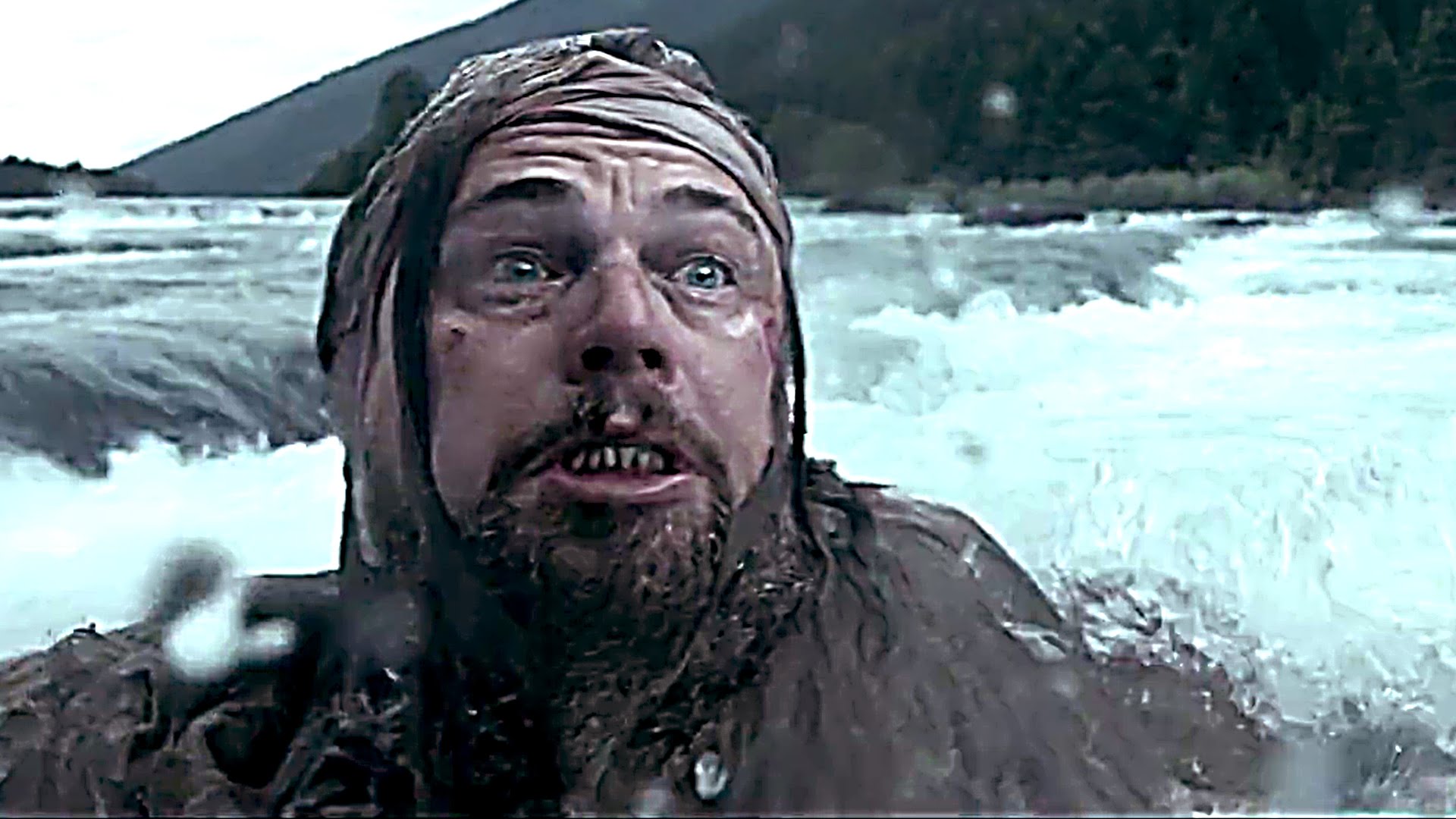
The acting-as-punishment routine takes this mentality to its lowest depth. Right now Leonardo DiCaprio is the front-runner in the Best Actor race for his performance in the survival epic “The Revenant,” in which he plays an 1830s trapper seeking revenge against a colleague who betrayed him and left him for dead in the wilderness. During the course of the film—which we’ve repeatedly been told was shot under very difficult weather conditions and in harsh terrain; filmmaker suffering is part of this narrative now, too—Leo wades and swims in icy water, crawls across hard tundra while dragging an injured leg behind him, eats raw bison liver, sucks the marrow out of the vertebrae of an animal skeleton, etc., in the name of survival, but also in the name of Art. “Just about every awards body has drunk the ‘Revenant’ Kool-Aid, buying
into DiCaprio’s endless boasting about how super-hard the movie was to
make,” wrote Matt Prigge, who agrees with me that Leo should not get an Oscar because it would reinforce poor messages.
Seen through this lens, DiCaprio’s performance becomes a physical manifestation of his desire to win an Oscar (and his fans’ desire to see him get one, finally, 22 years after his first nomination for “What’s Eating Gilbert Grape?”). It also seems of a piece with other Oscar nominations in recent decades that are mainly about proving one’s devotion to the art of acting by suffering before or during production (and some acclaimed weight-loss performances that did not get nominations, such as Christian Bale’s in “The Machinist”).
Robert DeNiro probably started it all when he ate his way across Europe to put on extra weight so that he could play the older, fatter version of boxer Jake LaMotta in “Raging Bull.” He did variations of this later in his career, putting on weight again to play Al Capone in “The Untouchables” and becoming pumped and ripped to play Max Cady in Martin Scorsese’s remake of “Cape Fear” (Best Actor nomination). Matthew McConaughey’s Best Actor win for “Dallas Buyer’s Club” was at least partly a byproduct of how shocking and impressive it was to see him drop all that weight to play an AIDS sufferer. Tom Hanks got an Oscar nomination for “Cast Away,” which shut down production for a year so that Hanks could lose 70 pounds to play a man who’d been stranded on a desert island. He had previously won two Best Actor Oscars, for playing, respectively, a Candide-like simpleton who had polio as a child (“Forrest Gump”) and a man dying of AIDS while fighting for his rights in court (“Philadelphia”).
Pauline Kael was first to call out this acting-as-endurance test idea,
writing of “Raging Bull” way back in 1981, “What DeNiro does in this picture isn’t
acting, exactly. I’m not sure
what it is. DeNiro seems to have emptied himself out to become the part
he’s playing and then not got enough material to refill himself with;
his [Jake] LaMotta is a swollen puppet with only bits and pieces of a
character inside, and some religious, semi-abstract concepts of guilt.” I love DeNiro in that movie, but he definitely validated some wrongheaded tendencies, as did the academy which rewarded him as much for his athlete’s focus on enduring pain as for his imagination as a performer.
Every year, one or more critics writes a piece complaining about this kind of thing. It’s been going on for decades now. Nothing ever changes.
There’s something seriously amiss here.
Endurance test acting, or transformational acting, can be great acting.
But why is it prized above other forms of acting?
Why do we not see subtle or “small” acting, fun acting, light acting, acting that is not about suffering or transformation, as great acting, too?
DeNiro is a great actor. Most of the people mentioned in this piece are great actors, including DiCaprio, who in the right role can be magic. He was magic in “Titanic,” for which he did not receive a nomination—boisterous, cocky, utterly charming. He is magic in more (as they say now) problematic roles as manipulative and deceptive alpha males, in “The Great Gatsby” and “The Wolf of Wall Street” (both the same year, and he got a nomination for “Wolf”).
DiCaprio at his best is so good that you don’t catch him acting, or you don’t think of what he’s doing as acting, even though it is. I imagine that part of the reason he’s played so many glum, violent, depressed sufferers during the last 15 years is because he’s bought into the idea that if you’re not losing or gaining weight, changing your appearance, spending long periods of time in extreme weather conditions and otherwise proving your mettle, then it’s not really acting—or, maybe just as bad, that it’s a sissy version of acting, all about clothes and makeup and hitting your marks.
Maybe he’s on to something. Cary Grant never won an Oscar.
ADDENDUM: No, Forrest Gump did not have Downs syndrome; this has been corrected. We were never told exactly what his condition was, though you can read speculation about it here.
Also: While I don’t want to change the headline of this piece because at this point it would feel like revising history, it did send people into it with the wrong impression: I do think transformational or “big” acting can be great acting—I would have to think that, otherwise I couldn’t enjoy Nicolas Cage, Orson Welles or Sir Laurence Olivier—and I did say that rather explicitly (I hope) further down in the piece.
The main point here is that, for whatever reason, subtle or quiet acting tends to be devalued by awards-giving groups and many critics, and the idea that an actor has to transform to be properly appreciated as an actor is now so ingrained in the culture that there’s a character in “Tropic Thunder” whose very existence amounts to an extended spoof of the idea. I do think that, ultimately, giving DiCaprio an Oscar for this, out of all the roles he’s played, would amount to an endorsement of the idea that this is the kind of role that will finally get you a little gold man. I think he should’ve gotten nominated and then won for “Titanic,” personally (he was ignored for that) and possibly for “The Wolf of Wall Street” or “Catch Me If You Can.”