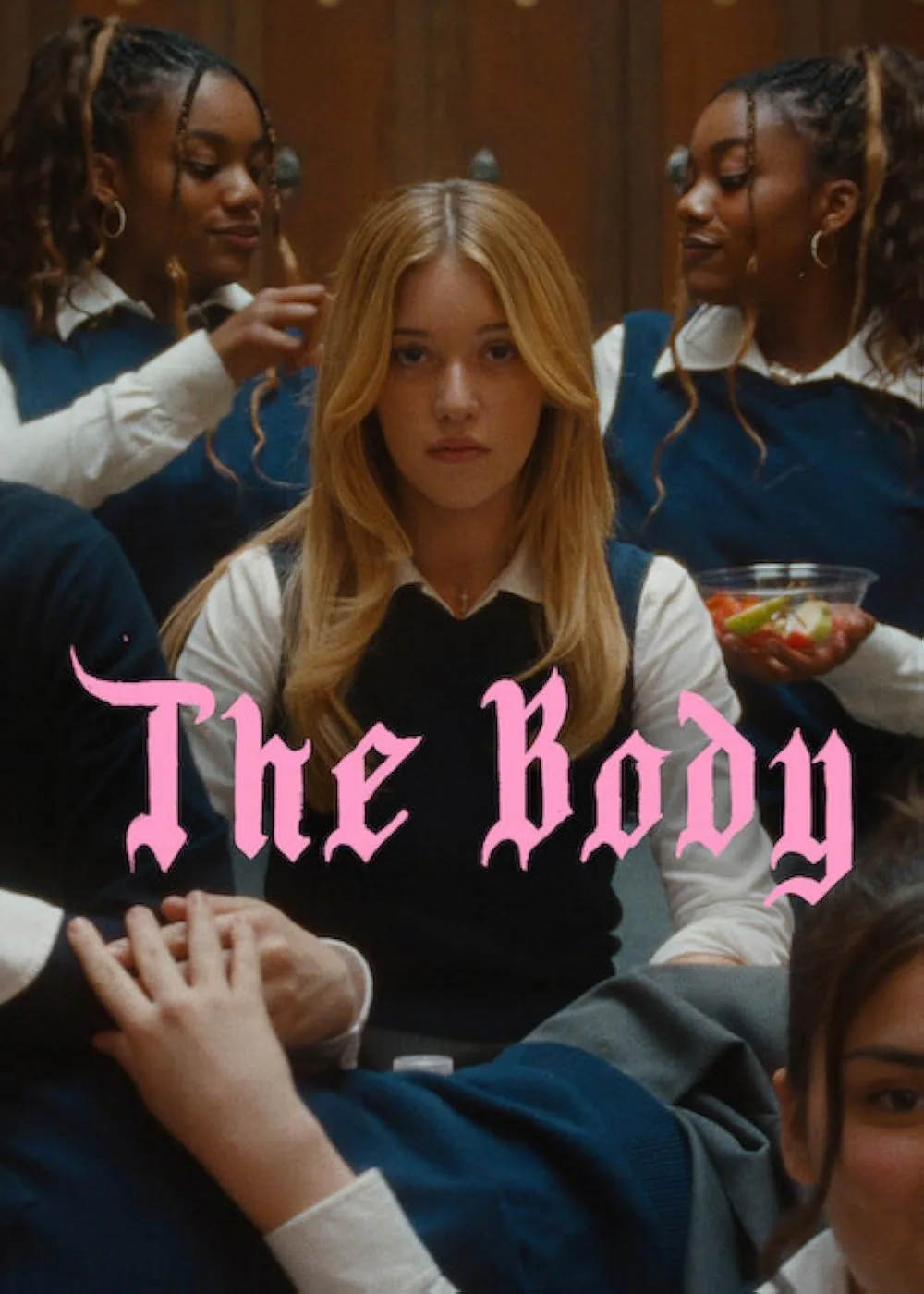
It’s oddly fitting that Quinn Sullivan’s Catholic schoolgirl psychodrama “The Body” comes out the same year that Ken Russell’s revelatory, controversial “The Devils” receives a second life in theaters in its full, uncensored form. Much like that oft-overlooked 1971 classic, Sullivan’s show sinks us deep into the thorny, horny social dynamics of a group of women psychologically collapsing under the weight of Catholic guilt, social orthodoxy, and their own repressed desires. Difference is, these girls are wearing a lot more Juicy Couture.
Clearly inspired by “Jennifer’s Body,” “Mean Girls,” and (clearly) actor-turned-showrunner Sullivan’s (of Hulu’s “Under the Bridge“) upbringing, “The Body” plops us in a prestigious Catholic school in 2004, which is seemingly ruled by its gorgeous, all-girl competitive dance troupe, the Lions. Amid the AIM group chats, low-rise jeans, and bedazzled flip phones, the girls all jockey for popularity and acceptance within the group, led by besties Anya (Kristina Bogic) and Elsie (Sara Boustany), who won’t quite cop to the fact that they get more than a little handsy when drunk.
This queer longing, complicated by the fact that Anya is dating hunky basketball player Steven (Orlando Norman), is just one of the many threads that get pulled during a fateful Halloween night initiation party, in which the girls pray to Satan for their new entrant, Grace (Sofia Wylie), to act as a sacrifice to go to Regionals. It’s all in good fun, but as the stolen booze and ecstasy come to a head, Grace finds herself in a coma by the end of the night. The only ones who know what really happened to her are Anya and mousy newcomer Lisbeth (Geena Meszaros), the school’s new kid who, along with outcast brother Leo (Jackson Kelly), has a mysterious past she’s trying to shake.
Before long, the guilt and confusion around Grace’s condition bubble up to the point where the girls start to see visions of her everywhere, succumbing to possession-like seizures as they slowly begin to shift their worship from God to, well, Grace, whom they feel is watching over and possessing them with her spirit. Meanwhile, the adults (including Nnamdi Asomugha’s Father Franklin) scramble to figure out what’s going on: Are their visions real? Are these hormonal, competitive young girls crying out for attention? Is this mass hysteria, or something more sinister?
To temper expectations, “The Body” never finds itself lapsing into outright supernaturalism; it, and Sullivan, are far more interested in the way the social dynamics of high school (especially in rigid, moralistic religious settings) can create the environment for this kind of chaos. Few people can turn from friend to foe, enemy to lover, outcast to inspiration quite as quickly as teenagers, and Sullivan finds gripping, darkly funny ways to explore that. There are flashes of “Picnic at Hanging Rock” in the yearning of young girls to find freedom from their repressive confines, the messy cheating, queer exploration, and drug use of “Euphoria,” and of course, all the millennial nostalgia and cutting one-liners of “Jennifer’s Body.” (“He totally ‘Lovely Bones”d her,” one girl accusingly says of Leo.)
But in navigating those disparate tones, Sullivan’s show finds some eerie notes to play on the nature of social indoctrination, and how vulnerable people, pushed in the right direction, can learn to believe anything. The architect of this design, naturally, is Lisbeth, Meszaros’ delicate stare and predatory glances evoking Morfydd Clark’s incredible work in “Saint Maud,” leveraging her checkered past as a member of a Pentecostal cult to carve her way into Anya’s, and the team’s, good graces (save Elsie, who comes closest to seeing through Lisbeth’s game-playing). As a character, Lisbeth sits somewhere between Sister Jeanne in “The Devils” and Carrie White in “Carrie,” the put-upon outsider who nonetheless worms her way into everyone’s good graces through a mixture of luck, serendipity, and her own skills in manipulation. (The entire young cast is excellent, but Meszaros is a heart-stopping standout.)
Like most Netflix shows, even good writing can get hampered by dim, muddy cinematography (its daytime scenes feel decently textured, but good luck making out much of what’s happening at night) and the languid pacing that comes from stretching your story out to eight hours. But these are relatively minor concerns in a show that so entertainingly balances religious horror with the teen-girl melodrama of something like “Gossip Girl” or “Pretty Little Liars.” Virtually every member of the Lions has something to hide, or something to gain, from going along with this shared delusion: how deep these secrets go, and the lengths people take to maintain them, supplies much of “The Body”‘s appeal.
Full season screened for review. Currently streaming on Netflix.