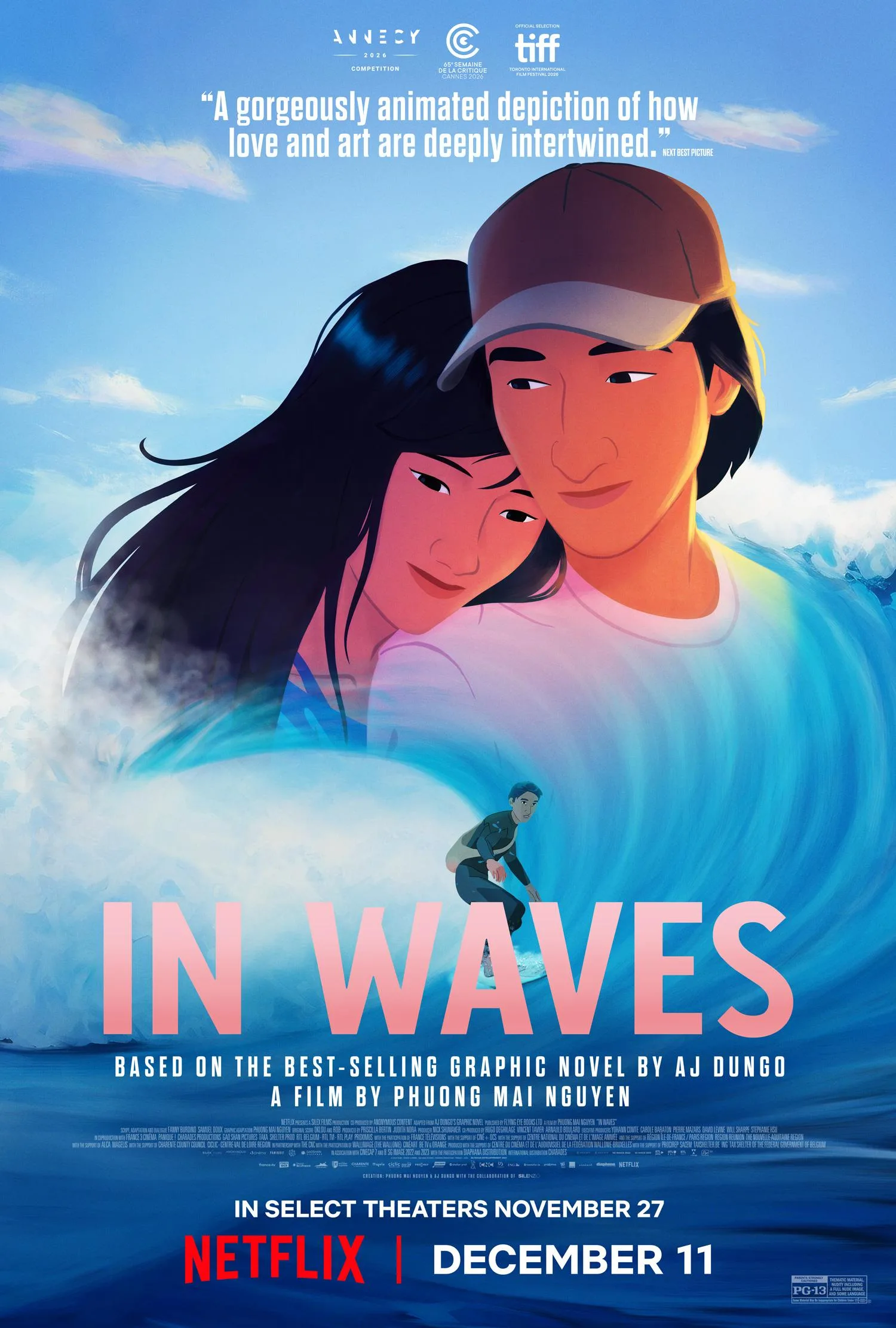
Director Phuong Mai Nguyen’s “In Waves,” which brings AJ Dungo’s graphic novel of the same name to the screen, understands that adaptation is as much about redefinition as recreation. It is on the screen, where creatives can take a second pass at the lives they have lived, presenting versions of themselves where they were better, sanding rough edges and modifying details ever so slightly, to present a reality that is similar but not the same as what they might have depicted in a prior medium.
That is not to say this film is starkly different from the book or operates in falsehood. Instead, we see cinematic translation as a dance between death and rebirth, where the beauty lies in witnessing how changes to the source material can present the same truth in different ways. The film focuses on the relationship between Dungo and his first partner of eight years, Kristen, and is a lyrical celebration of the hardships and joys of caretaking and the importance of maintaining dreams even when it feels like the world continues to strip away your options.
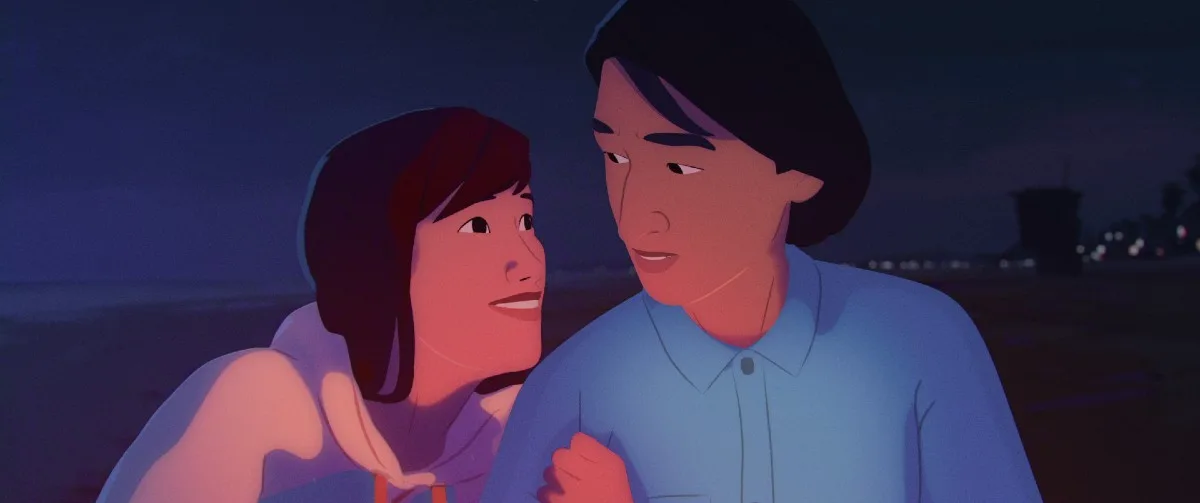
What gives “In Waves” its weight is a restrained animation style that anchors the film’s emotional center, and a layered texture palette that fits the beautiful convergence of disparate narratives. When we first meet AJ (Will Sharpe), he is as far from the water as one could be: his life revolves around skating, and the ways the animators capture his movements 3 turns and edge jumps emphasize the ways the activity makes him come alive against the immovable landscapes. The backgrounds remain fixed while his moves animate the frame, as if he is quite literally skating across the painting. Much of “In Waves”‘s style works this way, so its animation never feels unnecessarily ostentatious.
This means, though, that when the film does want to lean into its more surreal and experimental modes, they feel like a breath of fresh air. The animation team created a new way to animate water, combining hand-painted Photoshop backgrounds with 3D backgrounds, which makes the 2D graphics move with a vivacious expression not yet seen in animated works. It sets a career milestone for the style, and this interweaving of mediums speaks to the movie’s larger themes around the coalescing of narratives, how the beauty of relationships, whether they be romantic, platonic, or a register in between, is that disparate stories can be combined into a larger one without losing individual specificity.
When AJ meets Kristen (Stephanie Hsu), he’s instantly taken with her, and as the two fall in love, she introduces him to the water, where she tries to coax him to trade the skateboard for the surfboard. These surfing sequences are where the film feels most alive, as water represents so much to both Kristen and AJ. Take the moment when AJ first sets out to sea, and Kristen baptizes him, submerging him gently, then lifting him back up to greet the sun: he’s a new creation, whether his aquaphobia wants him to acknowledge it or not. In another beat, as AJ draws Kristen, her sketched hair transitions into waves crashing on a beach; this visual motif returns in full force later, when the film focuses on waves as if they’re caressing the beach, like hands made of sea foam. Such moments imbue the film with aquatic spirituality, showing how deeply the pair’s love is tied to the landscape.
Kristen’s and AJ’s dreams are disrupted when Kristen receives a cancer diagnosis. The film shifts to how to care for loved ones amid senseless, destabilizing anguish, and what it looks like for one person in a relationship to hold to dreams while the other’s options become increasingly limited. It’s devastating to witness, and to Nguyen’s credit, her earlier, restrained approach is recontextualized as a dignifying act as she commits to capturing the realities of healthcare with the same register as the film’s surfing scenes. Take a moment where Kristen lies comatose on a hospital bed, and all we hear are her labored breaths, the machine’s incessant beeps, and the pregnant pauses of her loved ones around her. Nothing is glamorous, but the film’s potency comes from Nguyen’s willingness to bear witness.
The film’s attempts to merge Kristen’s health journey with the broader origins of surfing are thematically salient, as they tie her love for the activity to a larger spiritual reality, but while these flashbacks are beautifully animated, they feel like interruptions rather than integrations. At ninety minutes, the film also tends to introduce a potential conflict and then can solve it in the next scene.
You can feel the love Dungo clearly holds for his partner of eight years bleed through the animation style and into Fanny Burdino, Samuel Doux, and Cairo Smith’s adapted screenplay, and while it makes it easy for viewers to be similarly enraptured, that reverence comes at the cost of depth. Kristen earns our sympathy even while being a character bereft of flaws, and the film could have benefited from an approach more willing to portray her messiness with honor. Still, this film remains a sobering, life-affirming gem and an ode to the fears we overcome in the name of love.
This review was filed from the premiere at the San Diego Asian Film Festival on November 5. It opens on November 27, 2026.