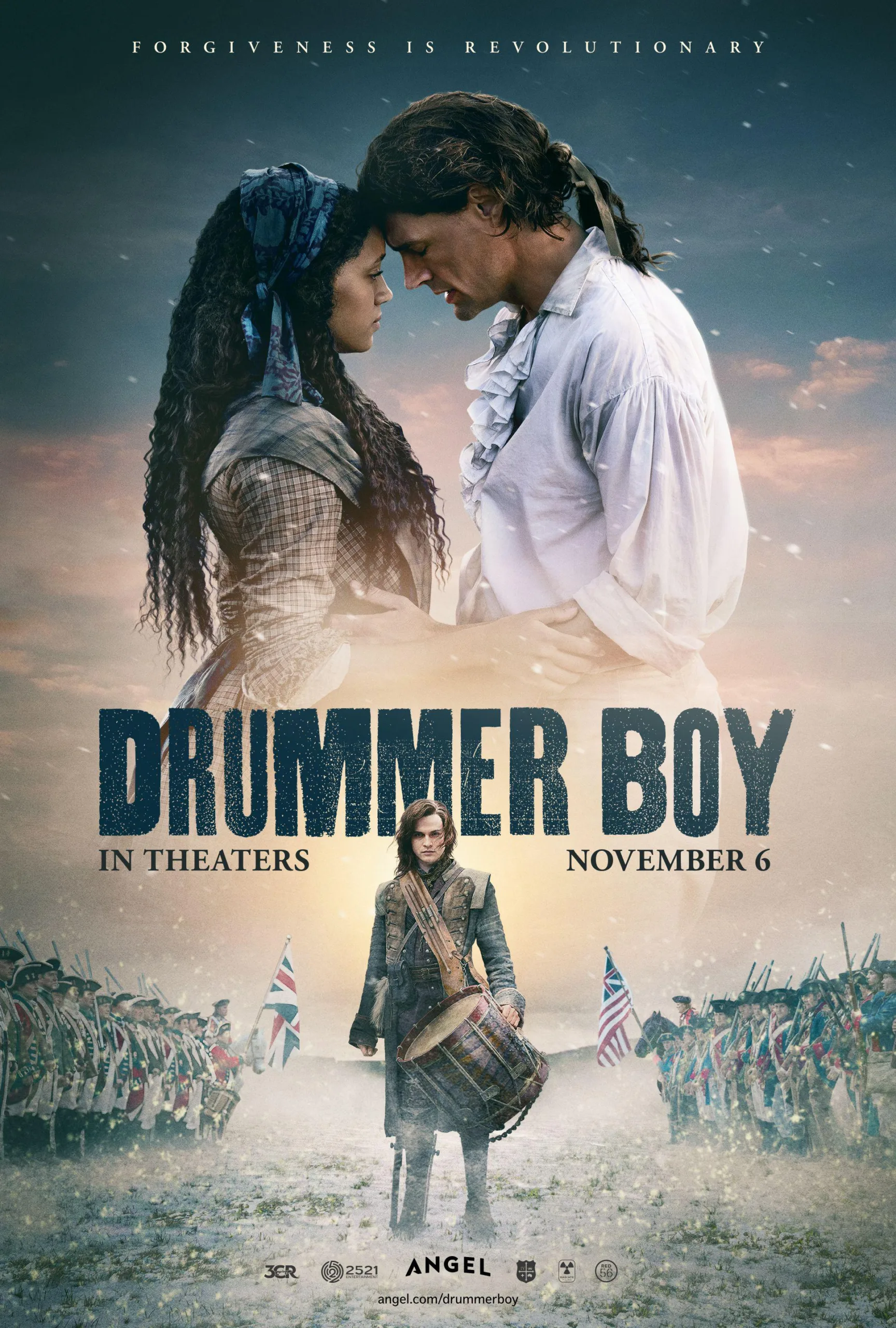
The musical-historical drama “Drummer Boy,” about brothers on opposite sides of the US Revolutionary War, has been described by its distributor, the politically conservative, Utah-based Angel Studios, as a “labor of love.” It’s certainly that. Brothers Luke and Joel David Smallbone, filmmakers who perform Christian pop as For King & Country, spent eight years making it. They developed the story (adapted by screenwriter Richard L. Ramsey), co-directed it, and wrote or co-wrote nearly all the songs. But a better description is “Un film singulier,” which translates as “a film that stands out from the norm.”
The story begins in flashback, on an English Navy ship bound for the American Colonies. We’re introduced to an English family, the Clems: naval officer Nathaniel (Ioan Gruffudd), his devoted wife Rachel (Melora Hardin), and their young sons Jeremiah and Benjamin. Moments later, Frenchmen blast the ship with cannons, overwhelm the crew, and shoot Nathaniel dead, leaving Hardin to play Mother Courage and confirming that Gruffudd was a day player.
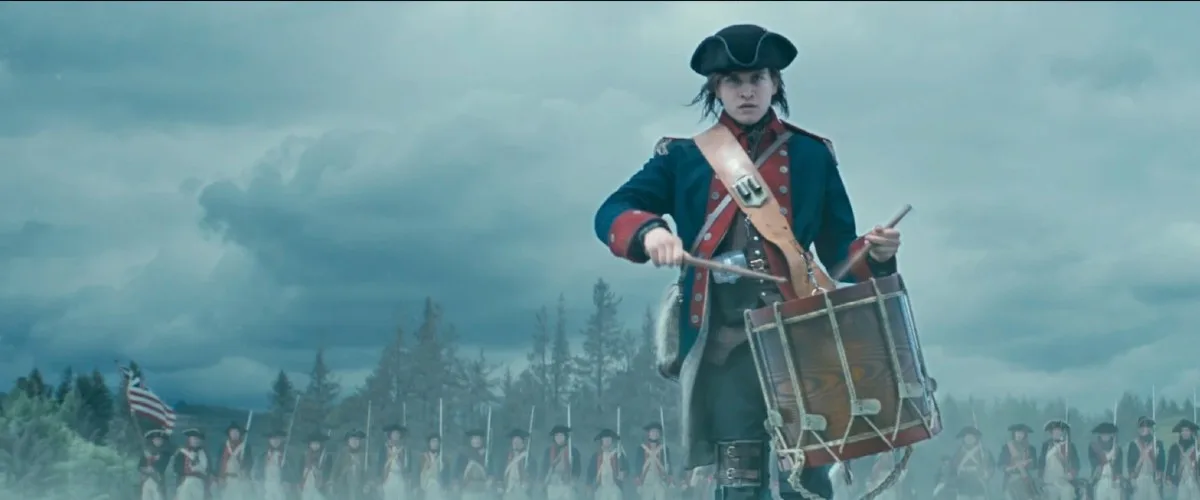
When the war starts, the surviving Clems are struggling farmers. The twentysomething Jeremiah is now portrayed by Joel David Smallbone (who, at 44, is too old for the role, but whatever; so were all the alleged teenagers in “Grease”). Relative newcomer Lucas Leach, an edgy young actor who looks like he could be Johnny Depp’s long-lost son, plays Benjamin, a talented drummer who lost half a leg below the knee and walks with a brace. Benjamin sides with the Colonists. He wants to carry a gun and kill the Brits, but is denied by his commanding officer in the colonial militia, Major John Ambrose (Iain Glen), who laments his disability but recognizes his musical talent and appoints him drummer of the regiment.
Big brother Jeremiah believes their father, a born-and-bred English officer, would still be wearing a red coat. But a more cynical aspect is at play: Jeremiah is a social striver who has fallen for a rich girl, Lady Elizabeth Balfour (Beth Easdown), whose father, Lord Balfour (Charles Esten), was a friend and Navy buddy of Nathaniel Clem and commands a British regiment. Jeremiah hopes serving in the war will earn Lord Balfour’s approval, cement him as a suitable husband for Elizabeth—who only kinda likes him—and guarantee his family’s safety and comfort. Waiting in the wings is Emmalin (India Brown), an English slave who came to America on the same boat as the Clems, was secretly taught to read by Jeremiah, and is now a servant to Lord Balfour and a handmaiden to Elizabeth. She’s saving what little money she earns, hoping to buy her freedom and head North.
You’ve seen variations of this material before. The lyrics invoke Cain and Abel. How could they not? You also realize from the tone of the filmmaking that this isn’t the kind of movie that ends with the cosmos stomping all over everybody, Jeremiah especially. His character is too decent for that anyway. He’s not evil, just misguided, and bad at reading social cues. You also know that the brotherly conflicts will work themselves out somehow. So will Jeremiah’s obliviousness to the fact that Elizabeth has been toying with him and his true love has always been Emmalin.
Quality-wise, “Drummer Boy” is all over the place. Many of the lyrics are trite (“Mother, dear/I don’t want to leave/But this is the moment to do what’s right/To face my fears”). The arrangements are mainly “stomp-clap-hey”-style pop that’ll alienate anyone who’s never been to a barnyard wedding. The plot is pure corn. And, like so many big-budget historical epics, the movie is filled with makeup, hairstyles, eyebrows, and, sorry to say, cosmetic procedures that didn’t exist until recently. Even the title is anachronistic: the only non-King & Country tune on the soundtrack is a reworking of the holiday favorite “The Little Drummer Boy,” which was composed in 1941.
What’s surprising and gratifying here isn’t the tale or its individual components. It’s the big swings the film takes, some of which connect powerfully. The Smallbone brothers have obviously seen a lot of musicals onstage and onscreen and thought about why they loved them and how to translate them into Smallbonese. And they’ve done it with such naive passion that whether the movie is verging on greatness or spiraling towards absurdity, you still root for it to be its best self.
The actors are 100% committed. Hardin’s solo scenes in church, praying for God to spare the brothers, are elemental melodrama, performed with chef’s kiss purity. Maj. Ambrose and Benjamin’s relationship shows how far sincerity and acting chops can take you. It’s not enough for Ambrose to take a paternal interest in the disabled drummer boy because he’s a good man who loves people and hates war; the screenplay has to put a hat on top of another hat by giving him a beautiful son who died at roughly Benjamin’s age. But damned if the two actors don’t tear your heart out anyway, just by performing the scenes as unsentimentally as they can. Glen, especially; he’s been a subtle MVP of every ensemble for decades, but he’s next-level here.
Musically, once the film gets past some early expository clunkers, it’s solid, sometimes inspired. There’s a round-robin involving most of the major characters, seemingly modeled on “One Day More” from “Les Misérables,” and a gorgeous spotlight number for Emmalin, “Wildflower,” that simply expresses her pursuit of freedom. Best in show is a sung-through epistolary montage in which Emmalin, appalled by her mistress’ failure to acknowledge Jeremiah’s letters, pulls a “Cyrano de Bergerac” and starts writing back in character as Elizabeth.
This sets the stage for an ugly reckoning once Elizabeth figures out that a slave she always assumed was illiterate has been writing thousands of words per week to Jeremiah. It also creates a thoughtful, ongoing dialogue that touches on the self-serving rationales of both the Crown and the Founding Fathers, and the unwillingness of self-proclaimed Christians to exemplify Christ’s teachings. “Ours is the faith that sets captives free,” Emmelin writes to Jeremiah, in character as Elizabeth, a line thick with ironies.
Many stage productions, films, and TV programs depict the Revolutionary War, but this is one of the few that treats both sides’ purportedly noble motivations as pretexts for doing what they would’ve done anyway, with carve-outs to ensure the privileged’s fortunes and lifestyles were maintained. This hypocrisy shows up when Emmelin teaches a fellow slave, Margret (Beverley Knight), to read by studying the Declaration of Independence. While discussing the phrase “inalienable rights,” Margret says quietly, “Mr. Jefferson wrote that.” Emmelin replies, “I see the contradiction. I dare say, so does he.”
Once you get some distance from “Drummer Boy,” you see that the vanilla pudding approach is crafty. The Smallbones write off self-regarding sophisticates who would never watch a movie like this except to mock it. Instead, they use Old Hollywood cinema grammar and melodrama’s greatest hits to put normie moviegoers at ease and lure them into musical contemplations of patriotism, class stratification, slavery, faith, and doubt. It’s far from pa-rum-pum-hum-drum, but it certainly plays its best for us.