
It really, really shouldn’t be this hard to do a rock-solid “Street Fighter” movie. Should it? The classic Capcom fighting game has one of the most eye-popping, invigorating casts of characters in video game history, a cadre of over-the-top brawlers with everything from hand-claw weapons to electricity powers to flat tops that, frankly, defy gravity. And yet, we’ve had two disastrous movies to date on the subject: The campy but convoluted Stephen E. de Souza film (which essentially reskins a G.I. Joe script with all our fighters), and Andrzej Bartkowiak’s dull-as-dishwater “Batman Begins” riff, “The Legend of Chun-Li,” which operated under the criminal presumption that we wanted to tone down these characters.
In theory (and in marketing materials), Kitao Sakurai‘s 2026 take on the fighting games looked to break the curse: faithful to a fault, soaked in ’90s neon nostalgia, and crucially, operating in a cartoonish universe where hadoukens and Psycho Crusher Attacks exist and are gleefully deployed. This is, ostensibly, how a “Street Fighter” movie should be made. So why isn’t it very good?
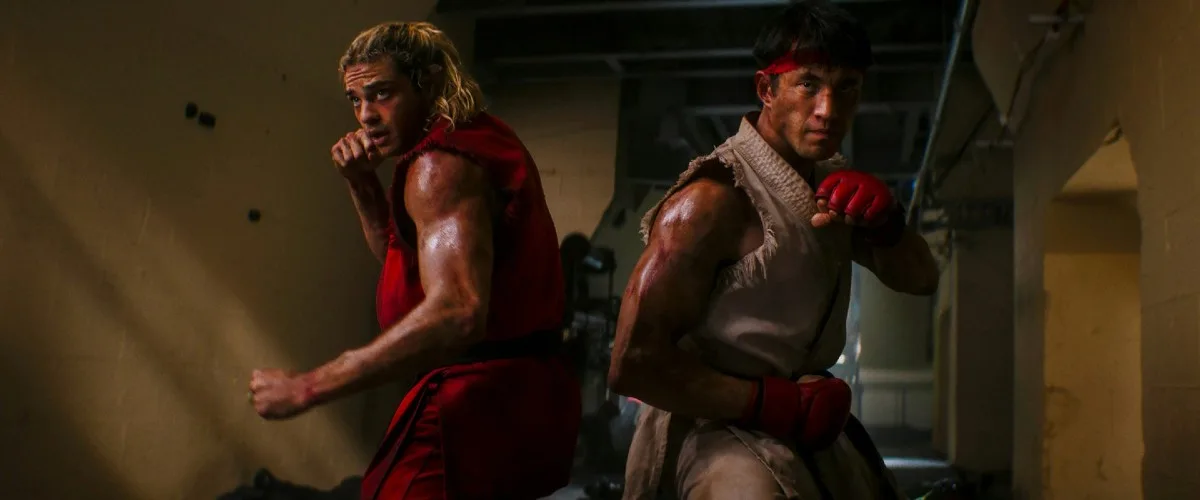
Perhaps the answer lies in unfair expectations, which the film itself sets up with a prologue in 1987, drawn in the anime style of something like the well-received “Street Fighter” OVAs from the 1990s; here we see the first World Warrior Tournament, in which expert martial artist Ryu (Andrew Koji) emerges victorious against Sagat, as his master Gouken (Don Lee) and best friend/brother in bulging arms Ken Masters (Noah Centineo) watch. But the victory is short-lived, as Gouken’s mysterious death shortly thereafter, and the rift Ryu’s victory creates, sends hin and Ken on their separate ways. While Ryu disappears into a life of monastic ramen-making, Ken launches himself into middlebrow celebrity as an MTV-famous martial artist slowly sliding into irrelevance.
But their paths cross again when Chun-Li (Callina Liang) assembles a group of fighters for the second World Warrior Tournament, hosted by shadowy dictator M. Bison (David Dastmalchian), and taps both Ken and Ryu on the shoulder. Ken is all too happy to seize his chance for glory; Ryu only reenters to save Ken from a horrible fate prophesied against the winner, courtesy of an evil demigod named Akuma (Roman Reigns). Meanwhile, Chun-Li is secretly on her own undercover mission against Bison and might need the boys’ help to pull it off.
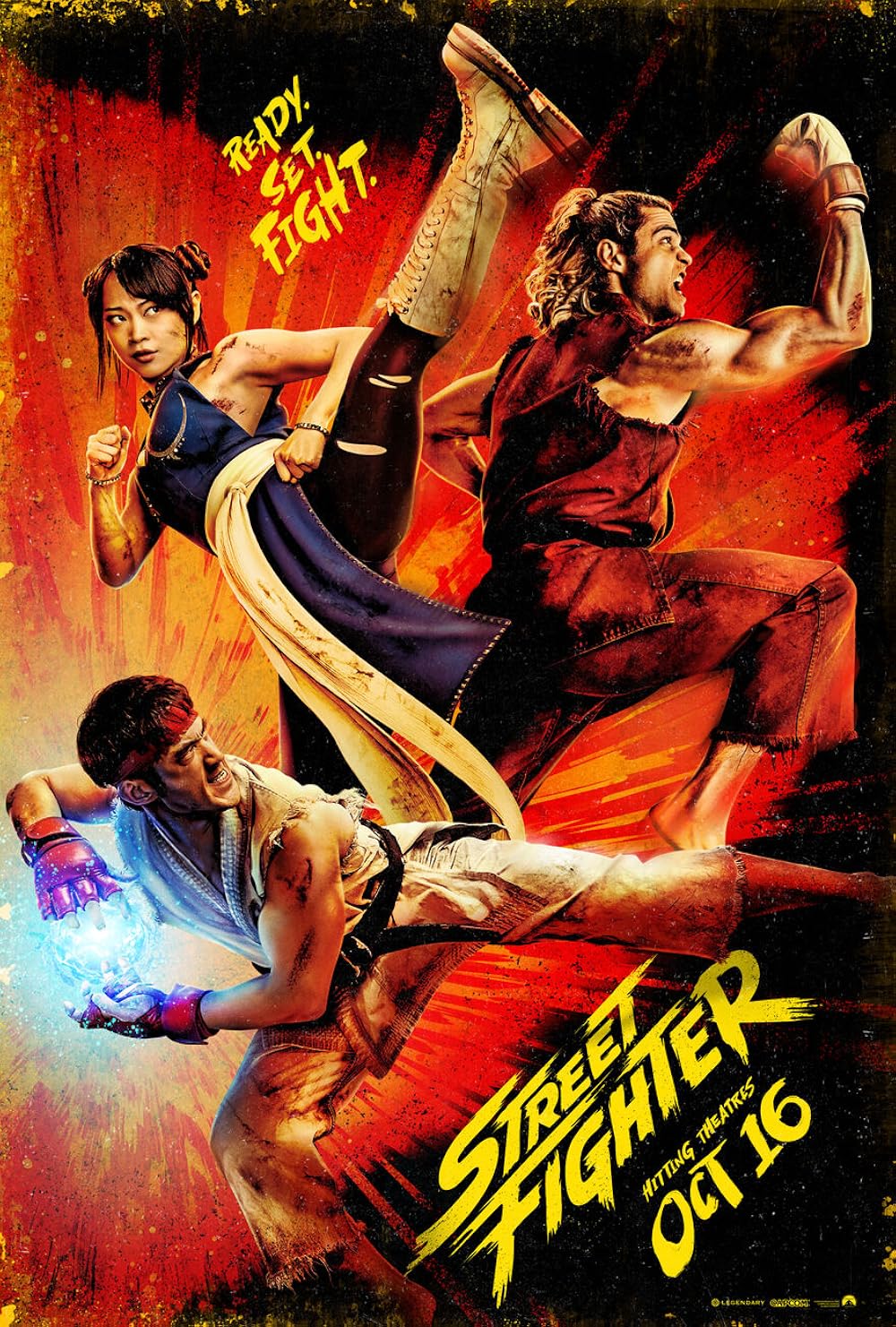
Much like the feuding brothers at the heart of the film, “Street Fighter” feels locked in its own messy battle of identity. First, the good: At its best, Sakurai understands the boisterous tone something like this needs to take, with a series of over-the-top characters throwing themselves wholeheartedly into every brightly-colored stitch of their game-accurate costumes (and, in Cody Rhodes’ case, haircut; Guile’s bleach-blonde ‘do is just as outsized as his personality, and his appearance is a highlight).
So many of the cast seem to innately get the rhythms of their characters, particularly Centineo’s Ken, who channels Kurt Russell in “Big Trouble in Little China” in his himbo haplessness, and Liang’s spit-and-vinegar Chun-Li. Dastmalchian is also deliciously reptilian even as he has to make lines that include phrases like “psycho power” work, and even Jason Momoa‘s blink-and-you’ll-miss-him appearance as the beastly Blanka carries surprising shades beyond the usual green.
The movie also looks way better than it should, with cinematographer Ken Seng soaking this thing in heaps of artificial film grain and ’80s-style neon lighting that accentuates each curve of every character’s anime-ready design. The fight choreography ain’t bad, either, making judicious use of the game’s special moves (complete with vocal callouts!) and occasionally involving the camera, too.
To borrow a phrase from a competing franchise, though, those elements hardly lead to a flawless victory. Sakurai and co-writer T.J. Fixman do their best to juggle the murderer’s row of game-famous characters, but “Street Fighter” is too overstuffed to give anyone besides Ken, Ryu, and a little bit of Chun-Li any oxygen. In addition to Guile and Blanka, we see glimpses of Dhalsim (Vidyut Jammwal), Cammy (Mel Jarnson), Balrog (Curtis “50 Cent” Jackson), Zangief (Olivier Richters), and Vega (Orville Peck, seemingly cast only because his on-stage persona also has a mask thing going for it), among others, but they don’t get much to do outside of one or two moments.
The tournament itself feels like an afterthought, with fights and forfeits happening offscreen so often that you wonder if there’s some mythical three-hour cut that would make the whole thing flow a bit smoother. Ryu is especially hurt by the helter-skelter script, which sidelines him in prison for much of the runtime; Koji’s deeply earnest performance suffers next to his more outrageous co-stars, making him feel like a wet blanket.
Instead, “Street Fighter” feels edited to within an inch of its life, speeding from one plot point and character thread to another with the speed of E. Honda’s (Hirooki Goto) hundred-hand slap. One moment, we’re ruminating on Ken and Ryu’s fragmented brotherly relationship; the next, Chun-Li chats with her simp Interpol partner (Kyle Mooney) about her revenge plot against Bison. Every so often, there’s a bar fight or another heart-to-heart where the characters just spit out their emotional baggage ad nauseam. If you like Andrew Schulz, get ready to see a lot of him: His BFF character Dan Hibiki feels like he gets the lion’s share of the screen time, and little of it adds anything besides giving Ken someone to talk to about his insecurities.
If I were generous, I’d chalk all this mess up to Sakurai emulating the goofy rhythms of a Saturday morning cartoon. But instead, the TikTok-quick cuts between beats and tones are reminiscent of another shaky martial arts flick from earlier this year: “Karate Kid: Legends.” What’s more, the punishing two-hour runtime ends in a flagrant call for a sequel, making the whole affair feel even more unfinished than it already was.
As much as Sakurai tries to mine some elder-millennial wistfulness by setting “Street Fighter” in the franchise’s 1993 peak (complete with Jolt Cola and Bugles product placement, and some needle-drops that feel wildly out of step: singing “What’s Up” in the ‘80s? Didn’t “Who Let the Dogs Out” come out in 2000?), it reads more like the ‘80s vaporwave nostalgia-bait stylings of something like 2015’s “Kung Fury.” Maybe if this does well enough, a sequel can iron out the wrinkles and give us a smoother tournament next time. Then again, we wanted that for “Mortal Kombat II,” and look how that turned out.