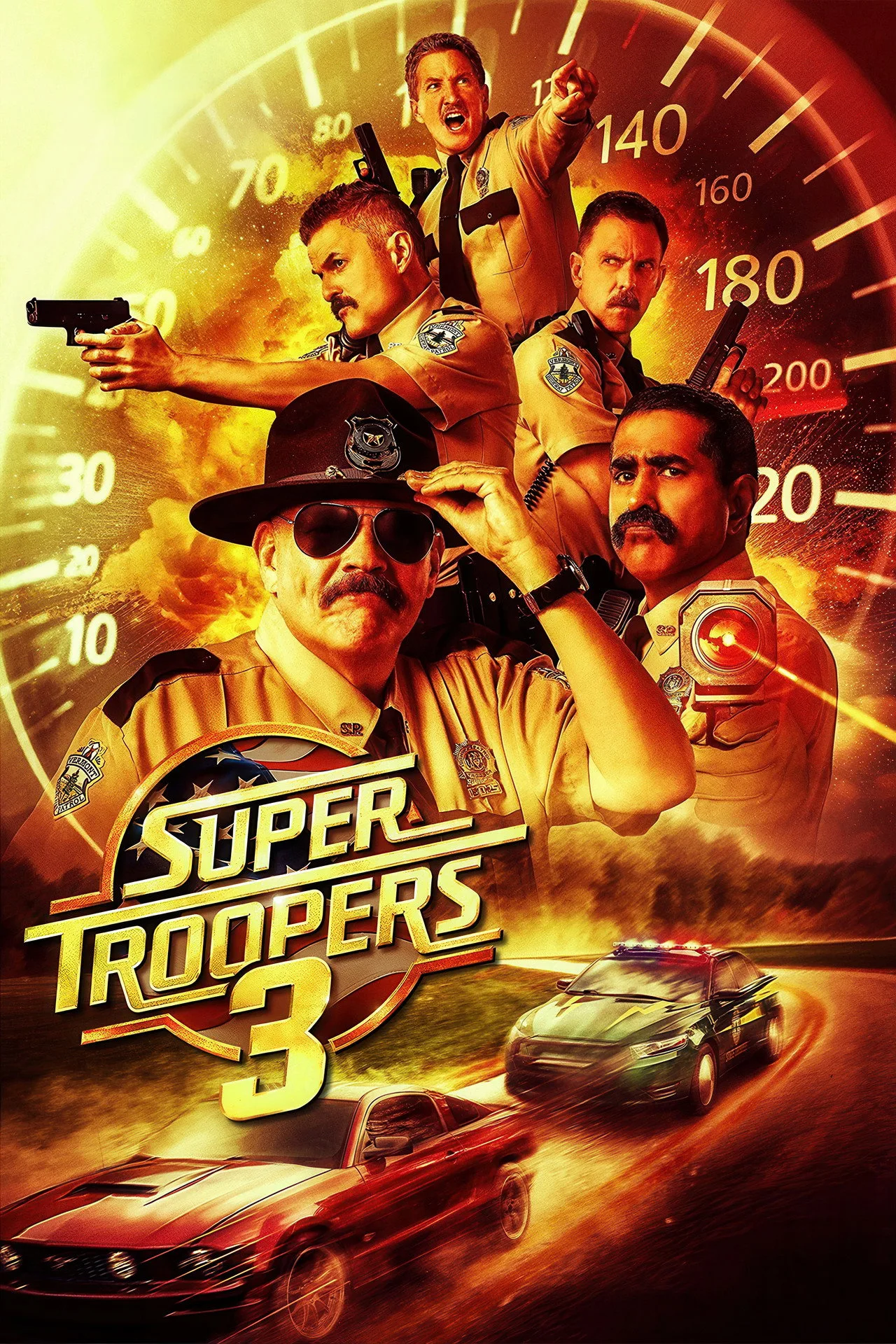

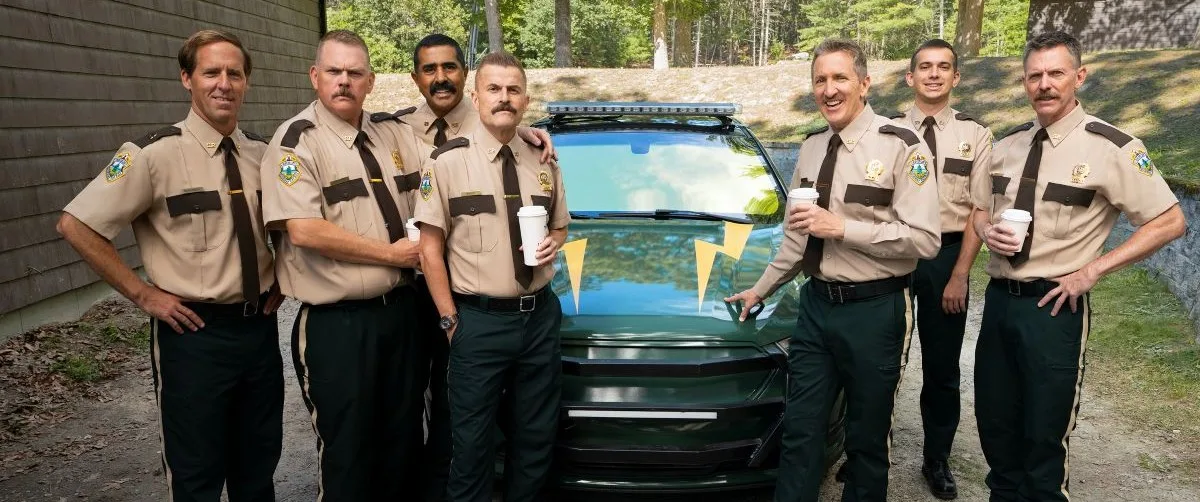
In “Super Troopers 3,” the usual suspects are all on hand, mustachioed, grinning, and eager to clown around. Most of the characters who were introduced in the original “Super Troopers,” released a quarter-century ago, are pushing 60 now, except for Captain John O’Hagan (Brian Cox), who is theoretically retired but comes around the station so often that you’d think he still worked there; when he offers to go down into the basement to take care of something, another character suggests they install a bed down there. The end product isn’t an exception to the rule that says weddings are what a series does when it can’t come up with a better idea. But that won’t matter to anyone who liked the other two, and between the cast’s still-sharp performance skills and their time-tested rapport, there are some laughs to be had here, and they manage to find surprising ways to stage bits you’ve seen many times before.
Take the mandatory cross-cultural wedding movie scene in which the bride or groom participates in one of their soon-to-be in-laws’ cultural traditions, and things go horribly wrong. In “Super Troopers 3,” the blessed event is an Indian wedding staged in Vermont. The groom is the loutish Vermont State Trooper Rodney “Rod” Farva (Kevin Heffernan). His bride is Sarita Makundan (Hannah Simone), the sister of his old colleague, Senior Trooper Arcot “Thorny” Ramathorn (series director Jay Chandrasekhar), who doesn’t want Farva to become his father-in-law and is desperate to stop the couple from getting to the altar.
The tradition is the Snake Ritual, where the groom has to reach into a wicker basket full of cobras and choose “his most compatible snake” for something called “the wedding cobra dance.” “Oh, no, we ended this tradition after the catastrophe in Madras,” warns the bride’s father, Dr. Makundan (Iqbal Theba). In reality, there is no such thing as a snake ritual, at least not in a traditional Indian wedding. The writers clearly invented it just so they could set up the moment where Thorny reassures Farva that the cobras writhing in the basket had their fangs removed at birth and are “basically tame,” and Farva finds out how wrong he is.
Here, as elsewhere, you can tell the scene exists because someone in the troupe came up with a potentially hilarious sight gag and everyone meticulously worked backward to build the narrative scaffolding that would allow it into the movie. The transparency of the mechanics is acknowledged in a way that makes it feel as if the movie looked you in the eye and said, “Just roll with me on this.”
Another instance occurs during the rehearsal dinner, a lobster feast. Farva takes the microphone and announces that he chose the food even though he’s allergic to lobster, to illustrate the fearlessness with which he’ll dive into marriage. The other guys mutter amongst themselves that they’ve never heard that before, the allergy thing. Then Farva says the allergy is ironic considering that his dad was a lobster boat captain. More murmuring; the guys have never heard this either. They are even more surprised when Farva starts speaking with a Boston-area accent, because they’ve definitely never heard that before. It’s all just an excuse to get us where we need to be, which is Farva defying Dr. Makudar’s warning that he could die of anaphylactic shock and tearing into a huge, still fully-shelled lobster like it’s corn on the cob.
The prologue lays the groundwork for the wedding, with Sarita’s car getting wrecked while she’s on the way to visit her brother and Farva, of all people, pulling her from the wreckage, sparking love at first sight. The rest of the movie alternates between the wedding storyline and a B-plot about some of the other troopers sitting out the wedding so they can break up a drug smuggling ring, which involves some machinations of its own, involving maple syrup, marijuana legalization, and the state’s decision to phase out gas-powered police cars and replace them with electric vehicles.
Unfortunately, despite intermittent bursts of wit, this one adds up to little, and subtracts time that would be better spent on the other storyline, which has a lot more weird and gross comedy in store, along with plenty of examples of the troupe’s philosophy towards possibly unacceptable jokes, which could be summed up as, “A comment isn’t racist if the character on the receiving end calls it out as racist and gets to deliver a killer comeback line.”
Let’s stop there, because this is probably one of those times where you decided whether or not to see it before you were finished reading the first couple of paragraphs of this review, perhaps even before you clicked on it. This is a shaggy, patched-together, but still likable movie, worth seeing in a theater if you’re a fan. That’s partly for the movie, and partly for the air conditioning.