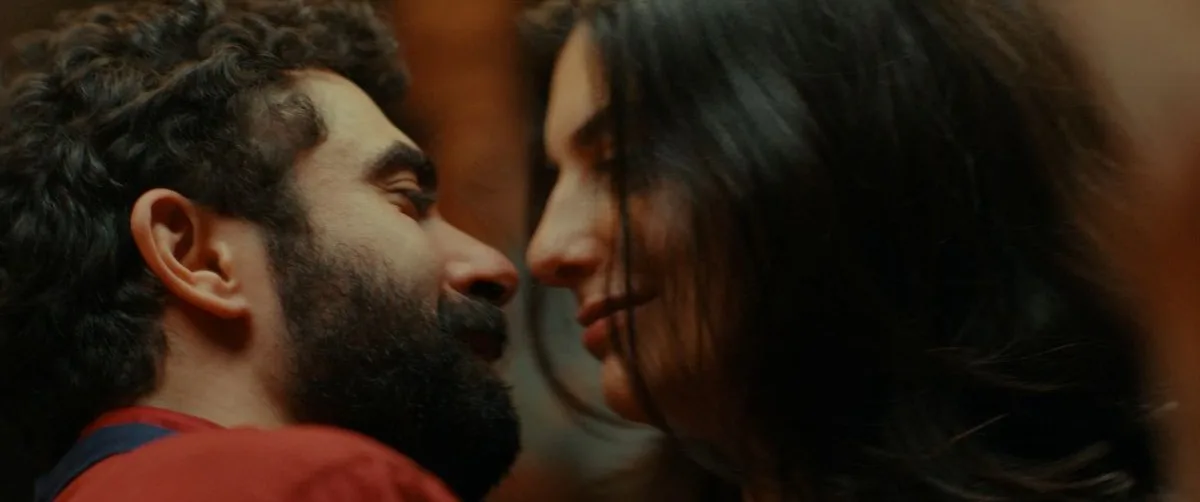
Recounting a social history through a love story is nothing new; some of you might remember “The Way We Were.” What makes such stories new is, of course, the context. “A Sad and Beautiful World” (no relation to the song by the rock band Sparklehorse, which was recently covered on record by the great Mavis Staples, who was scheduled to perform in New York, where I’m writing from, last week, but who couldn’t because the air was too filled with wildfire smoke for a singer—especially one now in her eighties—to breathe, speaking of the world being sad) directed by Cyril Aria, who co-wrote the script with Bane Fakih, places its couple in an often war-torn Beirut and depicts them through three decades of love and rockets.
The movie alternates between the past and present of Nino and Yasmina. Even as kids, Nino is a wide-eyed optimist while Yasmina is an often-cranky realist. (Their younger selves are Mohamed Farhat and Alex Choueiry respectively.) As they walk home from school, they argue: “You said something very wrong. That’s not how they make babies.” Nino’s parents are dead, and he speaks of them living on “The Island,” a paradisical place in his imagination. (We eventually learn that they’re victims of the war in Lebanon.)
As an adult, Nino is, among other things, a very bad driver—he crashes his car through a storefront window. As part of an amends, Nino, now a very proud restaurateur, offers a free meal to the woman and her family. The woman happens to be Yasmina’s mother. They stand face to face with each other in the dining room, and we don’t see them connect the dots; rather, we have a chortle as Nino goes back into the kitchen and tries to persuade his very stubborn chef to make changes to the meal as per the instructions of Yasmina’s sometimes pushy clan.
They catch up after dinner; Nino tells Yasmina of his plans to expand the business, and she says, “You know the country’s falling apart, right?” But they make time for each other; he teaches her a thing or two about cooking—she’s a professional administrator who’s trying to have her company transferred out of the country, which notion she suspends after falling for Nino. Soon they’re running through town together in blurry soft focus while the electronic score by Anthony Sayhoun thrums with vocoder brightness. On the night they first make love, Nino rhapsodizes, “We made it to the island,” while Yasmina, of course, is a little more businesslike: “Let’s leave it at that. Plain and simple.” (The island is more than verbally evoked; Aria films it, a sumptuous tropical paradise in a sky-blue sea, in one of the movie’s frequent touches of magical realism.)
But they won’t. They were meant to be! The movie’s opening shows us that the two were born on the same day, in the same hospital, during a rocket attack. And who can resist the big sad brown eyes of Hasan Akil as the adult Nino? Playing the grown-up Yasmina, Mounia Aki can turn on sultriness and sympathy and sternness, while we’re at it, with power to spare.
The movie reminded me of two classic songs, recorded a couple of years apart (although one was released several years after that): Talking Heads’ “Life During Wartime” and John Lennon’s “Grow Old with Me.” “The sound of gunfire/all through the distance/I’m getting used to it now,” David Byrne sings on the former. On the Lennon song, he lifts a bit from the Victorian poet Robert Browning: “Grow old along with me/the best is yet to be.” Nino and Yasmina embark on a life together in spite of the obstacles the sad world puts in front of them. (“This is no environment to raise a child,” she protests at one point. So guess what they do?) You root for them, and for the idea that love can make the world a little less sad and a little more beautiful.