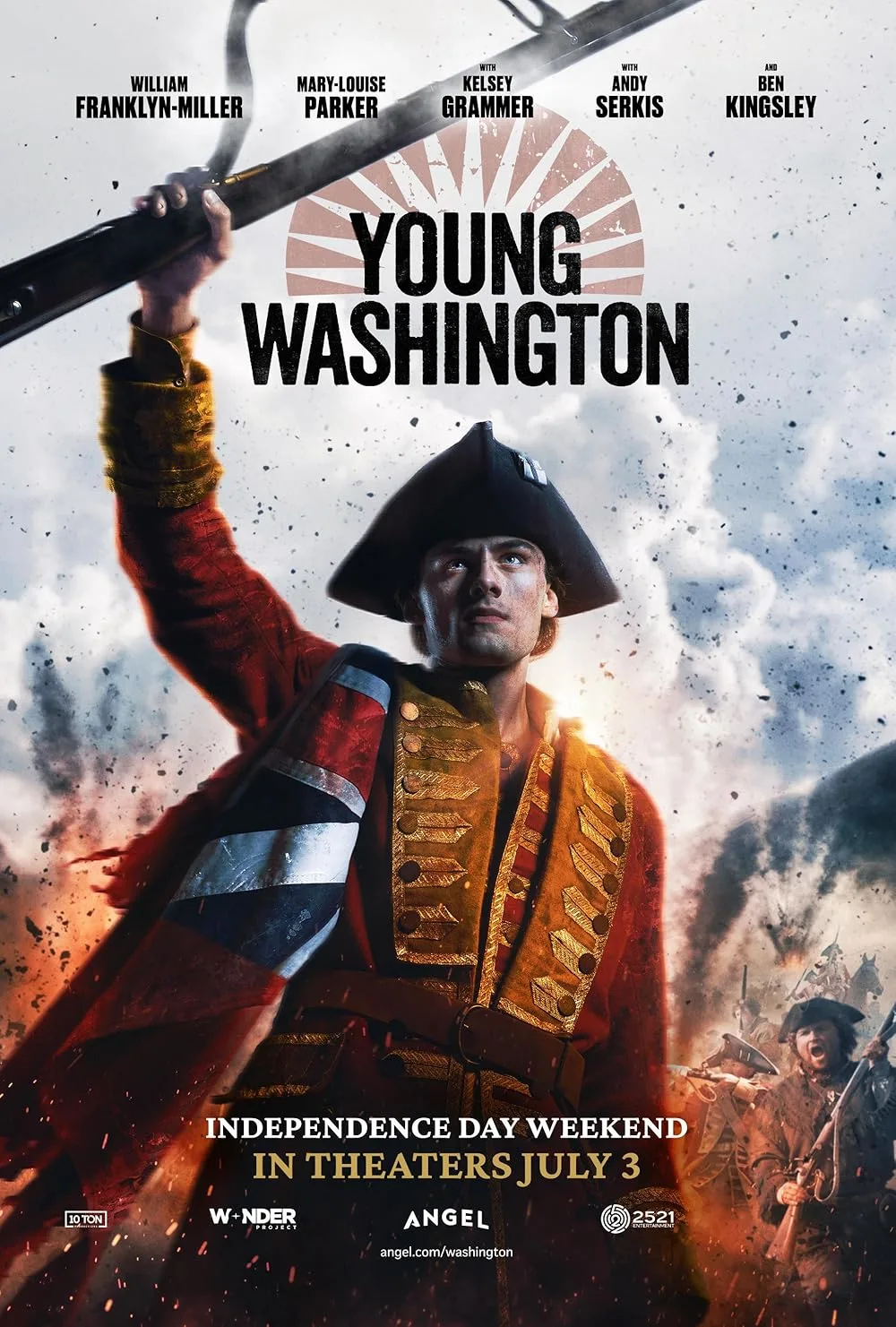

Releasing a film about a founding father of the United States during the country’s 250th birthday year is such a slam-dunk idea that it’s a wonder there haven’t been several already. Somehow, “Young Washington,” the latest release from faith-friendly, red state-targeted Angel Studios, has the field all to itself. Luckily, it’s good—not a knockout by any means, but a modern example of the sort of movie that used to be a permanent asset in Hollywood’s studio portfolio: a well-crafted but accessible biopic about the maturation of a person who helped shape the nation’s image of itself.
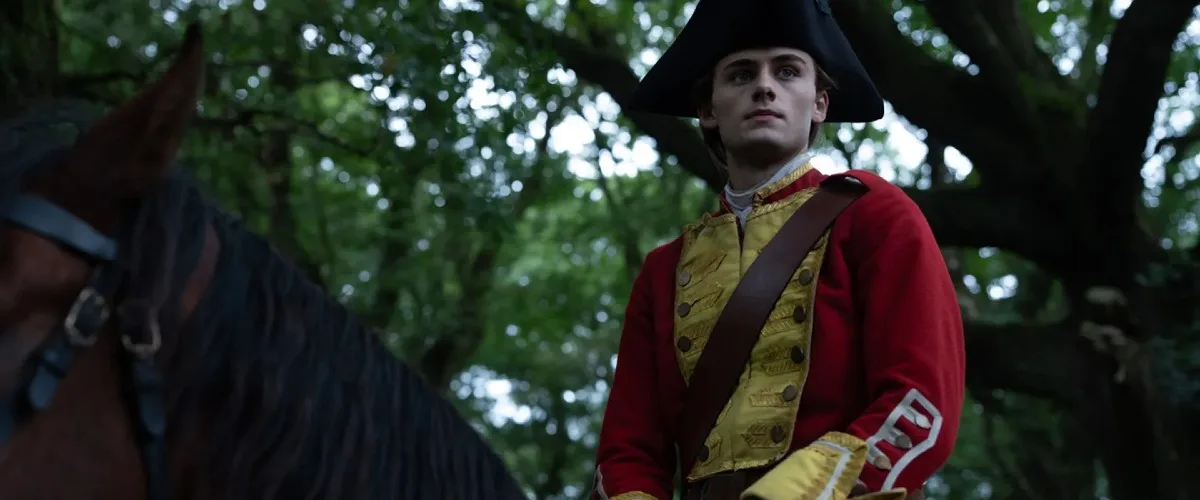
Jon Erwin’s drama is set during the French and Indian War, circa 1755. William Franklin-Miller, formerly of the CW series “Arrow,” plays George in his early twenties. Our hero grew up on a tenant farm owned by his widowed mother, Mary (Mary-Louise Parker), a tough woman whose energy has undercurrents of anger and desperation. He’s a good dude, this George—tall and athletic but never a bully; educated and eloquent but never a bore; confident but not cocky. He always wanted to be a commissioned officer in the British armed forces and leverage the position to become one of the landed gentry. But as soon as George commits to that journey, he learns that his low social standing and lack of connections are even bigger obstacles than he imagined.
Of course, he won’t give up, even though life has dealt him one bad hand after another. After losing his father at age 11, George was denied the chance to attend the local public school and make friends with people his own age because his mom needed him to work on the farm and help raise enough money to support the family and ten slaves. (More about the slaves in a moment.) As an adult, George tries to attend an elite party thrown by an important member of the local landed gentry, Lord Fairfax (Kelsey Grammer), who is related to George by marriage. He’s initially rebuffed by Fairfax’s doorman in an exchange that echoes the bone-dry humor of “Barry Lyndon.”
He finds his way into the party through the kitchen, and the slaves who work there help him find his way upstairs to Lord Fairfax’s office and charm him into setting up a meeting with Virginia’s Lieutenant Governor Robert Dinwiddie (Sir Ben Kingsley), whose default expression, boredom plus contempt, could’ve been sketched by the vicious 17th-century political caricaturist James Gilray. Dinwiddle is so disdainful of native-born farmers like the Washingtons that he repeatedly stresses that he’s making George an officer in the Colonial militia, not the British Army, and will consequently pay him less than British army wages. Washington says he’d rather do the Ohio expedition for free, a perfect example of his skill at standing up for himself without spoiling a great opportunity, and Dinwiddle dispatches him to the “Ohio Territories” to speak with the chief of the local Seneca tribe about a French fortress full of troops there, and how to get rid of it. (The Seneca were allies of the English only because they hated the French even more.)
It should be said here that this is a rare movie about history that doesn’t try to come up with excuses for opinions and practices now widely considered inexcusable. Nor does it stack the cast with characters meant to represent a modern, progressive point of view. It shows that Europeans were eager to move west and settle “unclaimed” territory occupied by Native Americans, but declines to make an editorial comment on whether that was a defensible ambition for George Washington or anyone else. “I think the Ohio (river) is a frontier,” George says brightly, “and it belongs to the one who tames it.”
The era’s ingrained class system and casual misogyny are also simply there, criticized by no one onscreen except Washington’s crush object, Sally Cary (Mia Rogers of HBO’s “The Sex Lives of College Girls”). Sally is depicted as a bright, strong-willed young woman who considers sexism both ludicrous and wrong. She hates attending her family’s grand balls and pretending to be happy being dangled as a prize for bachelors hoping to marry into money. But she deals with it because that’s the society she was born into. The script sands off some of life’s rough edges—we never get to see those slaves Mary mentioned—but not as many as you might’ve expected. The Seneca come around to George and even anoint him as a white savior figure in perhaps the only scene in “Young Washington” that tips its hand, indicating the political inclinations of its core audience. The movie’s attitude seems to be “this is who these people were, and it’s up to you to decide if they’re worthy of your interest.” That’s an honorable attitude for a storyteller to take, but only if the story delivers in a big way. This one falls short, but chalks up a few victories along the way.
Sam Erwin a regular producer for Angel Studios, directed and cowrote this film as well as 2023’s “Jesus Revolution.” He knows how to balance the need to clarify plot points and note relevant historical facts against the more urgent goal of holding the audience’s attention. This is a standard-length movie, two hours and change. It’s sincere, compelling, and economical in its storytelling.
It’s also part of a cinema subgenre of national myth-making, but with enough self-awareness not to come across as a reactionary lie. Scrape away the veneer of grit, and you recognize that it’s an inspirational historical fable, cinematic kin to John Ford’s beloved 1939 biopic “Young Mr. Lincoln” (which bore less relation to Lincoln’s actual life than this film does to Washington’s). Ford’s hero—played by Henry Fonda, who excelled at making nice guys exciting to watch—is tall, handsome, idealistic, persuasive, a good listener, and a badass who doesn’t advertise it. George is all that and more. What’s not to love?
The movie finds nobility in the idea of the United States of America, even as it concedes that certain catastrophic flaws were baked in. It borrows a bit of the tough-minded romanticism showcased in Michael Mann’s 1992 adaptation of “The Last of the Mohicans,” which is set in the same period but in a different part of the continent, as well as elements from films of similar temperament. And, incidentally, it does a brilliant job of conveying how vast the continent once seemed.
Consider Washington’s journey from Virginia to the Ohio Territories. It’s a six-hour drive today, but the movie shows what a commitment it was in the 1770s. You look at the panoramic images of mountains, fields, and bodies of water framed within Kristopher Kimlin’s desaturated, fine-grained panoramas and imagine how folks who’d spent most of their lives in one farmhouse must’ve felt sleeping atop beds of leaves on winter nights as wolves howled in the distance. There’s an action sequence of Washington and his expedition partner poling their way down a rushing, icy river that’s shot and acted so convincingly that you can feel the cold water seeping into your shoes.
Angel Studios’ website says it’s a place where “stories are more than entertainment” and that it only wants to “amplify the light.” The studio has released about twenty features by this point. It specializes in religious films (“King David,” “His Only Son,” “King of Kings”) and inspirational stories drawn from life, such as “Bonhoeffer,” about the anti-Nazi theologian; “From Darkness to Sight,” about Ming Wang, a Chinese immigrant turned Nashville eye surgeon with many famous clients in the country music community; and “The Sound of Freedom,” a vigilante thriller about child trafficking that unfortunately was also a biopic of Tim Ballard, the founder of a nonprofit rescue group who was later accused of sexual assault by 5 women.
The studio is also notorious for putting pitches at the end of every new release asking audiences to scan an onscreen QR code and “pay it forward” by purchasing tickets for friends and family and sending them electronically. This has been criticized as a way to inflate box office numbers: gift tickets are counted as part of the take even if the recipient didn’t show up for the screening.
Movies like “Young Washington” could help legitimize the studio. It has an agenda, to be sure; every historical movie does, especially ones that pretend they don’t. But it’s a solid piece of storytelling that respects its audience. We can always use more of those.