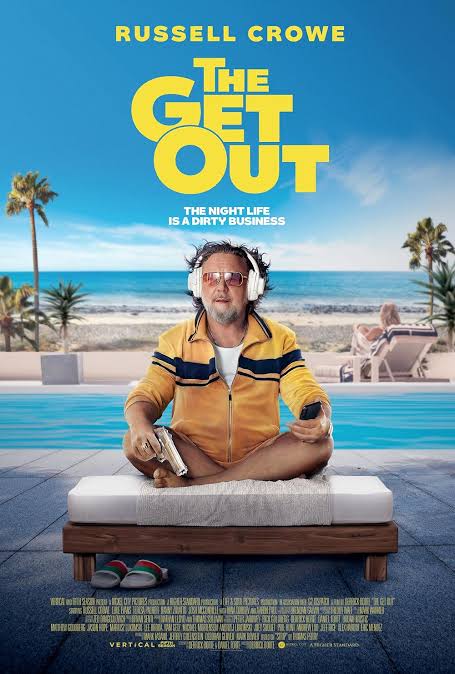

“The Get Out” is a mid-budget crime film with comedic overtones aimed primarily at an adult audience—the kind of thing that Hollywood used to regularly crank out once upon a time, but which hardly anyone seems to be doing these days, aside from Steven Soderbergh. It has a reasonably solid, if not blazingly original, premise, a more-than-solid cast, made with enough style to make for a reasonably diverting 100 minutes, but it never quite manages to be anything more than that. That said, it is certainly more engaging than a number of the bigger titles that have come out recently.
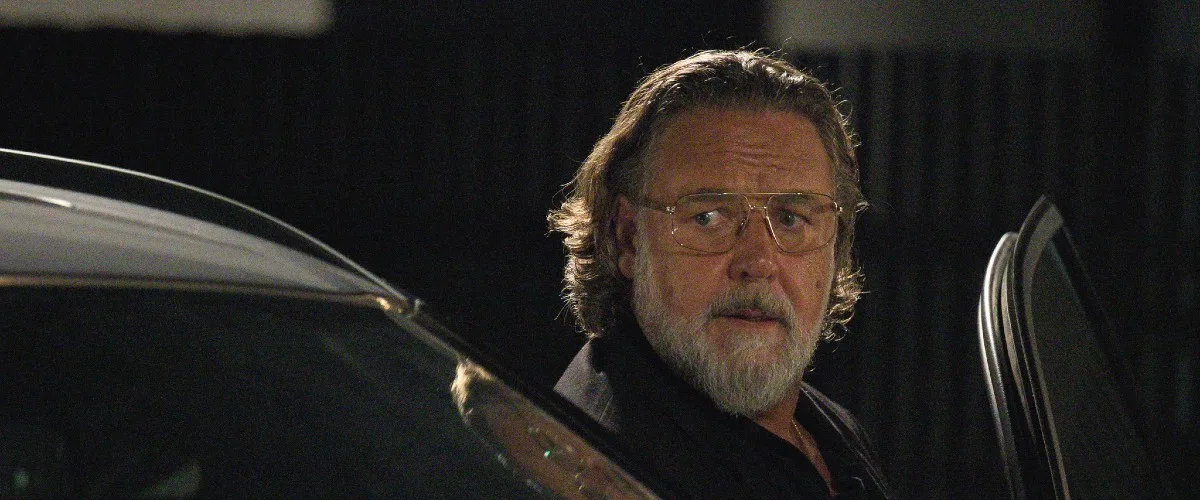
The film stars Russell Crowe as Manco Kapac, a man who relocated from Albania to Los Angeles years ago and now appears, at least on the surface, to be the epitome of an American success story writ large. He runs one of the city’s hottest nightclubs and has lots of money, a beautiful house, and an even more beautiful girlfriend in Sunny (Teresa Palmer). But things are not quite as ideal as they seem: We soon learn that the club also serves as a money-laundering operation for a Mexican crime cartel run by Rodriguez (Daniel Zovatto); the combination of spending late hours running the club and moving around Rodriguez’s money has taken its toll. They, combined with an overdose of Viagra, lay him low with a cardiac event while having sex with Sunny.
Advised to make considerable lifestyle changes for his health, Manco considers selling his club to a mysterious buyer, Joe (Luke Evans), and retiring to the good life on a faraway island. As anyone who has seen “Carlito’s Way” can attest, this is easier said than done; before long, Manco’s life becomes even more stressful when, while doing his regular money drop for Rodriguez one night, he is robbed of the entire $75,000.
We soon learn that the robbery was committed by Jeff (Aaron Paul), a community college professor with a side gig of surreptitiously writing admissions essays that guarantee students full rides to the colleges of their choice. Unfortunately, his last client didn’t get the scholarship, and his father, local cop Slosser (Josh McConville), has blackmailed him into robbing Manco in order to avoid prison.
To make things even more complicated for Jeff, when he skims some of the money and attempts to deposit it, bank teller Carrie (Nina Dobrev) knows exactly what he is doing and calls him out on it. The twist is that she happens to be a “Point Break” fanatic and demands to become his partner for his next job in order to bring her Johnny Utah fantasies to life, an opportunity that comes quickly enough when Slosser not only orders Jeff to do another job but insists that he hit Manco again during his next dropoff for Rodriguez.
The film is based on Thomas Perry’s 2010 novel “Strip,” and director Derrick Borte and co-writer Daniel Forte seem to have altered things considerably in their adaptation. The real influence here seems to be Elmore Leonard, the late and decidedly great crime writer who specialized in cheerfully convoluted narratives, delicious dialogue, and oddball characters, For years, Hollywood has long tried to translate Leonard’s work to the screen, leading to such misfires as “The Big Bounce” (1969), “Stick” (1985) and “Cat Chaser” (1989) before finally making it work in the ‘90s with such delights as “Get Shorty” (1995), “Jackie Brown” (1997) and “Out of Sight” (1998).
The problem with “The Get Out” is that it leans much closer to those earlier attempts that didn’t quite work than to the later ones where everything finally clicked. It juggles a number of subplots and a wide variety of characters that eventually converge, but while some of the scenes that develop from them work on an individual level, they never quite come together in a fully satisfying way. Likewise, the blending of the comedic elements with the darker material is not very smooth, as the story makes a largely awkward shift from the lighter tone of the first half to the more violent and bleaker stuff in the second. There is also an odd lack of any real tension to the proceedings—we never get a sense that Manco is in any real danger, either from the criminals, would-be and otherwise, in his orbit or from his bum ticker. As a result, once it all finally comes to an end, the movie doesn’t inspire anything more than a shrug.
And yet, there are some good things here, primarily the presence of Crowe, who previously worked with Borte on the pandemic-era hit “Unhinged.” This is not a performance destined for a place of prominence in any upcoming Lifetime Achievement Award clip packages, but he is clearly having fun going through his paces and busting out yet another dubious accent. (Put it this way: if you enjoyed his equally loopy turns in “The Pope’s Exorcist” and “Kraven the Hunter,” you’ll dig what he’s doing here.) The other performances are good as well—Paul and Dobrev strike enough sparks in their scenes together to make you wish that they could have been spun off into their own separate film.
Ultimately, “The Get Out” doesn’t quite manage to work as either a crime film or as a goof on one. And yet, it does have a certain charm and a low-key attitude, at least for a while. It brings to mind other crime-and-humor mergers such as “The Hot Rock” (1972), “Slither” (1973), “The Pope of Greenwich Village” (1984), and “The Whole Nine Yards” (2000). Anyone who likes those quirky gems might find things to appreciate about this one as well.