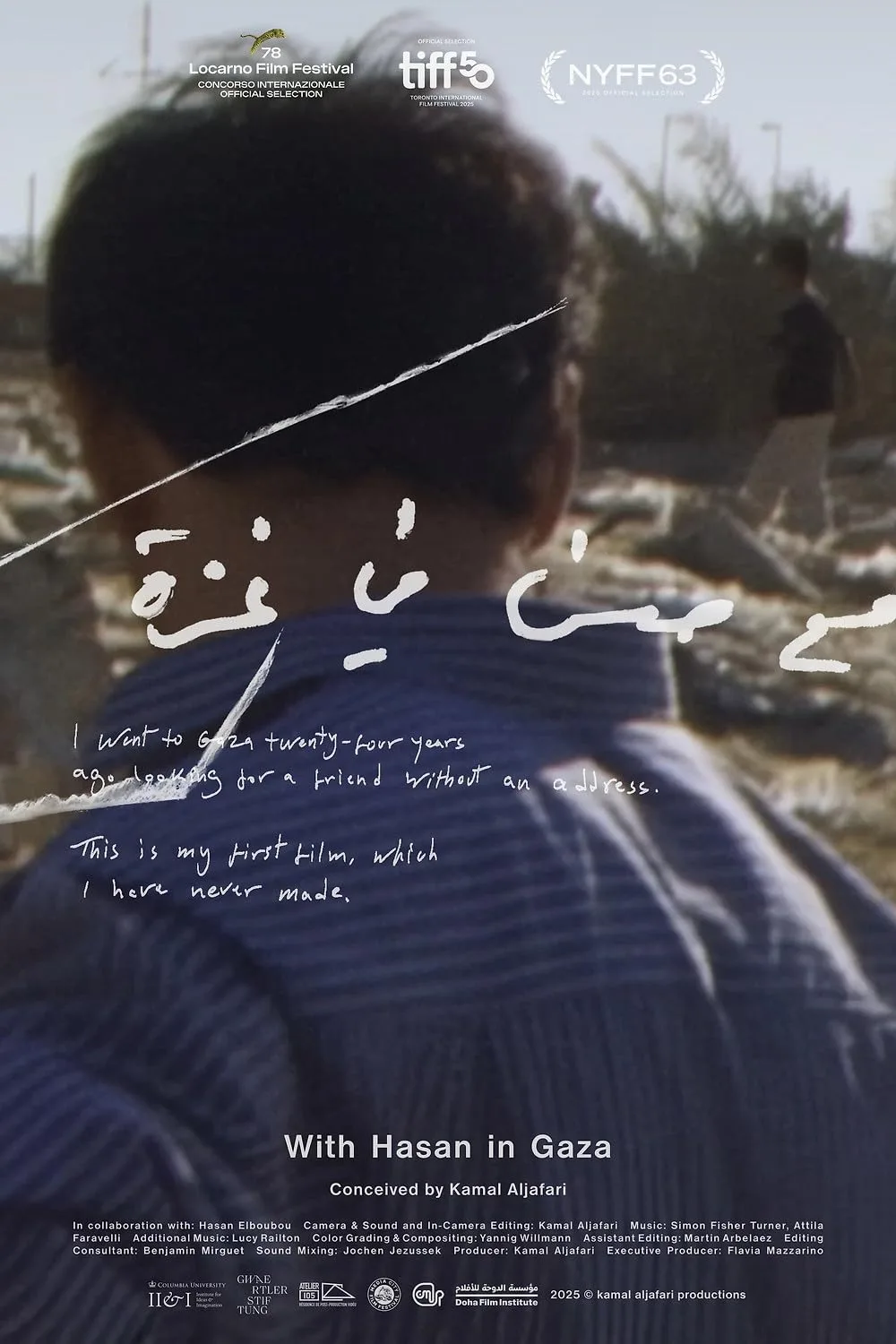

Like Berlin-based Palestinian filmmaker Kamal Aljafari’s previous experimental film, “A Fidai Film” (2024), his new documentary, “With Hasan in Gaza,” is an exercise in archive and memory. In that film, Aljafari explored what happens to a people when their archives are taken from them and their visual proof of their past is systematically obliterated. In this film, Aljafari’s own forgotten work, made in collaboration with Hasan Elboubou, becomes its own archive of the past.
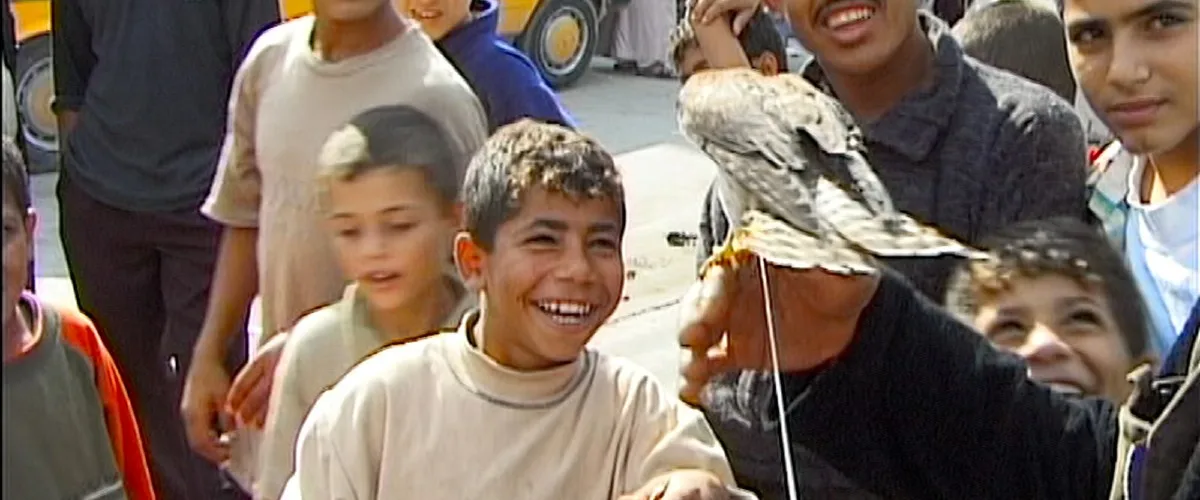
Filmed in Gaza over two days in November of 2001, the footage featured in this film remained locked on three MiniDV tapes for two decades, awaiting a reclamation that proves to be a powerful and poetic time capsule of a people and a place. Aljafari was visiting Gaza a year into the Second Intifada, searching for a friend he’d met while wrongfully imprisoned as a teenager during the First Intifada in the late 1980s. Without an address, Aljafari, along with his guide and sometimes cameraperson Hasan, drives across Gaza north-to-south, taking in the everyday life of ordinary citizens living under occupation, finding as much joy under the rubble as they do sorrow.
Less a distinct narrative than a city symphony of a place whose streets and buildings and homes and universities have since been destroyed. This is not a work of nostalgia, but rather an act of witnessing and a proof of life for those who are no longer with us. As I watched the doc, I couldn’t help but wonder how many of the children who asked the filmmaker to film them “so I have a photograph of myself” had been killed by occupying forces in the ensuing years? How many of the families, sometimes as many as several dozen, all crammed in the same ramshackle homes, had been wiped out by a single bomb, like Fatma Hassona and her family?
While traveling past occupying forces, a driver tells Aljafari to hide his camera, in case the Israeli soldiers mistake it for a weapon. As we’ve seen in the documentaries “In The Image” (2014) and the recent Oscar winner “No Other Land,” sometimes the camera itself is a weapon of resistance, one that can document the violence of occupation and broadcast it to the world. Here, however, like Emad Burnat’s “Five Broken Cameras” (2011), Aljafari does not just use his camera to capture occupier and settler violence (including the devastating aftermath of a housing complex that was shelled), but rather the joyful moments shared by families despite this ongoing violence.
As when, at the beach, Hasan films while Aljafari meets with a father who had recently been released from prison after eight years. “I’m trying to make up for the care they lost during my imprisonment,” the father shares as he introduces us to his kids. Their wide, beautiful smiles fill the frame as they play with a fish they found in the sea, clamoring to show it to their father and then to the camera.
Earlier, the film began with a black screen as the words of a poem appear: “Like the rain of my country in December, our blood falls in abundance, and like the every-flowing Jordan river, our blood flows freely, in the great cities of our world, in every corner of our homeland, our blood is spilled” While this undercurrent of death courses through the whole film, by contrasting it with scenes like the one described above, Aljafari crafts a film about resilience and about love. A film that centers on community and family, finding strength in this communion despite all the horrors that must be endured.
Much of the film is shot from moving vehicles, and the country is seen through its roadways, as well as the inequality that they represent. As they move southward, roadblocks increase, as do the walls erected to protect settlers who have been encroaching on the land of the Gazans, building their new homes on stretches of land that are already overcrowded by the two million Palestinians that call the strip home, many of whom are refugees who have been living in camps since the Nakba in 1948.
The many checkpoints are there, one driver says, “to protect the settlers,” but also “so that we cannot move freely.” Towards the end of the film, Aljafari recalls his youth in Jaffa, where he would see Gazans looking for work. Soon, the Gazans disappeared after being banned from leaving the strip. After this brief trip, Aljafari could no longer even visit his relatives in Gaza, as the place became sealed, no one allowed in, no one allowed out. He compares the strip becoming what he calls “the largest prison in the world” with his own brief imprisonment as a teenager all those decades ago.
In both cases, the goal is to restrict movement, to dehumanize, to keep people from their families, and to strip them of their memories. But through the power of archives like these MiniDV tapes, there is a path towards resistance, a path towards a shared memory of both the good and the bad.
The film ends with a simple sentence, “I remember.” And so can we all, thanks to those filmmakers, songwriters, and artists who use their lives to craft archives of Palestinian life that can be passed down through generations, even as those whose lives make up those archives are lost to the sands of time.