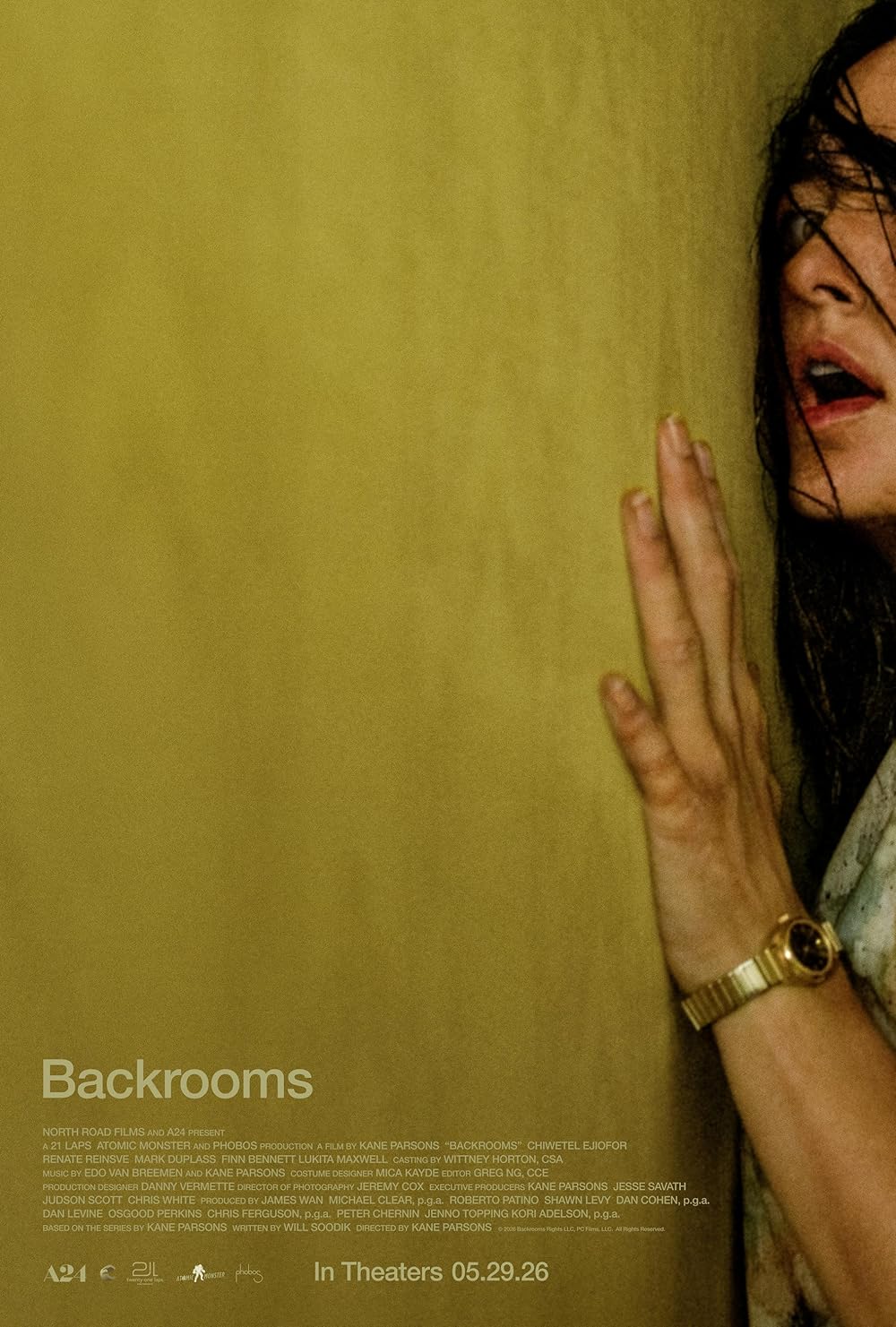

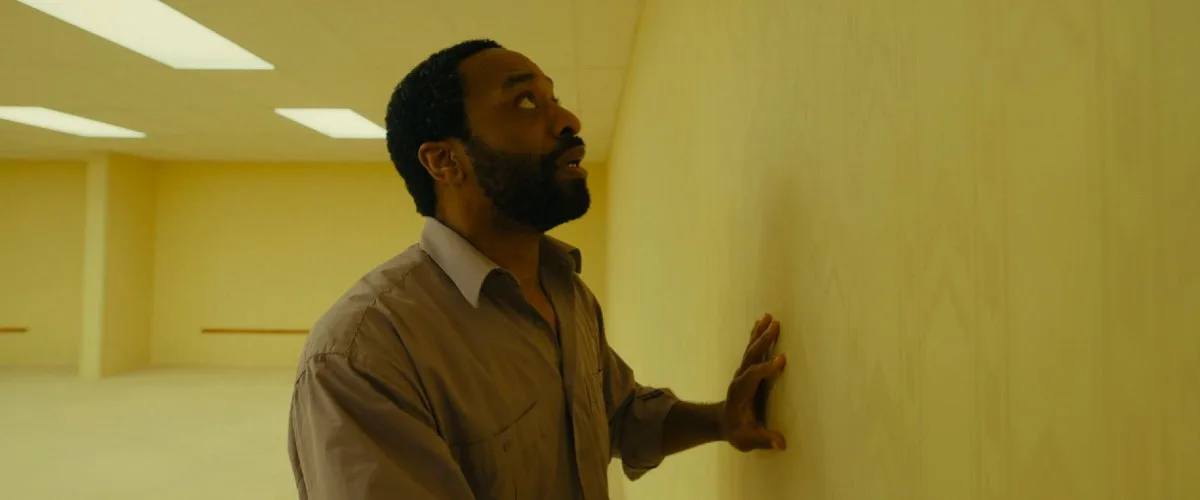
Halfway through this horror hit, Clark (Chiwetel Ejiofor) explains the concept of “Backrooms” by saying it’s like describing a dog to someone and then asking them to draw it. They’d get the basics right, but the details would be off. And probably in a deeply unsettling way. This “imagined dog” manifests itself in Kane Parsons’ highly anticipated film, one based on the creepypasta that spawned his own YouTube series and clearly inspired by everything from the never-ending hallways of “Severance” to The Black Lodge in “Twin Peaks.” With its effective visual language and strongly directed performances, “Backrooms” is more promising than anything else, a sign of what could be built within this subgenre and what its creator could make in the future.
To say Clark is in a rut would be an understatement. In 1990, Santa Clara, Clark manages a furniture store with a mascot that’s kind of a pirate and kind of a sultan, but definitely has no customers. He’s sleeping at the store, drinking straight from the bottle, and complaining to his therapist, Dr. Mary Kline (Renate Reinsve), about just about everything. He’s one of those guys who blames everyone but himself for the life rut in which he resides; he spends most of his sessions complaining about his ex-wife. An underdeveloped root of Will Soodik’s screenplay is that Clark, like so many people, is already stuck in his own never-ending liminal space, not really living but not dead either.
So what are “Backrooms”? Originating on 4chan, it’s the term for a space that one reaches that’s basically adjacent to reality. They’re often portrayed as empty office spaces with the oppressive hum of fluorescent lights adding to the creep factor. At first, they may just seem like mundane, empty hallways and rooms, but then they often take on an M.C. Escher quality, with impossible spaces, doors in the wrong places, and miles of unoccupied real estate. And what’s worse than being alone in one of these spaces? Not being alone.
Clark finds himself in the Backrooms when he clips through a wall in the basement of his furniture store. At first, he’s almost excited by the discovery, mapping it out for Mary and even convincing an employee named Kat (Lukita Maxwell) and her boyfriend, Bobby (Finn Bennett), to bring a video recorder to document it. Of course, that doesn’t go well, but Soodik and Parsons are careful not to turn “Backrooms” into a predictable jump-scare experience. Parsons and cinematographer Jeremy Cox play not only with some smartly staged POVs but also with visual language, shooting an important section of the film through Bobby’s grainy VHS lens. And they stage a climactic chase scene remarkably well, making even this expansive space feel threatening and oppressive.
With characters who often remain silent as they explore these impossible spaces, sound design and score become essential to the success of “Backrooms.” Parsons co-scored the film with Edo Van Breemen, layering in atmospheric compositions that fit the material without drawing attention to the melodies. It’s an insidious score, one that almost sounds as if it emerged from the Backrooms itself, just underneath that recognizable hum of the soul-draining lights.
While “Backrooms” finds some twisted imagery along the way, it does have a bad habit of trying to explain itself more than it should. Comparisons to “Eraserhead” and “Skinamarink” have greeted the film, and the truth is, those are much weirder than a movie that does an excellent job of showing us someone else’s nightmare without quite making it feel like one of our own. There’s a difference. While Parsons could get there with a series he’s already revealed he hopes to continue, “Backrooms” sometimes feels like it lacks the confidence to get as terrifyingly dreamlike as it could have been.
Parsons is helped a great deal by casting two Oscar nominees (and a nice supporting turn from Mark Duplass doesn’t hurt). Ejiofor and Reinsve have similar strengths in that they both succeed at their most important task here: Being immediate enough that we believe their situation. Importantly, they don’t resort to hammy “horror movie acting,” often responding with shocked silence, letting us imagine what’s going on in their heads and how fast their hearts are racing.
Horror is having quite an impressive moment in 2026, with the remarkable box-office success of “Obsession” and critical love for “28 Years Later: The Bone Temple,” “Send Help,” “Hokum,” and more. Someone asked me recently why horror is so successful while other genres fail, and other than its typically low budget, my answer was that it taps into that shared communal experience we still need the theater to truly feel: The moment when a room full of people feels the hair stand up on the back of their neck at the same exact time can be pretty special. The best thing about this movie is how much it feels like Kane Parsons is going to create a bunch of those moments in the future.