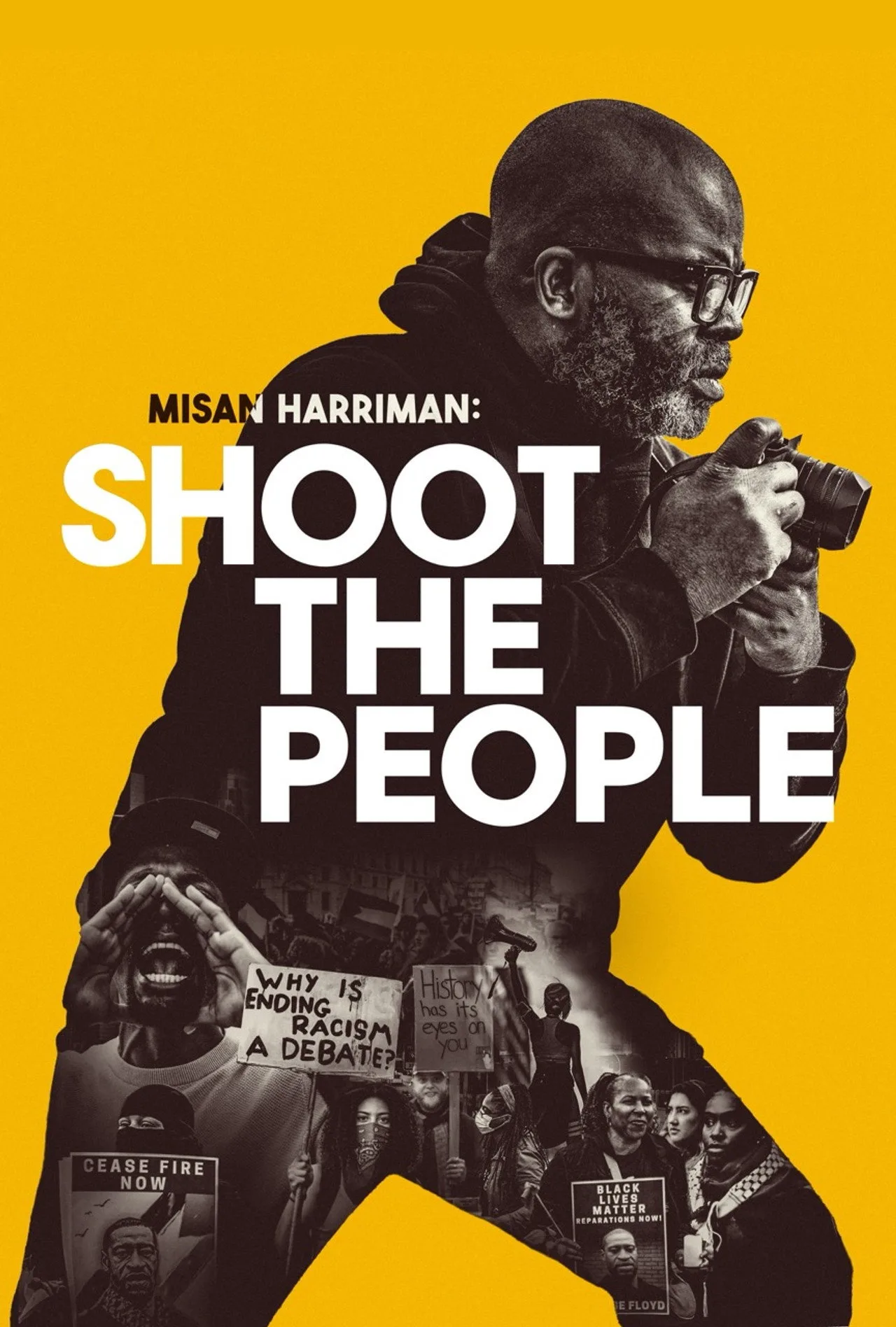

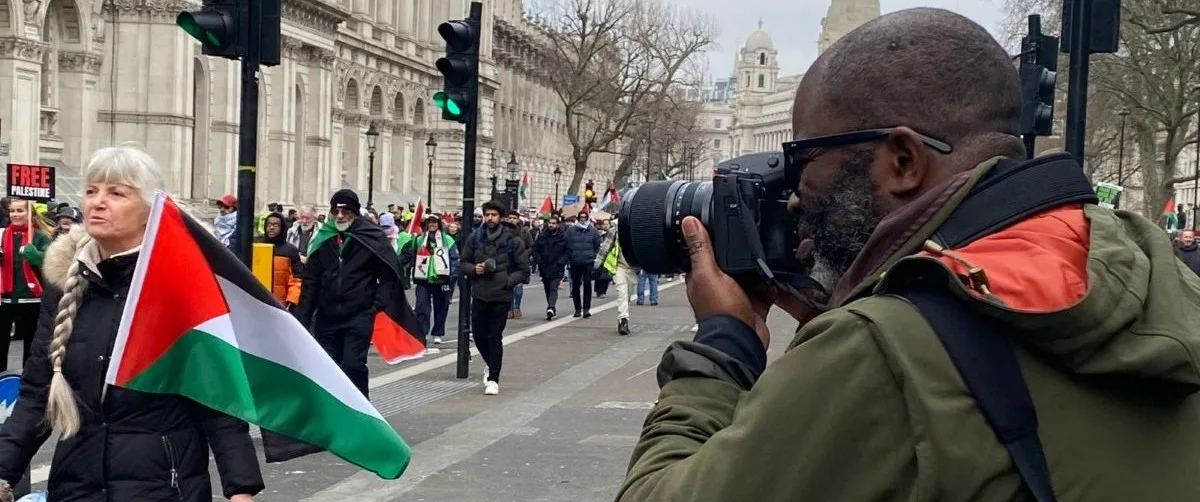
Into a sea of photos from protests around the world, “Shoot the People” dives deep from the jump, immersing us in a reminder of very recent histories. The social-justice-oriented documentary follows photographer Misan Harriman on his travels. Simultaneously, the movie memorializes the political and cultural events that he attends. Along the way, there are reflective vignettes in which he elaborates on his career, all the while the film attempts to emulate Harriman’s lens, serving as an extension of his purpose in “observing the human condition.”
Director and producer Andy Mandy-Castle’s thesis for his documentary is three-pronged: giving Harriman a platform for his artistic practice, documenting his rise as an Oscar-nominated filmmaker (a live-action short, “The After”), and demonstrating how protest creates connectivity across continents. Beginning in the U.K., “Shoot the People” grounds us in Harriman’s home and the place where he began picking up a camera to capture the world around him. His crisp, shadowed black-and-white photos are peppered amongst archival clips. The colorless stills settle in our minds while social media and news videos give us context. The film benefits from Harriman’s portfolio, which assembles a plot shaped by the cast and crew’s collective compassion. As more movies are made about the pandemic years, it’s still jarring to see how essential the vertical, phone-sized videos are in recounting what happened.
Strategically, “Shoot the People” selects parts of Harriman’s work that amplify censored issues, like those protesting for Palestine’s freedom. It then bounces from capturing the ongoing apartheid in South Africa, to the Black Lives Matter Movement across the United States. Along the way, Harriman speaks with many people, learning as he goes. Community members, historians, activists, and civic leaders, like Martin Luther King III, are all key players throughout the film. These conversations and interactions with Harriman allow him and Mandy-Castle to co-opt their agendas while also developing the film’s narrative and Harriman’s work.
Overlaid narrative audio from news segments mirrors journalistic reporting, contributing to the film’s sobering tone and its desire to preserve these moments. Alongside highlights of Harriman’s life, such as being the first Black photographer to shoot the cover of British Vogue, we endure devastating news of global injustices. Conflictingly so, we celebrate the work of the man while pretending that we, too, are doing the work by bearing witness from the comfort of being behind a screen.
However, Mandy-Castle does not shy away from asking Harriman critical yet carefully curated questions about how his growing fame affects his place among the people and places he collects in his photos. In response, Harriman places some blame on his famous peers who do not take action, yet, like many working social-justice artists, he notes that proximity is important, and he proceeds to pose on the Oscar red carpet while claiming he’d prefer to be shooting the protests against The Academy. The audience is appeased by seeing the cognitive disconnect that many of us experience (to varying degrees) and by understanding why he does it. Should we not celebrate personal accomplishments while the world burns? Harriman, a Black boy from Nigeria who is achieving his wildest dreams, exemplifies how that duality is possible, but showing up and doing the work can never cease.
“Shoot the People” thrives on its visual storytelling, amplified by composer Nik Ammar’s score, which is string-forward, strumming our inner fire to help us fight harder for change. Disappointingly, as many subjects of the film call out, little change has been brought about, despite the global consensus that the compassionate party is in the majority. Harriman states he is “making sure empathy does not leave the room” by being physically present and through the photographs that he hopes will live on. In one of the film’s final montages, a snippet of Nicholas Britell’s “Agape” (from “If Beale Street Could Talk”) conveys a sense of brighter days ahead, and its inclusion demonstrates a stunning understanding of exactly what feeling that song evokes.
With “Shoot the People,” Watermelon Pictures, the distributor behind the acclaimed film “The Voice of Hind Rajab” and many other Palestinian stories, succeeds in presenting truths that meet the moment, ensuring marginalized voices are heard around the world. Interestingly, this particular documentary is perhaps their most Western-centered. In doing so, the movie offers a reframing for those who may not yet understand the universal reckoning occurring right now, with wanting a better world and what it will take to create that. As Harriman and the filmmakers produce permanent pieces of this movement in real time, with a clear desire to reinvigorate hope, it will be interesting to see how it crystallizes or crumbles in the future.