

The director of one of the best horror films of the 2020s, “Oddity,” has returned with a new haunter that traffics in similar themes but never feels like a retread of that film’s spectral ground. Yes, the excellent “Hokum” also plays with folk horror and the idea that real-world violence can unearth a supernatural reckoning, but it firmly stands on its own. Damian McCarthy’s first project with Neon checks so many personal boxes, using largely a single setting to tell a story that seems inspired by touchstones like “The Shining” and “The Innocents,” but also affirms its writer/director as one of the most interesting voices in the genre today. If “Caveat” and “Oddity” were indicators of a strong future by their creator, “Hokum” is the fulfillment of that promise.
Adam Scott does his best film work to date as a famous horror writer named Ohm Bauman, a lead who seems to be modeled on Stephen King, or at least one of his many troubled author protagonists. Bauman travels to a remote hotel in Ireland, where his mother and father went for their honeymoon, to scatter their ashes near a redwood tree captured in a photo of his beloved mom from those days. It’s revealed that Ohm’s mother died years ago, a victim of a tragic accident that Bauman needs to exorcise as much as the demons he will encounter. His dad fell into alcoholic grief, making Ohm’s life miserable. One of many wonderful small touches in McCarthy’s production comes when Ohm delicately places his mother’s ashes under the tree and pours out dad’s remains like it’s an unwanted obligation.
The Irish hotel is populated by quirky personalities, including a woman named Fiona (Florence Ordesh), who interacts with Ohm just before she goes missing after a Halloween party. Due to another interaction that won’t be spoiled (as well as somewhat trying to save the mother he couldn’t), the irascible Ohm feels attached to Fiona and endeavors to find her, even as most of the men in the area, including the manager of the hotel, seem to have given up. When Ohm suggests that perhaps they search the locked-off Honeymoon Suite, everyone insists that she can’t be in there. After all, that’s where the witch lives.
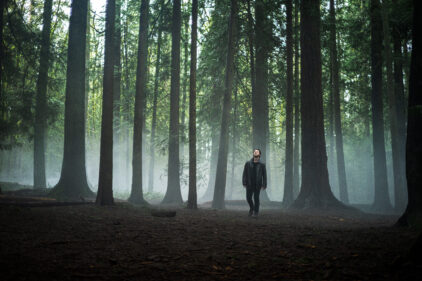
“Hokum” is a deceptively simple piece of storytelling: An angry, alcoholic writer who basically travels to Hell to learn the truth about a missing woman. But that doesn’t detract from the remarkable craft displayed by McCarthy and his team. First, there’s Colm Hogan’s mesmerizing cinematography. The D.P. of “Oddity” knows how to use framing, negative space, and shadows in a manner that’s never showy, echoing the inspirations of this film without ever cribbing from them directly. “Hokum” has a subtly mesmerizing visual language as the camera often stays locked in Ohm’s POV, forcing us to wonder what exactly is in the dark in front of him as much as he is. There are sequences in this that are among the scariest you will see all year, but other than a few jump scares, they’re not aggressive in their presentation, understanding that getting under your skin is just as effective as shocking you out of your seat. “Hokum” isn’t a slow burn, but one of its strengths is how it slides in and out of shocking images and dread-filled atmosphere.
The key to that flow is in how McCarthy works with editor Brian Philip Davis to give “Hokum” its rhythms. We’re prone to praising editing often as “most” instead of best, usually looking at action blockbusters as the peak of the form, but the art of editing a horror film is essential to its success. This one glides around haunted chambers and terrifying corridors, knowing exactly when to force us into Ohm’s POV and when to loosen the tension. It rarely leaves a small number of sets, so its construction becomes essential to its success; this is a perfectly designed haunted dollhouse of a piece.
It helps to have arguably Scott’s best work to date. He’s an actor who sometimes seems better in silence than with dialogue, able to sell Ohm’s rising fear, deep regret, and even his annoying personality without worrying about being likable. Ohm is a dick, a guy who literally burns someone asking him for career advice. Scott and McCarthy’s refusal to turn Ohm into a traditionally likable horror hero helps sell the realism of the piece, as we start to wonder if maybe this guy doesn’t deserve a little trip to Hell. It feels like Ohm wonders, too.
There is a new generation of horror filmmakers with growing fan bases, including Oz Perkins and Zach Cregger, among others. Every few years, a new crop of horror voices rises out of the choir to take center stage, but just as many end up sliding back into the dark again after running out of ideas. These predictions are wrong as often as they’re right, but it feels like there’s something truly special in McCarthy’s work, a classical sense of the genre that somehow never feels dated. He doesn’t present something overly familiar as much as build on a foundation to present something terrifyingly new, blending his love of folk history with a rich sense of character, space, and nearly biblical justice.
The title of his latest feels almost like a challenge to those who would dismiss ghost stories as little more than fables shared around an Irish fireplace. Tales of Irish witches have been told for generations not just to scare people but because they tap into something true. “Hokum” rises above so many films like it because it takes its character’s plight seriously, never winking at the audience, even as the impossible happens. Dismiss the folk tales at your own peril.
This review was filed from the SXSW Film Festival. It opens on May 1, 2026.