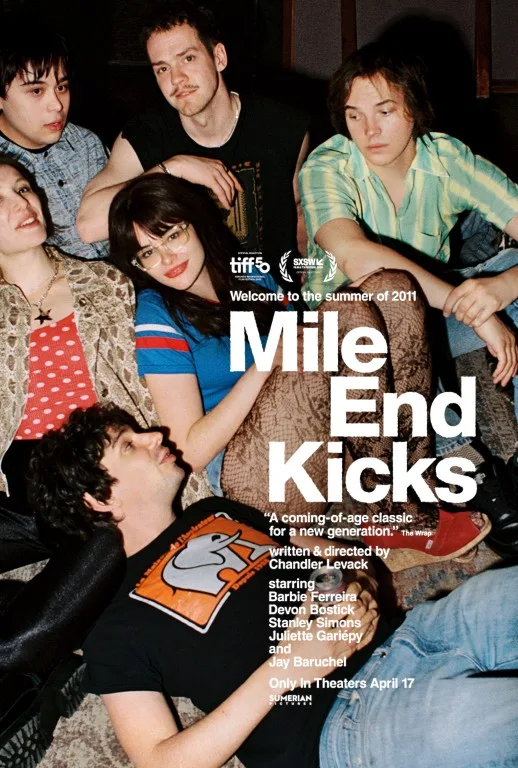
A movie that will soothe the hearts of every single female journalist who, on various occasions, felt pushed to the periphery while bearded dudes in plaid tossed around their self-satisfied takes, “Mile End Kicks” instantly offers a breath of fresh air about what it means to pursue one’s passion for writing about the arts while being a woman. I should know, because that was my very own experience of journeying through this beautiful and unassuming late-coming-of-age flick—like an indie “Almost Famous,” except one where women are inside arts networks not as band-aids, but as creators and appraisers. The film’s gentle, rom-com-adjacent nature shouldn’t be confused with weakness or meekness. In that, “Mile End Kicks” constructively taps into a specific kind of womanly anger, a kind of earned and silent rage all my fellow females will be familiar with inside and outside of journalism.
It’s no surprise that a story so deeply knowing and insider-y about arts criticism comes from a former entertainment journalist, Chandler Levack (“I Like Movies”), and undoubtedly her very own observations and experiences in a strangely male-dominated field. In movies, it’s one thing to have lived-in visuals and an entirely other thing to have lived-in ideas. Set in the early 2010s, “Mile End Kicks” manages to achieve both, offering a complex portrait of a young woman in search of her voice against the beautifully constructed backdrop of Montreal’s 2010s indie music scene.
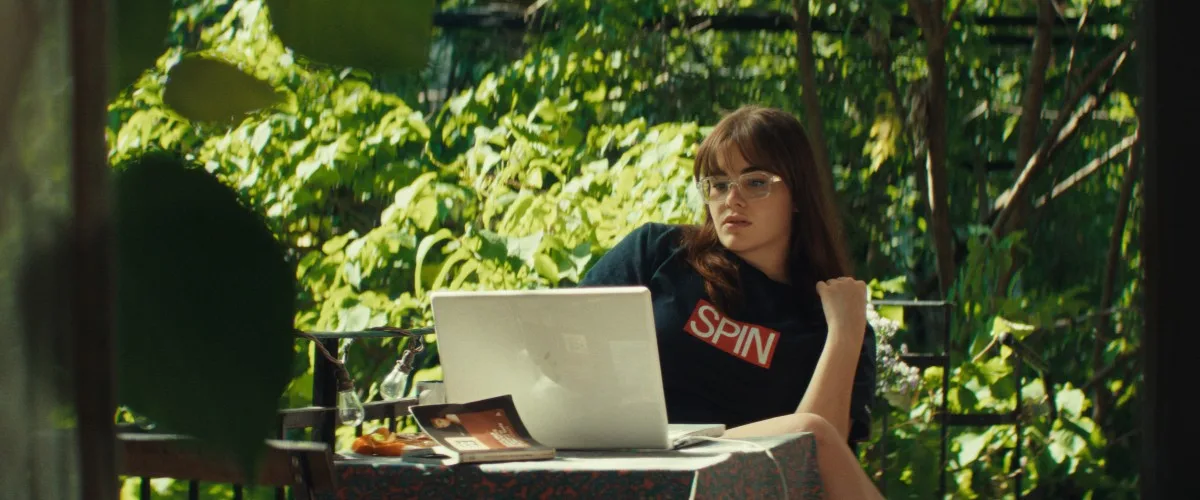
Plunging deep into that ecosystem is the film’s twenty-something protagonist, Grace (a terrific Barbie Ferreira, also currently in “Faces of Death”), leaving her dwellings and abusive work situation (the details of which are revealed smartly) behind to search for something more worthwhile in Montreal as a music critic. She scores a pretty great apartment share situation on Craigslist (remember Craigslist?) with the impossibly cool French-Canadian Madeleine, who happens to know a thing or two about good sex, homemade culinary delights, and music as a local DJ.
When not pulling out her notepad to jot down notes during concerts like the good critic that she is, Grace doesn’t really have a solid plan for her next move. Except, she wants to write an appreciation book on Alanis Morissette’s 1995 triumph, “Jagged Little Pill.” And in a way, by telling everyone that she is writing the book (despite lacking representation, a rough outline, or, you know, a contract), she lives in her own “fake it till you make it.” But when a miraculous thing happens, and a publisher actually greenlights her project with a tight deadline, we realize that she will make it after all, thanks to her smart pitch about what Morissette’s achievement meant in the history of music. To Grace, Jagged Little Pill marks the first time a modern-day young woman screamed about how angry she was, and her scream translated into financial success as opposed to being shunned from culture as a misogynistic punishment. With a smart take like that, what could possibly go wrong?
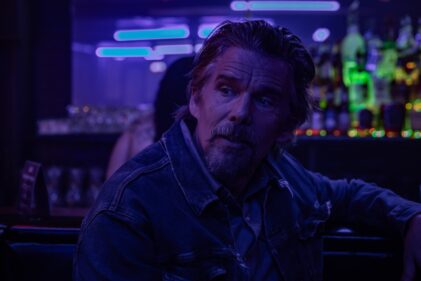
A lot, it appears, at least when Grace herself sabotages the opportunity presented to her, squandering the goodwill and patience of her publisher and her roomie Madeleine. Among her questionable decisions are the romances she launches into with two members of the same band (played by Chevy Olsen and Devon Bostick), one undoubtedly dumb (he clearly doesn’t even know who Morissette is), and the other, well, with a different set of challenges.
Now, if your 20s didn’t or don’t include enough privilege for you to experiment with things like blowing off work emails, ignoring responsibilities, and dismissing ways that could help with your rent (this Gen-X critic’s certainly didn’t), Grace will be a frustrating character for you to consider. But that is exactly why you should consider her in the world that Levack presents wholly, and engage with what insidious abuse of the “perhaps I asked for this, and it’s my fault?” variety can do to one’s idea of self-worth and self-esteem. (Here, it’s worth mentioning that Jay Baruchel is truly great in his brief role as Grace’s slimy, despicable boss who exploits his relative position of power.)
Levack is gifted both on the page and behind the camera in neither harshly judging nor excessively endorsing Grace’s poor decisions. Instead, she does what a great storyteller does: she gives her character room to grow and step up on her own terms, without pandering to the audience.
In her quest, Levack finds a great screen lead in Ferreira, whose empathetic and realistic portrayal of Grace should go down as one of the greats of 20-something representation. Confident yet reluctant, sweet yet strong-headed, wide-eyed yet unassailably herself, Ferreira’s Grace is sometimes what we go to the movies for, someone who retroactively makes us forgive whatever dumb thing we might have done back in the day, and who promises the young ones, it will get better.