
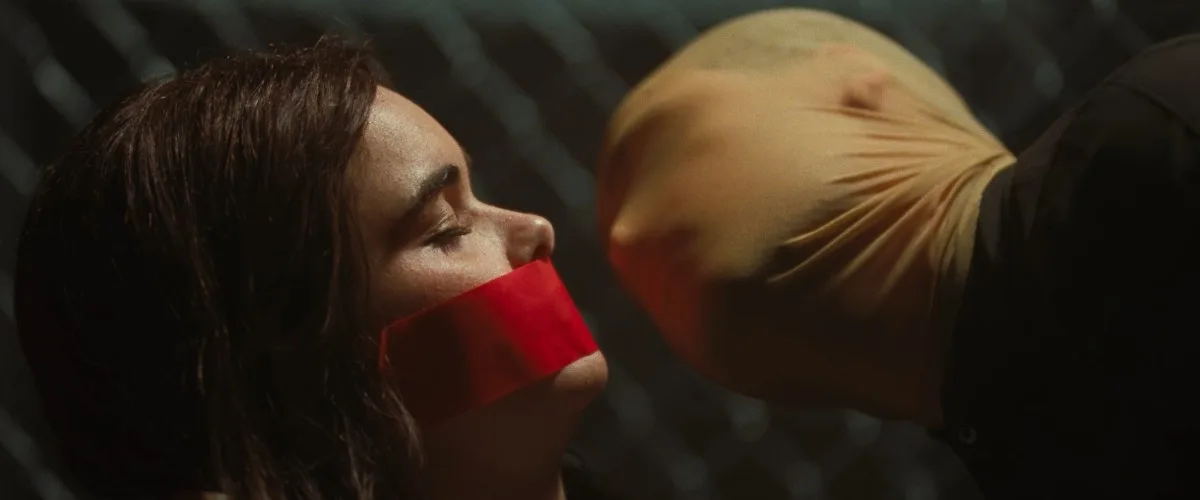
A glut of films about how the internet is slowly (or quickly) killing us gets an unexpected standout in this week’s clever meta slasher remake/reboot/retooling of the cult classic “Faces of Death.”
As a Gen X-er who used to manage a video store in the ‘80s, I know a thing or two about the buzz that surrounded John Alan Schwartz’s 1978 gore-a-palooza, particularly the persistent-to-this-day rumors that the horrible footage contained on it was actually real. In a sense, it was a viral horror hit before anyone knew how pop culture could be viral. Director Daniel Goldhaber (“Cam”) has taken the offer to reignite the “Faces of Death” IP and made a horror movie that also serves as commentary on the kind of people who love to watch grisly content online. As it feels like less and less of what we see online is real, what does that say about the human condition? Are we becoming numb to the violence of the world? If so, does it matter if it’s fake or not?
These questions and more are at the center of the new “Faces of Death,” a film that uses the original to a surprising degree. If you’re unfamiliar, the 1978 original features an alleged doctor named Francis B. Gröss, who introduces footage of horrible things he’s found from around the world, including a man being killed by an alligator, a SWAT assault that ends in death, a man being killed by the electric chair, and, notoriously, people killing and eating a monkey’s brains. While Schwartz did obtain some of the footage from news sources, he also fabricated nearly half of it, including the most gnarly stuff. The monkey brains were cauliflower, and the foam coming out of the electrocuted man’s mouth was toothpaste.
Goldhaber and co-writer Isa Mazzei take this curious pop culture artifact and use it to imagine a “Scream”-esque story about a serial killer inspired by it, who continues Dr. Gröss’s work by reenacting some of the most intense scenes from “Faces of Death” for the internet era. “Euphoria” star Barbie Ferreira plays Margot, a moderator at a TikTok-esque company called Kino. She spends her days watching footage for approval or tagging. When she spots the first new “Faces of Death” video, which features a beheading, she assumes it’s fake. Wouldn’t you?
Being herself a victim of a horrible death that she witnessed going viral—she’s often called “Train Girl,” further commenting on the dehumanizing impact of the internet—Margot may be more inclined to pause on the next “FoD” video that crosses her desk. She knows that real death has been caught online in ways that most people presume are fake. So when she sees someone being executed, she flags it to her boss (Jermaine Fowler). When no one but her seems to care, she decides to track down the source of the video, leading her into the world of Arthur (Dacre Montgomery, an actor who feels on the verge of a breakthrough with this and “Dead Man’s Wire“), a serial killer who has been using “Faces of Death” as a playbook.
What “Scream 7” should have or at least could have been, “Faces of Death” effectively digs deeper into the themes that the Ghostface franchise has only been flirting with recently, particularly the impact of becoming not just numb to online violence but weaponized by it. Montgomery is a chilling villain, leaning into a different portrayal of a serial killer than we’ve seen lately, coming off far more terrifying through his ability to almost shapeshift to the scenario. He can pivot from someone who appears to be awkwardly harmless into someone who Ted Bundy would fear with a shift of his body language. He seems like thousands of people who doomscroll themselves to sleep, which makes him all the more terrifying.
Ferreira is a tick less effective due to a lack of character detail beyond her job and trauma, but “Faces of Death” becomes more of a writer/director showcase than a performance piece, really sparking to life in a phenomenal centerpiece scene done via split screen in which our heroine thinks she’s getting closer to the villain but we see alongside her image how he’s using her online activity to find her at the same time. It’s one of several scenes that have an immediate urgency that horror often lacks. When Arthur is hunting his victims, Goldhaber excels at forced POV and using the back of the frame to point our eyes to the menace waiting to attack.
It actually got me thinking that Goldhaber and Mazzei would work really well in the Thomas Harris universe. While Hannibal Lecter will always be Sir Anthony Hopkins or Mads Mikkelsen to this super-fan, I would watch their take on the character with less trepidation than most modern genre creators. They understand how to make the invasive nature of how serial killers break the social contract of mundane reality into thrilling storytelling.
As the pair push to an inevitable climax, Goldhaber and Mazzei have a few surprises up their sleeves, including a showdown at Arthur’s house that feels like an ending but only opens the door to a bloodier, unforgettable final act. And, without the common moralization and over-explanation that derails so many “Internet Bad” movies of the current horror age, “Faces of Death” reaches its intense endpoint with two people, forever warped by the tech era, facing off. It becomes a heady swirl of themes and ideas: the moderator of the online age fighting back against what this dark time has birthed.