“Hamlet” begins with a question: “Who’s there?” To quote the great Canadian television series “Slings & Arrows,” the play is “the world’s longest knock-knock joke.”
“Hamlet” is also the longest of Shakespeare’s plays. If you read the whole thing out loud, you’d be reading for four hours. In 1996, Kenneth Branagh made the bold move to bring an unabridged version to film, playing with an intermission. There have been other “Hamlet”s since then (like the 2000 version with Ethan Hawke, where the melancholy Dane is a film student in New York City). The play that starts with a question is filled with questions from end to end (including the biggest, whether “to be or not to be”). In between “Who’s there?” and “The rest is silence,” however, very few satisfactory answers are provided. The mystery of Hamlet continues to mesmerize. It’s no wonder the play is a constant in repertory companies around the world.
Aneil Karia’s new version, with Riz Ahmed as Hamlet, takes place among a South Asian family in London, whose enormous wealth comes from a rapacious real estate company called Elsinore, of which Hamlet’s father was CEO. Cleverly, the word “Elsinore” is seen everywhere, on billboards, the sides of buildings, and newspaper headlines. Elsinore has a sinister reputation for tearing down affordable housing and erecting luxury high-rises, evicting tenants in the process, many of whom now live in tent cities, seething with resentment (a clear “stand-in” for Fortinbras’ armies galloping towards Denmark as the play comes to its murderous close).
Even with the drastic cuts (no Horatio or Rosencrantz and Guildenstern, no Yorick’s skull or the humorous “over it” gravediggers, no bumbling Osric), the film is still pretty long at an hour and 53 minutes. Without distractions, Hamlet’s fluctuating emotions suck the oxygen out of every room. The character is so dominating and three-dimensional that he turns everyone else into vaguely moving phantoms. In 1710, the Earl of Shaftesbury wrote, “It may be said of this Play that it has but ONE Character or principle Part.” You really feel this in Karia’s version, where the isolated cold sweat of Hamlet is ruthlessly exposed. The film plays at jangly full throttle, with Stuart Bentley’s cinematography holding close to Hamlet always, hand-held cameras following Ahmed from room to room, through nightclubs and storage spaces, creating a stifling psychological bell jar around the character.
Hamlet returns from time abroad to find his recently widowed mother Gertrude (Sheeba Chadha) engaged to his uncle Claudius (Art Malik). Hamlet is disgusted and agitated. Is he really seeing his dead father walking topside like a zombie? Is it a bad dream or the devil? Hamlet finally confronts the vision, who reveals that Claudius murdered him to seize control of Elsinore. The ghost commands Hamlet to avenge this murder. Famously, Hamlet stalls. And stalls, (Lawrence Olivier’s 1948 film begins with Olivier saying in voiceover, “This … is the tragedy … of a man who could not make up his mind.”
There may be another way to think about it.
In Act II, a troupe of players shows up at court to put on a play. Polonius praises the actors to Hamlet, saying they are skilled in all genres, “tragedy, comedy, history, pastoral, pastoral-comical, historical-pastoral…”
Hamlet adds a small “revenge tragedy” to the play program, one that will re-enact his father’s murder, thereby publicly accusing Claudius. Hamlet is, of course, in the “revenge tragedy” genre, heavily influenced by Thomas Kyd’s The Spanish Tragedy, a huge hit at the time. The play-within-the-play is very meta, but Hamlet spends most of the play avoiding the revenge demanded by the genre.
Harold Bloom wrote, “Hamlet cannot tolerate being the protagonist of a revenge tragedy.”
Hamlet is, after all, an actor. He puts on an “antic” disposition to fool the court; he instructs the players in acting techniques. And yet he resists the genre he finds himself in. He probably yearns to be in a “pastoral-comedy” where he could romp in the woods with his “fair Ophelia.” Being stuck in a “revenge tragedy” must be awful, and Ahmed captures this stand-off and the way it drives Hamlet to distraction, almost by centrifugal force. The tension is so acute that he tips over into suicidal ideation, murmuring the “to be or not to be” soliloquy as he drives at a maniacal speed, hands off the wheel.
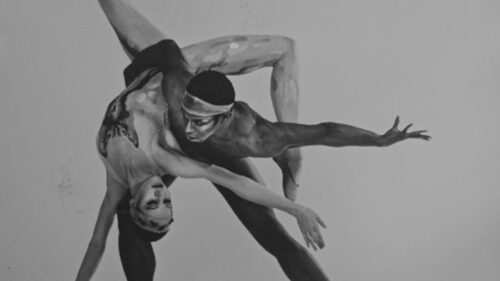
There are fresh approaches to familiar material. The play-within-a-play is now performed by a dance troupe at Gertrude and Claudius’ lavish wedding. Hamlet, wearing lipstick and a woman’s head veil to play up his “craziness,” serves as emcee, making everyone uncomfortable. The dancers, decked out in vivid silks and turbans, perform vigorously and joyously until the performance turns dark with the murder-pantomime. (Huge credit should go to every one of these extraordinary dancers. Especially effective was the handling of the late scene with the poisoned cup of wine. It was truly shocking, the choices made and their impact.
Polonius (Timothy Spall) is not the usual foolish old man spouting half-baked wisdom; he is instead a ghoulish sidekick to Claudius. Polonius’ daughter Ophelia (Morfydd Clark) is a fragile, sensitive girl, devastated by Hamlet’s rejection of her (when he taunts her about “country matters,” Ahmed emphasizes the first syllable of “country” with particular venom). Joe Alwyn plays Laertes as a rambunctious party-boy, who doesn’t register as a part in the action. Anything even slightly light-hearted has been cut, and the film suffers as a result. Shakespeare knew what he was doing when he interjected “comic relief” in his tragedies. Without them, the tragic can become monotonous and exactly what Hamlet warns the players against: it “tear[s] a passion to tatters, to very rags”.
Still, there is much here to recommend. The film has atmosphere and energy as well as a specific point of view. Hamlet is alone in every room he enters, no matter how crowded. Ahmed has spoken of the isolation he felt—how “different” he was—growing up. Seeing him look wildly around the room for a friend, a confidante, someone who might understand, is a relentless reminder of this material’s universality and why we will never tire of it.