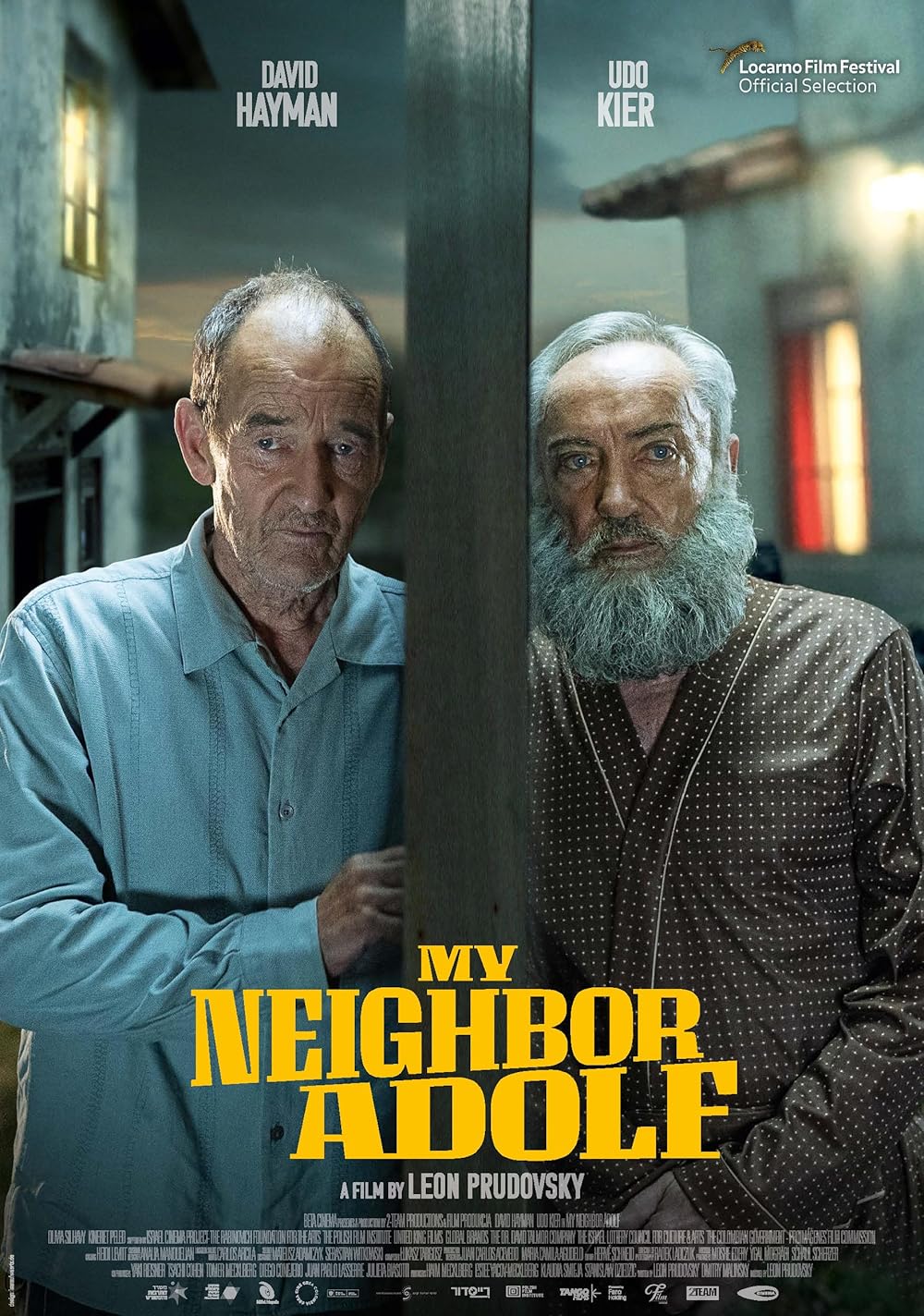


A Holocaust survivor wants his neighbor, Hitler, to get off his lawn. Or, at least, he thinks his neighbor is Der Führer. That’s the “New Yorker” cartoon-worthy setup for “My Neighbor Adolf,” a muted but whimsical comedy that takes place somewhere in South America. The movie arrives soon after the death of one of its two co-leads, the late, great, protean German scene-stealer Udo Kier, who naturally plays the title character. Hiding behind smoky sunglasses and a Castro-sized beard, Kier still grounds his underwhelming scenes with a thankless grace and comic gravitas. He’s also a terrific foil for his screen partner David Hayman, who’s about as funny and human as a traumatized Shoah victim can be.
An establishing scene hints at the personal loss that motivates Marek Polsky (Hayman), a cranky hermit who tends to his flowers (black roses, oy) and keeps to himself. This is “Eastern Europe” in 1934, where a woman in heels (not seen above the waist) strides across her family’s backyard, and tends to her own garden while the voices of the soon-to-be-missing kibitz and indulge viewers’ fantasies of a vibrant pre-war past. That kind of treacly symbolism would be easier to swallow if the following scenes offered more enlivening details to pick up where this opening sequence leaves off.
Instead, we flash-forward to South America in 1960, where Mr. Polsky immediately clashes with his new neighbor Hermann Herzog (Kier), a mysterious, German-accented loner who likes to play chess and hang out with his German shepherd Wolfie. The dog almost immediately breaks into Polsky’s yard and relieves himself. Some hacky jokes about dog waste and chess moves eat up time during Polsky’s tedious investigation of Herzog’s identity, which involves the Israeli consulate and a skeptical, unnamed Intelligence Officer (Kineret Peled).
A dispute about Polsky’s roses is also largely mediated by Herzog’s officious assistant, Frau Kaltenbrunner (Olivia Silhavy), a “Hogan’s Heroes”-worthy stock character who mainly exists to say things like, “You have no say in any of this. It’s the law.” Unfortunately, Polsky’s not much more complex, as you can tell from his stock reply: “You can stick your law deep in your a** and get out of my yard now.”
That sort of toothless humor might be funnier if it were developed past broad schtickiness. As it is, many jokes feel calculated instead of genuinely corny. That’s what this material needs: a disarming integrity that makes you want to buy its shameless appeal to sentimentality. At such a low-boil intensity, though, “My Neighbor Adolf” mostly seems unconvincing. An alternately zany and cloying score by Lukasz Targosz, replete with woodwinds and percussion, sets the movie’s pace, as in one early scene’s for-the-cheap-seats combination of martial percussion beats with klezmer-like clarinet swooning.
The filmmakers also occasionally suggest that they know they’re smarter than their own jokes, like when Polsky interrupts Herzog’s one-man chess game by telling him how many moves it will take to complete. “Oy, did I ruin your game?” Hayman sneers from off-screen with such leaden, borscht belt swagger that it’s hard to believe that the line’s delivered while Hayman’s off-camera. Then again, the fact that he is off-camera at the time suggests that the filmmakers understand how far over the top they’d be sending us if they showed us Hayman overcompensating with his face for such a shrug of a line.
Luckily, you don’t have to care about the movie’s rote situational comedy or its sketchy characters to find both Hayman and Kier to be typically winsome. Hayman does what he can with some heavy-duty accent work, rolling his Rs hard enough to match his heavy rasp. Kier, likewise, makes a meal out of Herzog’s rare standout moments, like when he asks Polsky why he wants to know if he thinks Miss Kaltenbrunner is attractive. Polsky reminds Herzog that he actually asked Polsky that question. “Never mind the details,” Kier sighs.
Hayman and Kier have a decent enough buddy chemistry, though only a few gags use their comic talents so well that it eclipses their underwhelming roles. In one standout scene, Polsky insists that Herzog help him write a letter, and Herzog agrees only after they play chess together. The two actors make a game of one-upping each other by placing different emotional stresses on their lines each time they repeat them. Why isn’t this movie always pitched at such loopy intensity, you might wonder.
Unfortunately, more bland than broad humor otherwise stands in for Polsky and Herzog’s personalities. It’s still sometimes nice to be reminded of how much value a talented ham like Kier can be, like when he wiggles his shoulders as Herzog teases Polsky about Kastenbrunner’s sex appeal. That bit of physical business is funny; the rest of the joke could stand a little workshopping.