
There is an indescribable thrill in seeing a director hit a new technical and storytelling level. Writer/director Cherien Dabis is on her third feature. Her debut, “Amreeka,” which premiered at Sundance in 2009, concerned a Palestinian family from the West Bank encountering Islamophobia in their new surroundings in Chicago. Five years later, she helmed “May in the Summer,” a dramedy about a woman returning home to Jordan for her wedding, only to question her desires. Both films were modest and intimate yet brimming with immense emotion.
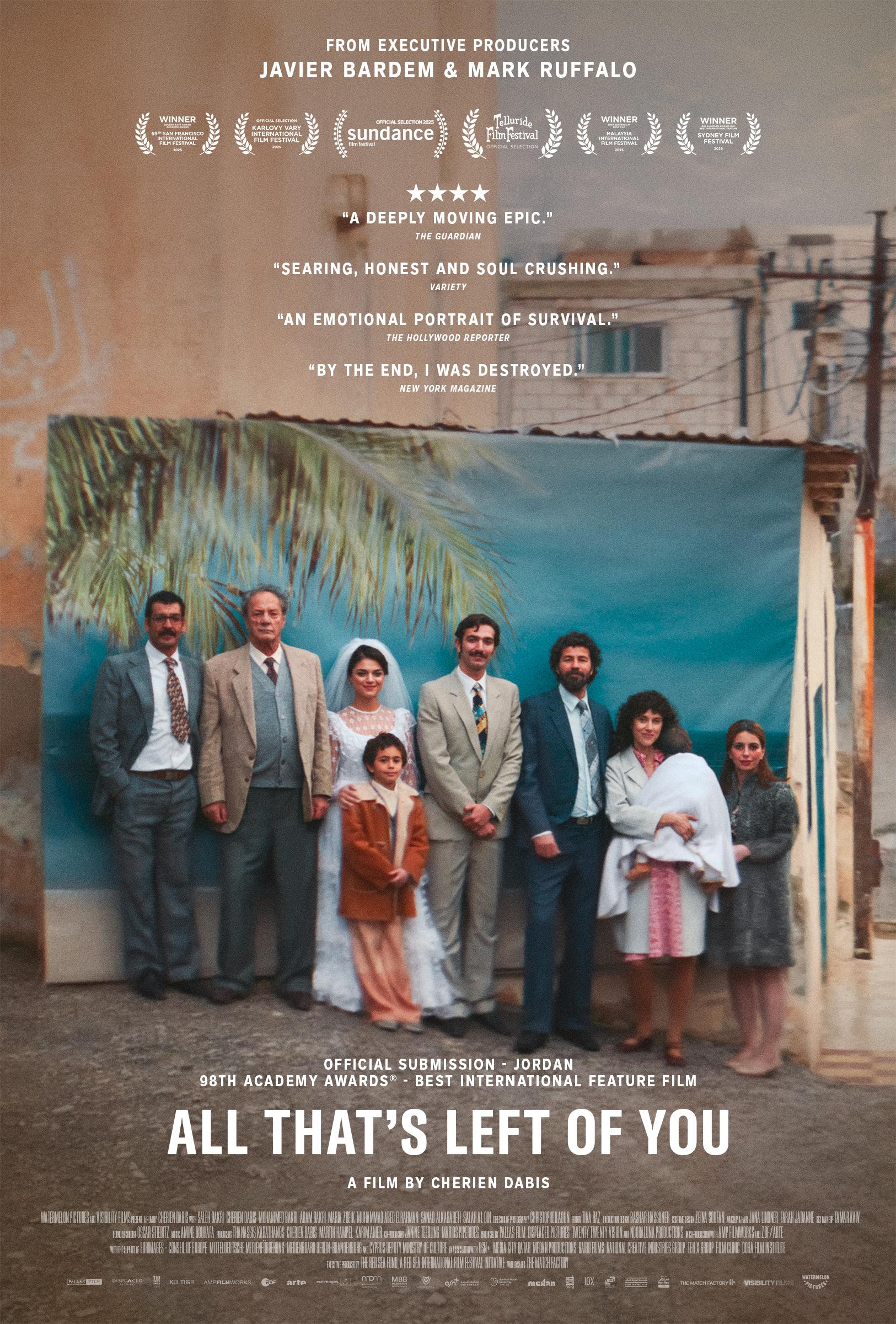
But her latest, the Javier Bardem and Mark Ruffalo produced “All That’s Left of You,” a multi-generational Palestinian epic, is the kind of accomplished, immaculately rendered film that’s indicative of a director who’s learned much and is ready to seize more. It is also Jordan’s Academy Award submission for Best International Feature, for which it has been shortlisted.
A non-linear wonder, Dabis’ film begins on a haunting note: Two teenage boys, Noor (Muhammad Abed Elrahman) and Malek (Rida Suleiman), race across tin rooftops and down narrow streets, sketching the fragile geography of their confined corner of the occupied West Bank. Noor zooms into his home, barely catching his mother Hanan (Dabis) before leaving for an anti-Israel protest. At the demonstration shots ring out; Noor ducks; Dabis then cuts to an older version of her character. In a fourth-wall break, Hanan explains, “I know you are wondering why we are here… But for you to understand, I must tell you what happened to his grandfather.”
Those two aching scenes, both startlingly immersive in their frankness, exemplify the ease with which Dabis and her editor Tina Baz temporally oscillate between eras. Their film takes place in four different decades. The first is in 1948 in Jaffa. A young Salim (Salah Aldeen Mai) looks up to his father Sharif (Adam Bakri), who owns orange groves and teaches him a romantic poem: I am the sea/ In my depths all treasures dwell./Have they asked the divers about my pearls? Their idyllic existence is broken during the Palestinian War, which results in the Nakba (the ethnic expulsion of the country to form the State of Israel). Consequently, Salim and his family flee to a refugee camp, while Sherif, who decides to stay and defend their home, is put into forced labor. In 1978, an adult Salim (Saleh Bakri) and an aged Sharif (the late Mohammad Bakri) joyfully watch Salim’s sister Layla (Hayat Abu Samra) marry; she will eventually move to Toronto. Salim, a teacher, has his own family, including his young son Noor (Sanad Alkabarete), who loses faith in Salim when Israeli soldiers force Salim to demean Noor’s mother. By 1988, the First Infitada is happening and Noor wants to be part of the uprising.
In each part, Dabis organically plants her themes. There’s the helplessness felt by paternal figures, which is partly reinforced by the casting of the elder Barki and his sons and by the varied instances of dehumanization by the IDF on these Palestinian men. It also occurs through the language itself. Returning to the aforementioned poem, “I Am the Sea” by Egyptian poet Muhammad Hafiz Ibrahim, Dabis uses verse to convey the beauty of the Arab language. The occupying Israeli force, however, never bothers to learn Arabic. The subtitles in every decade, in fact, note that the IDF speaks broken Arabic. Dabis smartly interweaves these instances of degradation with the varieties of violence inflicted at every level of Israel’s occupying apparatus. Some of it is physical — like arrests, imprisonment, and death — some psychological, and others bureaucratic. The latter barrier, which finds equal resonance in “The Voice of Hind Rijab,” occurs when an unspeakable tragedy strikes this battered family.
Beyond the film’s narrative qualities is its near-pristine craft. Dabis shoots in wide. But unlike most directors, she doesn’t waste the opportunity. Every frame is overflowing with information and beauty, with the former arriving via televisions in homes broadcasting the Lebanese Civil War, IDF crackdowns, and Palestinian uprisings. The gorgeousness, on the other hand, arises from Dabis and her DP Christopher Aoun’s classical framing, keen depth of field, and ability to capture images that spell wonder and bleakness, like purple-hued silhouettes of Palestinians swinging pick axes, a drone shot that drinks up the marriage between the Mediterranean sea and the Jaffa skyline, and vivid family gatherings that oscillate between celebratory and mournful.
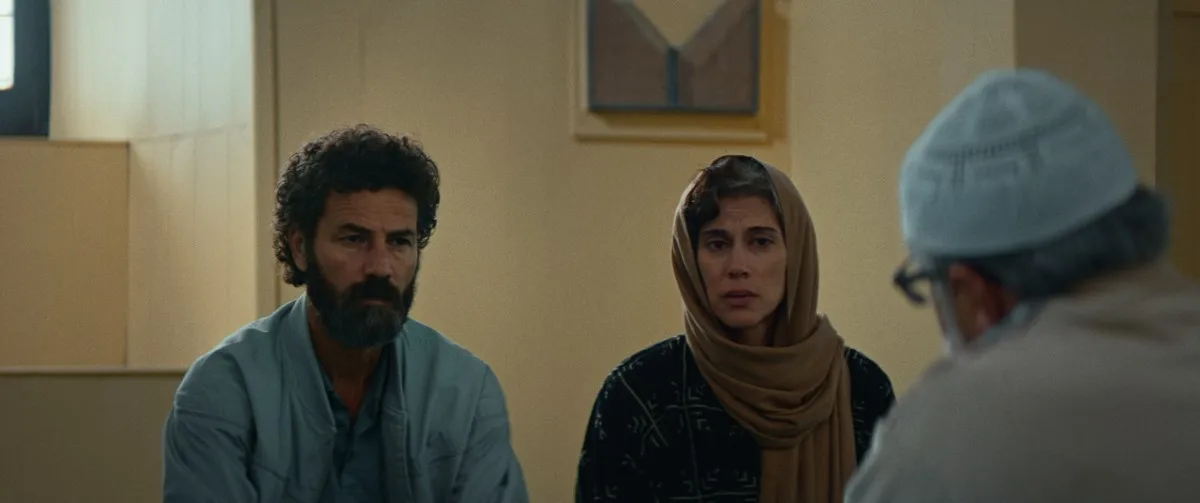
With regard to the heartbrokenness on display, Dabis, an actress as well, understands the oft-quoted Cassavetes belief: “The greatest location in the world is the human face.” She has assembled an exceptional cast. The elder Bakri carries decades of anger and pain across his weathered visage; Saleh elicits sorrow through his vulnerable searching eyes and his bent posture; Dabis, as Hanan, elicits warmth and goodness for a faithfulness that feels conceptual in this world but is no less important.
Most of all, through these performances, she lands a kind of symbolism—the heart as a physical and metaphorical organ that binds languages, experiences, and hopes—that would seem cloying if you attempted to explain it aloud. But it’s not here. The desire is earned. Even when the picture feels like it’s on the verge of crumbling, like a sentimental sunset between Hanan and Salim that occurs in the year 2022, we don’t break away from the pureness of Dabis’ intent. We cherish the pieces that make up the humanizing whole of “All That’s Left of You.”