This was my first year covering the Venice Film Festival for RogerEbert.com. It was also my first year participating in the Biennale College Panel, which convenes a small group of critics and historians at the Venice Film Festival to give notes on four features made by creative teams from different countries. The four are drawn from a larger group of proposed projects by filmmakers who all vied for the same top prize: a grant of $200,000 Euros (roughly $230,000 US) to shoot and finish a feature-length movie in about ten months, in time to premiere at the next festival.
The organizer and moderator for over thirty years is the great Peter Cowie, author of, by his own estimate, 35 books and editor of 100 more. He has written books on subjects drawn from many eras of film history, including biographies of Ingmar Bergman, John Ford, Louise Brooks, Joan Crawford, Akira Kurosawa, and Francis Coppola and surveys of cinema in Japan, Iceland, and Finland. It was an honor to get to know a man whose byline appears innumerable on my own bookshelves and has inspired me from my college days to the present, and whose wife Françoise is a delight. The panel included Stephanie Zacharek of Time, Chris Vognar of The Boston Globe (and RogerEbert.com), Finnish film scholar Sara Ehnholm Hielm, and former San Francisco Chronicle film critic Mick LaSalle.
It’s an honor for the directors of the final four movies to have been selected for Venice screenings at all, and a rare privilege for any filmmaker to get a greenlight to make something fast and cheap but with artistic control and a mandate to make it personal. From this writer’s perspective, it was a comparable honor to see new work by very different, as-yet-unknown filmmakers, who have long artistic journeys ahead of them but already demonstrate an exceptional sense of craft and a vision unlike any other’s.
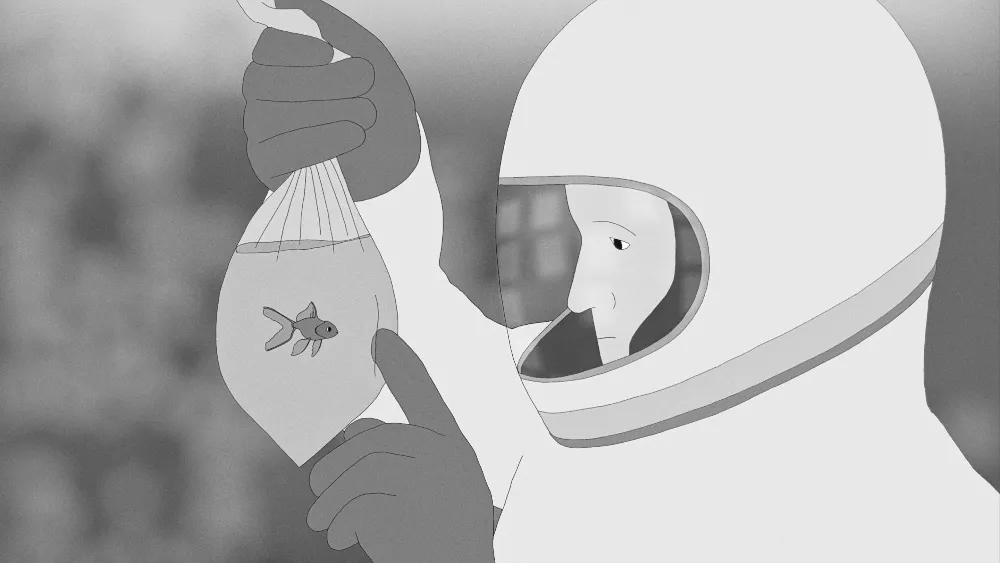
“Moonfish” began its journey to the screen ten years ago, when a doctor misdiagnosed Brooklyn-based animator Daniel Zveriff’s benign arrhythmia for a potentially fatal heart condition. The two-week interval between thinking he was going to die and learning otherwise was marked by overwhelming fear, depression, and loneliness. Zvereff transferred his misery into this bespoke feature film, made for little money, but fueled by enough ambition to send a rocket into space.
In the future of “Moonfish,” all commerce and most of daily life are ruled by a handful of corporations that have divided all known planets and moons into real estate over which owners have total control. Teams of astronauts with mining skills extract lucrative minerals; they can spend months or years in space with no personal contact (except with their partner) and must perceive the universe beyond their capsule entirely through screens. They must meet their quotas, or the company will abandon them and leave them to die.
The story follows an unnamed astronaut (voiced by Morgan Spector) sent with his unnamed partner (Lucy Liu) to mine a distant asteroid. The hero’s partner dies in a spacecraft malfunction, leaving him to meet their quota while grieving the loss of a woman to whom he was very close (the movie doesn’t specify the exact nature of their relationship, but their chemistry confirms they were as close as two people can get). The setup might remind science fiction fans of both “Gravity” and “The Martian,” although it’s less extravagantly emotional than the former and lacks the disarming goofball charm of the latter.
But this is no copycat’s cut-and-paste job. In the manner of an Eastern European filmmaker from the Cold War era smuggling social criticism past state censors by wrapping it in metaphor, the film’s analogies for the challenges and injustices of modern life are plain to see, but only if you make a point of looking for them. The work stands on its own as a personal statement that becomes more emotionally involving as it goes along.
The monochrome visuals and 4×3 aspect ratio intensify the hero’s claustrophobic desperation, to the point where you may feel like you need a hit from an inhaler even if you’re not asthmatic. The biggest challenge facing this director moving forward is preventing the larger budgets he’s likely to get from suffocating the outlaw flame that burns so brightly in this first effort.

As the mythologically ripe title suggests, “Demeter in Exile” owes less to any feature that’s been widely released in recent years than the greatest hits of 20th century experimental cinema as selected by film history classrooms, including Maya Deren’s “Meshes of the Afternoon,” Luis Buñuel’s “The Exterminating Angel,” and Kenneth Anger’s “Eaux de Artifice.” Although it’s set in present-day Milan, it’s indebted to the ancient tale of Demeter and Persephone: the former, the goddess of the harvest, is stricken with sadness when her daughter suddenly disappears, not knowing that she was abducted to become the bride of Hades, ruler of the underworld.
The mother, Daria, is not a harvest goddess here, but a botanist who maintains a makeshift arboretum in her apartment in late summer, a time when many Milanese citizens have left town and those who remain feel stranded. (Notice a theme in these movies?) Lia, her daughter, serves as her devoted daily caretaker. The job is so emotionally and physically taxing that she feels as if she has no life of her own. But she suppresses the impulse to strike out on her own because it would feel uncaring and disloyal, instead channeling her frustrations into an art project that retells the myth of Demeter and Persephone.
First-time feature filmmaker Maria Giovanna Cicciari doesn’t follow that story exactly, however, treating it as loose inspiration and the origin point for a few echoes. There are no devilish abductions, but the pull of independent adult living does eventually turn into an equivalent of a seductive and dark force that could sever the daughter from the mother. She understands the value of restraint, and even when the movie seems about to land on a precise equivalent of the myth that inspired it, it pulls back at the last minute, leaving the viewer room to dream.
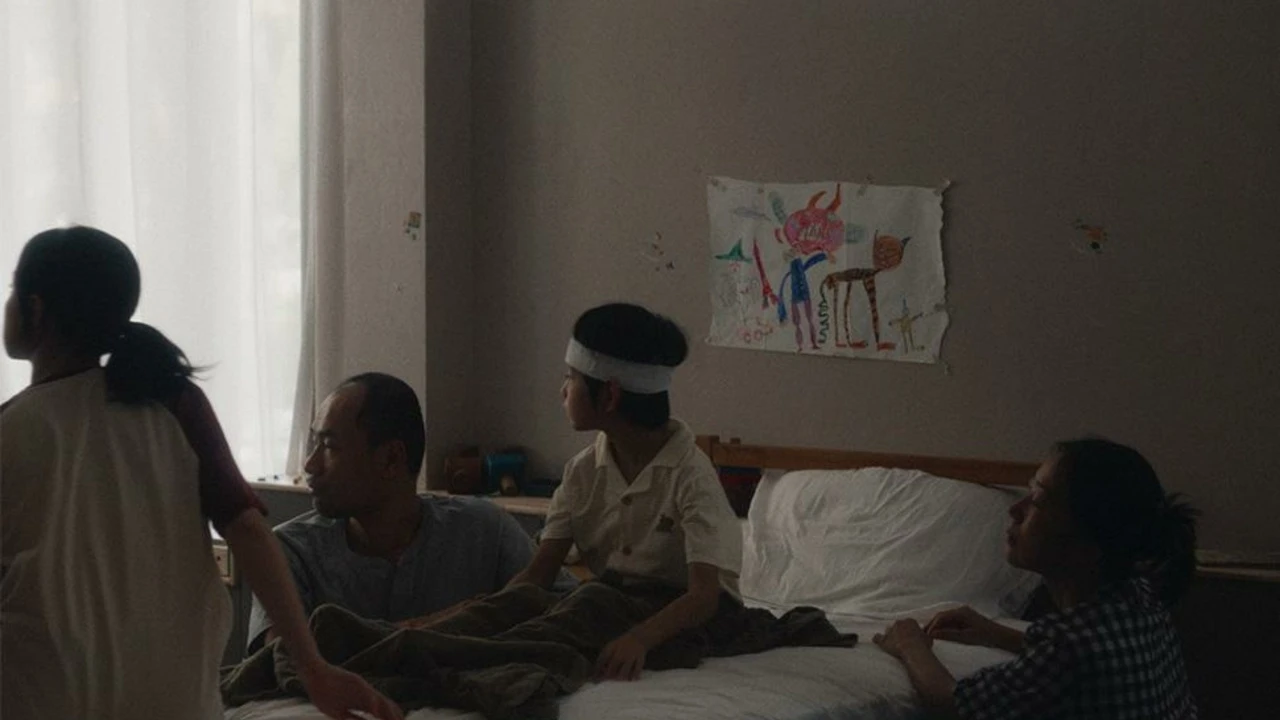
Another quasi-experimental narrative in the program is “Gu Shi,” by Amie Song, a young filmmaker who divides her time between China and the United States. As in the previous two films discussed here, the main characters go unnamed (what, if anything, could this indicate about the overall state of things?). And both the tale and its telling are at once heavily allegorical but unmoored enough from interpretive guideposts that the viewer can view things through their own prisms. (This Yankee imagines that if the point involves present-day China in any way, it’s self-preservation to keep things vague.)
The movie follows a family of four, identified as Mother, Father, Daughter, and Son. They’re traveling, perhaps migrating, from the ocean to a forest when their trip is interrupted by an accident that leaves the son confined to a bed. The family passes an undefined period of time by telling stories about the ocean, which are soothing and transportive but have the side effect of making the listeners forget. At the same time, the Daughter begins having a series of nightmares involving a girl in a green dress. As the movie progresses, our already limited ability to distinguish dreams and fantasies from reality shrinks, until the entire thing seems to be unfolding in a gentle fugue state, with sounds and music taking on eerie and unusual associations.
At times, “Gu Shi” strikes notes reminiscent of the 2005 art house hit “Tropical Malady,” which likewise treats a forest as a dreamspace, and presents sequences of events that felt less like stages in a narrative than lines from an incantation. But what is being conjured? “The Exterminating Angel,” mentioned in the preceding capsule, slides onto the mental viewscree again with its story of people trapped in a house, not because they’ve been imprisoned there by others but simply because, for their own mysterious reasons, they are unable to leave.
This is a slow, quiet movie. It requires patience and concentration from the audience to intuit or make meaning. But if you can free yourself of the usual expectations that audiences have been conditioned to bring into feature films, even ones that have no interest in meeting them, this is a rewarding experience, though more satisfying to discuss afterward.
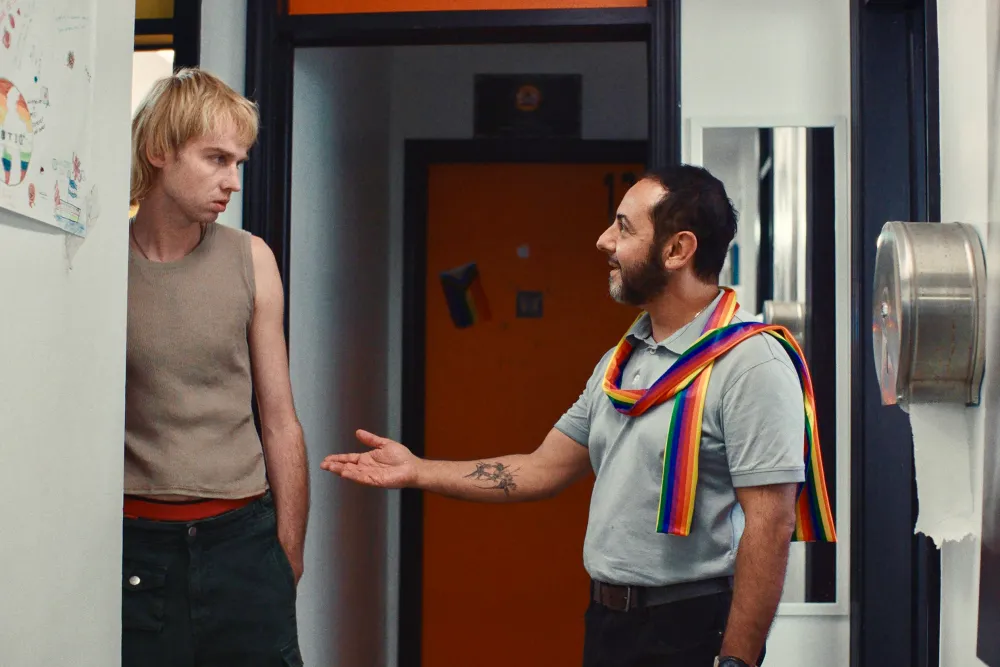
“Tijuana, Todovia” is a bawdy comedy of the type that regularly played mainstream arthouses back in Pedro Almodovar and Gregg Araki’s golden era, but has been driven underground by a combination of homophobia, xenophobia, and an especially bland, dull anti-sex mindset.
It focuses on the relationship between two young queers in Tijuana, a chaotic horndog native named Chavo (producer-lead actor Humberto Busto of “Amores Perros”) and a Russian national named Maksim (Petr Filimonov) whose default expression is a bored, disdainful sneer better suited to an Oscar Wilde minor royal than a couch-surfer who doesn’t have two pesos to his name. Maksim fled his home country when his opposition to the Ukraine invasion made him an even bigger target than his queerness, and is at risk of deportation unless…
Well, let’s say the solution is a sitcom-ish way of kicking things off (even the characters seem to know this), but also a handy shortcut to the heart of a story about citizenship, love, sex, and the necessity of treating others decently even when you can’t stand them. This is the story of a couple unlikely to have ended up together through conventional means. The movie honors them by avoiding obvious jokes and sight gags, except when one could lead to a belly laugh, in which case it’s staged and played with gusto. The characters are so overflowing with life that even ones that appear in just a scene or two could be the stars of their own movie.
“Tijuana, Todovia” is written, edited, and directed by Gabriele Gonzalez Morales, whose director statement said the film was made to showcase the young, diverse, cosmopolitan Tijuana that the cast and crew know, which is a far cry from cinema’s usual representation, a dust-fogged hellhole where gringo frat boys lose their virginity and cops and drug dealers kill each other. The perspective here is that of an artist creating a comic fable from personal memories, which gives the movie a vivacious energy. It is also the fourth of the Venice student films to put a lonesome, rootless post-national existence at its center. And it has as much to say about technology’s effect on relationships as “Moonfish,” mainly by way of the characters’ incessant but narratively necessary cell phone usage.
It’s been said that the hardest thing to master in any form of storytelling is tone. Like other seriocomic filmmakers of recent decades who turned out to be artists of some significance (such as Wes Anderson, Jared Hess, and Boots Riley), Morales seems to have arrived not just with a tricky, arresting tone, but a unique rhythm as well. See a bored and immobile Maksim barely raising an eyebrow at those he considers stupid or pretentious, or Chavo going full Daffy Duck in situations that require a cool head, and the next time you encounter either of them, you’ll find yourself smiling even though they haven’t said anything yet.