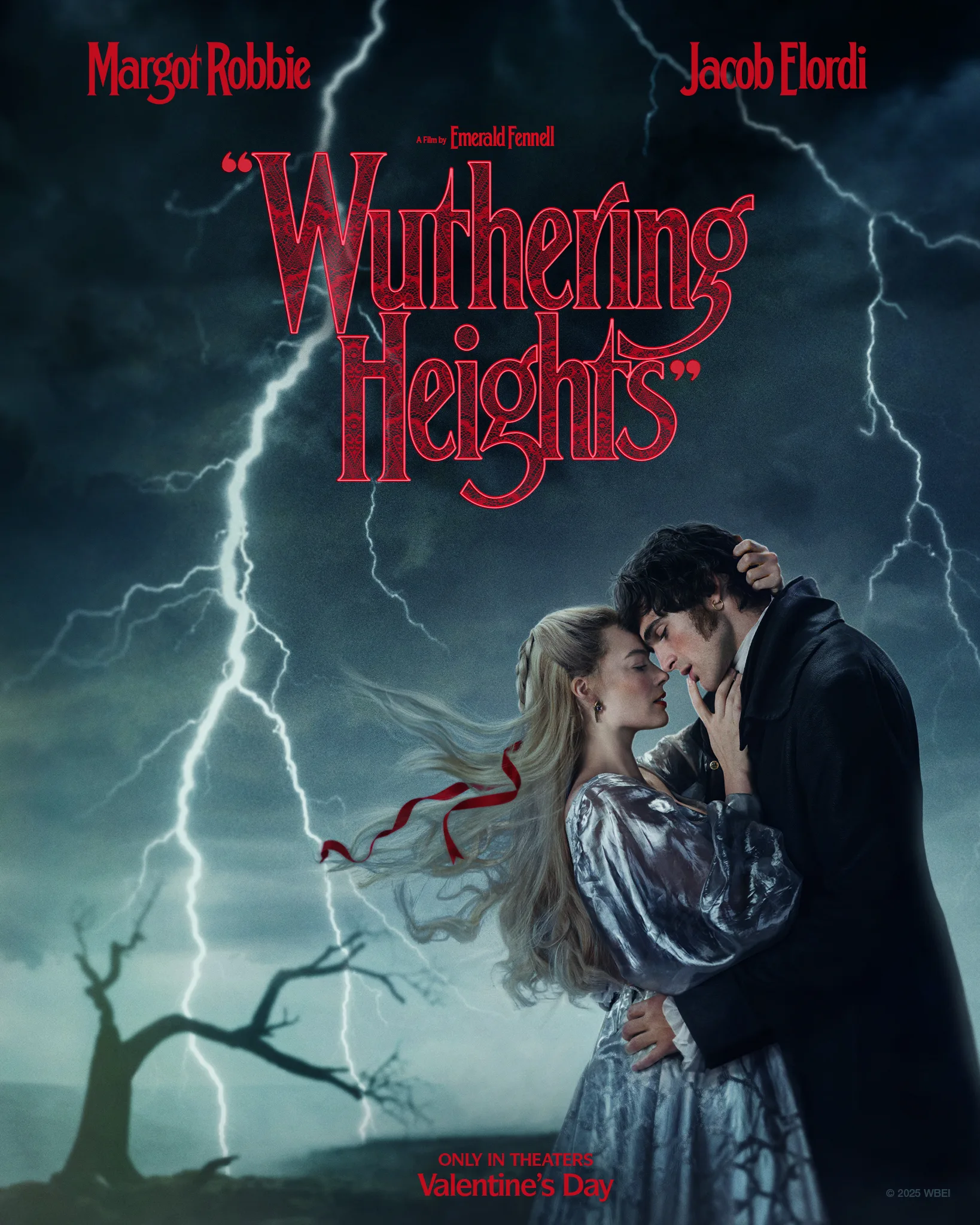

Emerald Fennell’s psychedelic adaptation of “Wuthering Heights” declares that it will play by its own rules right at the start. The opening teases us with the sound of a man’s breathy groaning and subtle moaning over a dark, blank screen. Also audible are quickening creaks of wood as the grunting intensifies—the screen might be pictureless, but the erotic suggestion is clear as daylight.
Once the moving image appears to match what we’ve just heard, though, it is, surprisingly, not of a sexual act like Fennell has implied, but of a man being hanged at a town square, desperately trying to hold onto his final reserves of life. It’s a period-defining and admittedly subversive kick off for Fennell’s loose—very loose—interpretation of Emily Brontë’s 1847 book, the sole novel of the English author and poet that mainly tells the story of two star-crossed lovers, Catherine (Margot Robbie) and Heathcliff (Jacob Elordi), in the late 18th-century England. It’s a dare, and an invitation to experience all the ways Fennell herself felt the arousing sway of the classic, where she sees lust and demise as two inseparable sides of the same coin, if her opening is any indication.
After this powerful proposition, it is unfortunate that the film that follows becomes an increasingly timid affair, with a series of aggressively styled set pieces and, inexplicably, even oppressively hushed emotions. Do a quick search on socials on “Wuthering Heights,” and you shall see countless top hits (with thousands of engagements each), all swearing that they and only they know what Brontë’s novel was about. It’s not just about romance, but also class. It’s not just about class, but also racism. It’s not only about this, but also that (violence, trauma, domestic abuse, societal outcasts…the list goes on), as if the story isn’t encompassing of all of the above.
In that, and with already countless film, TV, and stage adaptations of “Wuthering Heights” (from William Wyler’s 1939 Laurence Olivier-starrer to Peter Kominsky’s version with Juliette Binoche and Ralph Fiennes in 1992, and beyond), Fennell is more than allowed to mine her own impression and memories of the text. But if modernizing the setting with anachronistic choices in music and design and leaning into the inconsolable longing between the tale’s stubborn and destructive lovers was her priority, you can’t help but wish that she really committed to the bit.
Instead of an effervescently out-there emotional scope, she gives us something halfway, intriguingly sizzling when yearning takes center stage between Robbie and Elordi, two of the greatest actors working today, but oddly cold and even wooden when the duo finally falls into each other’s arms. It brings me no pleasure to say that the rain-soaked kiss scene in the trailer (“let us both be damned”) is perhaps the most believably sensual intimacy scene in the movie—elsewhere, there are several shy and lifeless ones. And it’s curious that the leads’ intense chemistry lands mostly when they are lust-filled yet apart by circumstance. This seems to have less to do with Robbie and Elordi, but more with Fennell’s style-over-substance approach to the material. While the filmmaker has always married excessive colors and textures with her storytelling, like in the pitch-perfect “Promising Young Woman” (still her finest film) and the deliciously Gothic “Saltburn,” her instincts feel misguided here. It’s hard to feel free when you are constantly and loudly reminded by every aspect of the movie that you are supposed to feel things.
The strongest segment of Fennell’s “Wuthering Heights” is its first chapter, when we are introduced to the world of young Catherine and Heathcliff (Charlotte Mellington and Owen Cooper of “Adolescence”). The basics of the tale are as you know them. Catherine is the daughter of the Earnshaw family at the increasingly neglected Wuthering Heights farm, and the latter, an orphan, Cathy’s abusive, hard-drinking father (Martin Clunes) has taken her in to raise. (Since it is strongly suggested in the book that Heathcliff isn’t white, Fennell’s casting of Elordi in the role stirred up some recent whitewashing controversy.)
Matched perfectly in their volatility, the two grow up causing trouble, having fun over the expansive and foggy Yorkshire moors, and misbehaving, with Heathcliff often taking the blame for Cathy’s wrongdoings. Meanwhile, there is also the housekeeper Nelly (played by the great Hong Chau, with Vy Nguyen in a younger role). One of the book’s main narrators, she is defined here more by her silent observations as Cathy’s lifelong friend and companion, derailing a possible romance between Cathy and Heathcliff. A deeply emotive performer, Chau is absolutely perfect in the part—so much so that you increasingly wish Fennell’s adaptation allowed her character a crescendo or two.
Despite harboring obvious feelings for one another, the gruff Heathcliff and insatiable Cathy won’t confess and get together right away. Instead, Cathy marries Edgar Linton (Shazad Latif), the wealthy tenant of Thrushcross Grange estate, after Heathcliff abruptly leaves due to a misunderstanding. When he returns years later, rich and well-groomed, it’s already too late for the two, especially with Cathy’s pregnancy. Still, obstacles don’t stop the two lovers for a while. But when things take a darker turn throughout their forbidden affair, Heathcliff sets his sights on Edgar’s smitten yet sexually repressed sister Isabella (a scene-stealing Alison Oliver) with a messy and heartless scheme of revenge.
On paper, the stakes couldn’t be higher. But in Fennell’s hands, the all-consuming nature of the world feels softened, even flattened. Then again, maybe it is just crushed under the production design and costuming choices, often eye-popping in all the wrong ways. There is something too tidy and uninteresting about the great majority of Robbie’s garments during Cathy’s Thrushcross Grange years. The problem isn’t the contemporary liberties the costuming takes with the Georgian era of the story—period inaccuracy in aesthetics can be a wonderful creative asset in film—but the taste level.
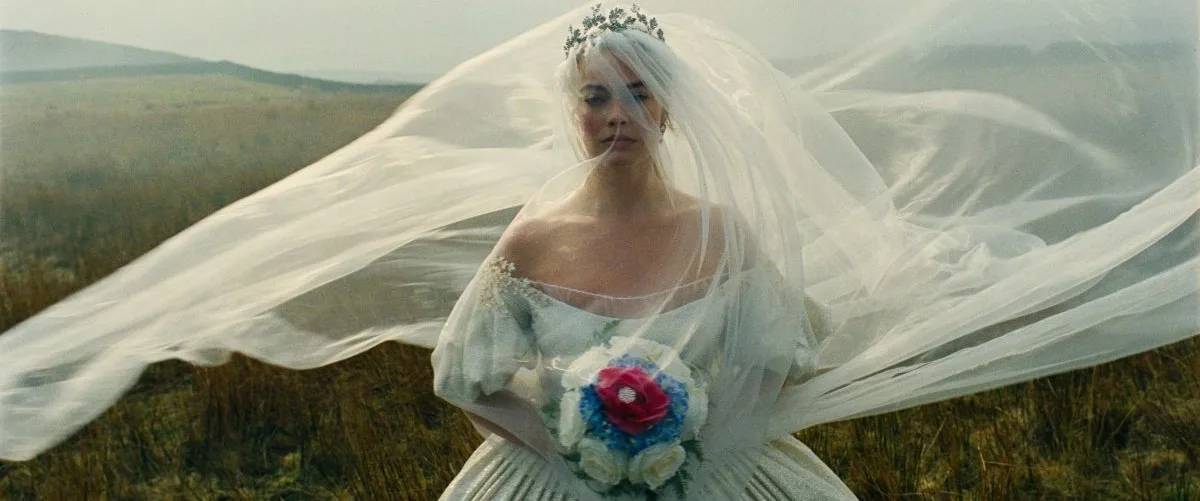
There are some inspired pieces, like Cathy’s lush wedding gown, and a richly draped black frock that Linus Sandgren’s high-contrast lensing casts in white light. But for the most part, the costuming reminded this critic of the standard-issue Barbie doll gowns she used to collect in her dollhouse. (Peerless costume designer Jacqueline Durran dressed Robbie in “Barbie” too.) And Suzie Davies’ production design explores several interesting concepts, but many of them don’t blend into the story’s Gothic hues. Cathy’s pink Thrushcross Grange room feels almost comically bare, going against the visual excess we yearn for in these types of melodramas. And the wall dressings that are supposed to represent Cathy’s freckled skin are certainly an idea, but whether it’s a good one is debatable. Elsewhere, the location (shot actually in Yorkshire) and Sandgren’s cinematography of high contrasts, deep reds, and fog—lots of fog—feel cinematic enough. Though the whole thing feels like an artificial music video, rather than an inviting fantastical world we want to get lost in. Charli xcx’s admittedly beautiful (but ultimately distracting) songs and musical cues further this feeling.
Fennell is a bold filmmaker unafraid to try something new and unexpected. And “Wuthering Heights” deserves some recognition for being a movie that she made entirely on her own terms. If only those terms ignited the riotous feelings that we were promised.