As horror continues to thrive through the 2020s, A24 is preparing to drop a terrifying gem in Ian Tuason’s excellent “undertone.” It’s a movie that has some of the themes that have dominated the form lately like grief and lack of faith but embeds them in a sonic and visual nightmare that announces its filmmaker as a major talent. Horror directors often cut corners when it comes to form, using cheap tricks like jump scares, overcooked music cues, or even just presuming that the spooky storytelling will do all the work for them. Tuason prioritizes elements such as negative space, a constrained POV, canted angles, and simply incredible sound design to lock viewers into the same nightmare as his protagonist. He doesn’t want you to watch something unfold; he wants you to feel it as sound and image reach something primally fearful. Some will argue that all of the themes of “undertone” don’t connect, but that’s a feature, not a bug. This is a film that doesn’t feel the need to explain itself. Nightmares rarely do.
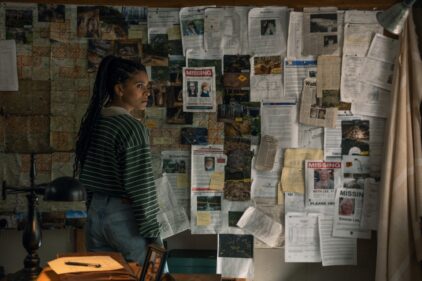
“undertone” is essentially a one-woman show. We spend its entire runtime locked into the POV of Evy (Nina Kiri), a podcaster who moves home to care for her dying mother (Michele Duquet), who is catatonic in bed through most of the film. Evy’s mom needs round-the-clock care, but Evy gets a bit of a break when she does her podcast with her friend Justin (Adam DiMarco). “The Undertone Podcast” is about paranormal activity with Justin playing the believing Mulder to Evy’s skeptical Scully. They’ve dug into stories like a video that forced people to hurt themselves a la “The Ring” and something eerie with a Ouija Board, but their latest episode is going to be their last: Justin and Evy have been sent ten recordings about a married couple who started to hear things in their home. As they try to decipher exactly what they’re hearing, Evy’s world starts to break.
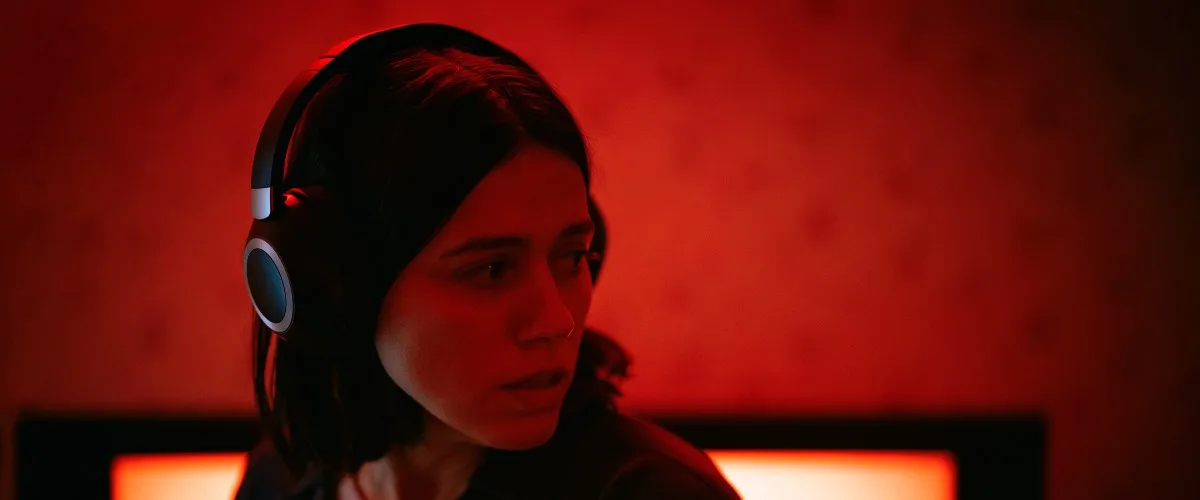
Tuason never leaves Evy’s side or the creepy home in which she lives, one in which her mother’s death hangs in the air. (He actually shot the film in his parents’ house, which is something he might want to bring up in therapy.) When Evy puts her podcasting headphones on, we are similarly locked in a sort of noise-canceling hum, hearing only the podcast and the audio clips they’ve been sent. As Evy and Justin play detective, trying to figure out what’s going on with these supernatural sounds, we join the mystery. Anyone who has ever watched a clip of a shadow that someone thinks is a ghost can identify with the “spectral hunting” aspect of “undertone.” Of course, in the realm of horror movies, we all know that Evy and Justin should NOT listen to all ten clips, especially as the world of these audio files seems to be invading theirs, but curiosity is a powerful motivator.
Tuason weaves interpretable themes into “undertone” without doing the exhausting underlining of so many indie horror writers. Evy is pregnant, and the audio clips involve not just baby noises but potential child murders. Evy speaks to a doctor in a scene that implies she’s considering terminating the pregnancy, and, of course, her mother is dying in a bed in the room upstairs from the podcast, one in a house surrounded by religious imagery like little ceramic statues, crosses, and paintings of Jesus and Mary. Life, death, faith, good, evil—these elements weave their way in and out from Evy’s real life to the auditory nightmare that she can’t quite believe is happening on her podcast.
The claustrophobia of the single setting of “undertone” is enhanced by Tuason’s expert use of space. Cinematographer Graham Beasley loves to tilt his camera, sometimes ever so slightly to enhance dread, sometimes drastically when the demonic shit is hitting the fan. Most impressive is how Tuason and Beasley place Evy within their frame, often having her podcast on the edge of it as the camera centers on a darkened hall or a half-seen stairway. Watching a podcaster do their thing is kind of a tough sell visually, and so Tuason compensates by encouraging our eyes to wander. Is that a shadow in that dark doorway? Is there something or someone at the top of the stairs? There’s usually nothing there, and yet we start to see things that aren’t real, much like people do in reportedly “true” clips of hauntings online every day.
The relatively slow burn that is “undertone” culminates in one of the most truly chill-inducing final acts in recent memory. As Evy’s world collapses and “undertone” spirals in image and sound, we feel as trapped as she does. What does it all mean? What really happened on those audio clips? Or to Evy? Horror has been so dominated lately by films that connect all their dots and over-explain themselves for streaming viewers distracted by their phones. It’s refreshing (if someone could use such a word for a truly scary film) to see a project that goes the other way, one that understands that it’s the images and the sounds of horror that have the greatest impact, not the twists or the exposition dumps that explain it all away.
When A24 landed “undertone” in a seven-figure deal, Blumhouse hired Tuason to direct the reboot of “Paranormal Activity,” a clear influence on this project. Given how much that franchise devolved into utter nonsense over the years, Tuason has to do some heavy lifting to make it relevant again.
After “undertone,” I believe.
This review was filed from the Sundance Film Festival on January 29. It opens on March 13th.