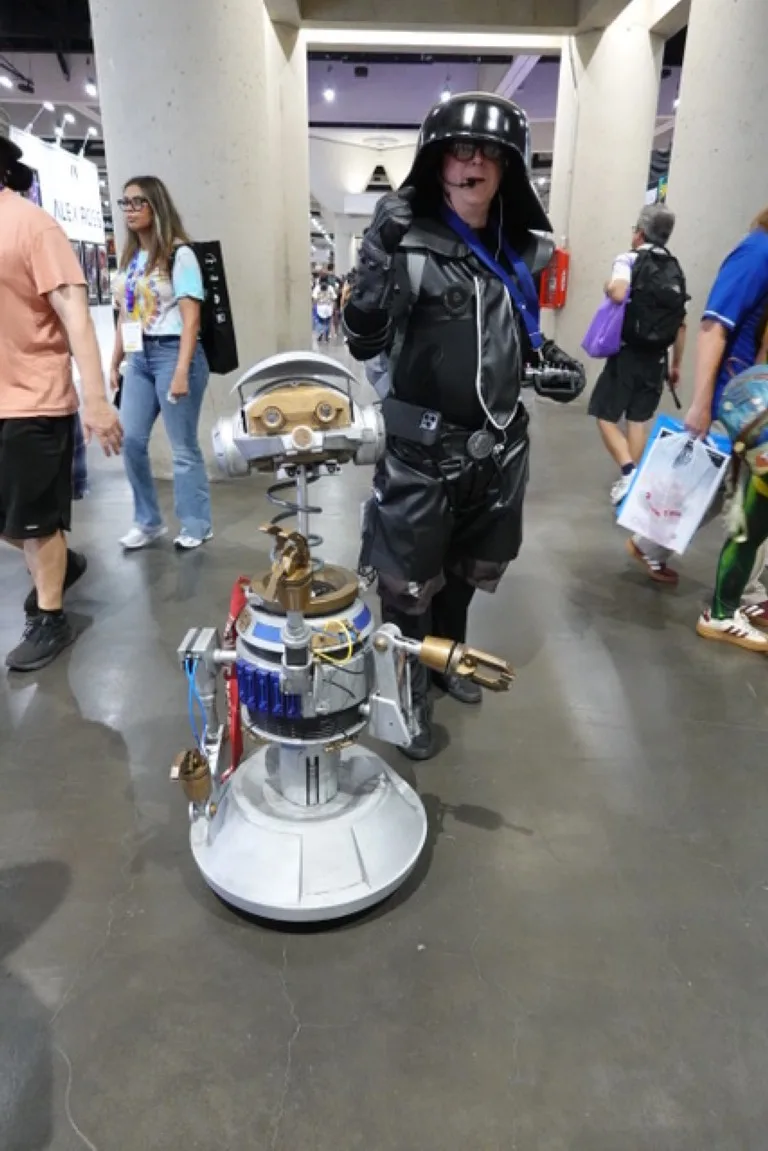
San Diego Comic-Con always has a few up-to-the-minute costumes (like someone dressed as Cyclospora lettuce), and a few looks especially popular among a wide range of people. This year, I saw Monkeys D. Luffy from “One Piece” in all shapes, sizes, and ages, easy to spot with the red vest, blue pants, and straw hat. One reason may be that the costume is easy to make and comfortable to wear.
But another reason is the series’ ability to earn the affection of its audience. In one of Impact24’s Fan Favorite panels featuring the craftspeople behind popular movies and television, “One Piece” editor Eric Litman talked about working on the reverse mountain sequence to “make sure we understood the scale and relationships of the characters” in a shot featuring “a whale the size of the Empire State Building.” With a “danger we thought was a threat but is lovable and misunderstood,” he used “lingering shots” to make it more touching than scary. How did he know it was finished? “We would not stop working on that sequence until someone in the cutting room cried.”
“Spider-Noir” editor Jennifer Barbot also used longer shots to evoke the classic noir films of the 40s, with temp scores from “The Maltese Falcon” and “Double Indemnity,” but when it came to the action sequences, she shifted to the kind of pacing modern audiences appreciate.
Co-composer Matt Bowen said the key to his music for “The Boys” was whose perspective the score evokes. For one scene, where a mother has to make a painful decision about her very sick child, he initially wrote something to get “the cry factor.” But it turned out the showrunner wanted to make clear that the mother was considering something very unethical, so it had to be rewritten from the audience’s perspective, less sympathetic, more uncomfortable. Blair James, costume designer for “Obsession,” looked out at the colorful choices of the attendees, some in costume, some just wearing t-shirts with snarky comments or showing off their favorite cultural touchstones, and said, “Everything you wear has conscious or subconscious meaning in it. Costumes help explain the story without saying it, making you see without noticing.”
While the big stars and blockbuster movies were taking over the 6000-seat Hall H, I went to the smaller events, with audiences in about one percent of that size previewing clips from two upcoming films. “Ultraduck” is animated, based on Arcana’s graphic novel about a superhero duck. And “Buddy” is a horror film about a Barney/Pee Wee Herman-like children’s television character from director and co-writer Casper Kelly (“Too Many Cooks”), featuring Keegan-Michael Key as the voice of the murderous plush unicorn-costumed host and Patton Oswalt as the voice of Strappy the backpack.
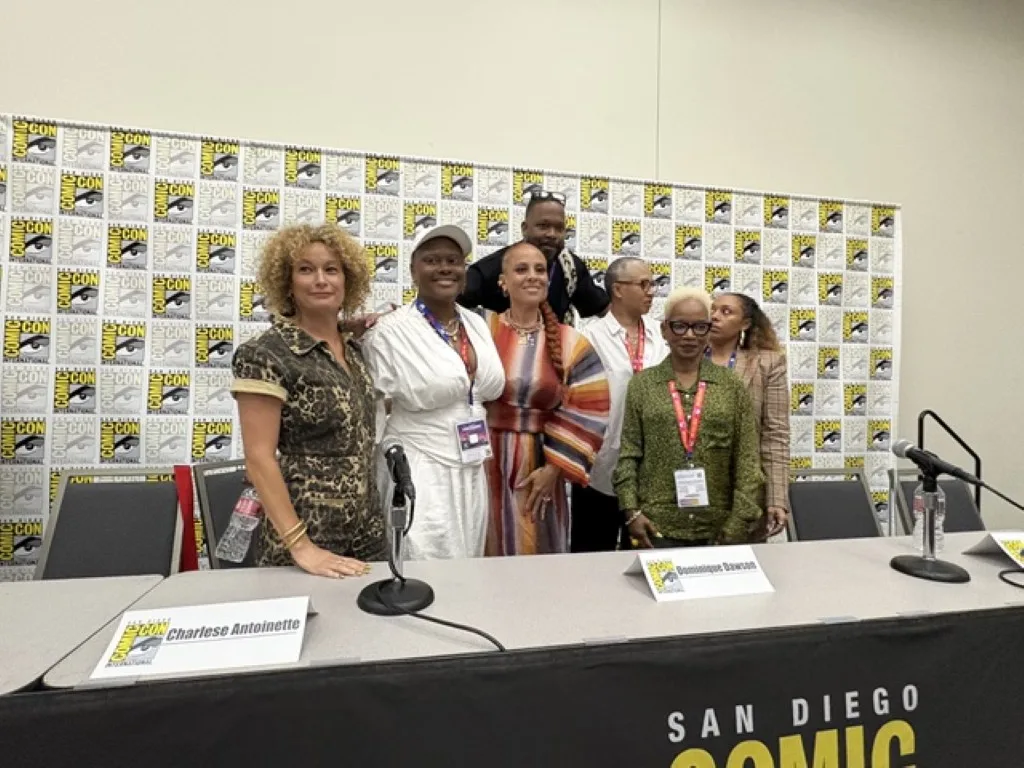
For the first time in its 29 years, The Black Panel was all-female. Dr. Lando Tosaya responded to complaints about diverse casting of traditionally white characters: “Why are we otherizing something that’s fictional?” And she pointed to the “one Black friend” cliché in mainstream culture that “uses diversity as a checkbox,” keeping those characters “in the Blackground” instead of making the relationships authentic. Research scientist-turned comic and novel author Stephanie Williams quoted Toni Morrison: “If there’s a book that you want to read, but it hasn’t been written yet, then you must write it.” And she responded to critics who point to work they say is “not Black enough.” She was very clear that “If I touch it, it’s Black.”
The “You’re Wrong, Leonard Maltin” session moderated by his rainbow-haired daughter, Jessie, is always a lot of fun. He has missed some of the big releases this year, but so far, his favorite of 2026 is “Tuner” with Leo Woodall and Dustin Hoffman. As always, he responded to critiques of his criticism with grace, charm, and astounding recollection of every detail of the tens of thousands of movies he has seen. Some of the films he was asked about were ones he respected more than loved, like “Blue Velvet” (he urged the audience to watch another David Lynch film, “The Straight Story”), “Taxi Driver,” and this year’s breakthrough, “Backrooms” (“like a ‘Twilight Zone’ episode that never resolved in a satisfying way”). He liked the documentary about the making of Francis Ford Coppola’s “Megalopolis” as a portrait of a filmmaker who is “a creative spirit who doesn’t limit himself, shackle himself, a dreamer like [the real-life character portrayed by Jeff Bridges in one of his films] Preston Tucker, a creative spirit but not a disciplined creative spirit.”
Every year, Comic-Con seems to take over more of the Gaslamp neighborhood, with streets near the Convention Center shut down to traffic, events at nearby hotels and public libraries, buildings, buses, and train cars being wrapped with ads for movies and television series, and some stores and restaurants being completely taken over for extensive “activations,” installations featuring sets and props. Paramount+ had the biggest one for “The Lodge.” LAIKA had a small but beautiful activation promoting its October release “Wildwood.” Attendees entered a small but immersive forest set with hints about the movie’s story: a newspaper headline about a missing child, a sweater left on a wagon.
The activation for the upcoming Christmas Carol story, “Ebenezer,” was wonderfully detailed, a humorous winter creation in a hot California summer. Very realistic-looking snow and icicles decorated a Victorian-looking storefront with a Scrooge and Marley sign, a moving animatronic crow and large clock with hands that spun around, and inside a glimpse of Bob Cratchit’s desk, with the flickering candle he’d use to warm his hands. Actors in winter Victorian costumes interacted with the crowd, and star Johnny Depp came out as a surprise, wearing full Scrooge make-up and costume to greet some lucky visitors.
Long-time Comic-Con attendees know that the funniest panel is just before it closes down, the Starship Smackdown, celebrating its 25th anniversary as a beloved tradition. Mark Altman, television writer/producer and big-time “Star Trek” nerd who has written the definitive guide to the show, presides over a panel of experts that, with some audience participation, creates a bracket of the best movie and television starships, from the iconic (Millenium Falcon, various versions of the Enterprise) to the esoteric (the Rocinante, and does the TARDIS qualify?) for very lively, hilarious and encyclopedically nerdy debate. This year’s winner was a first-time entrant, but an undeniably worthy one: the Hail Mary.
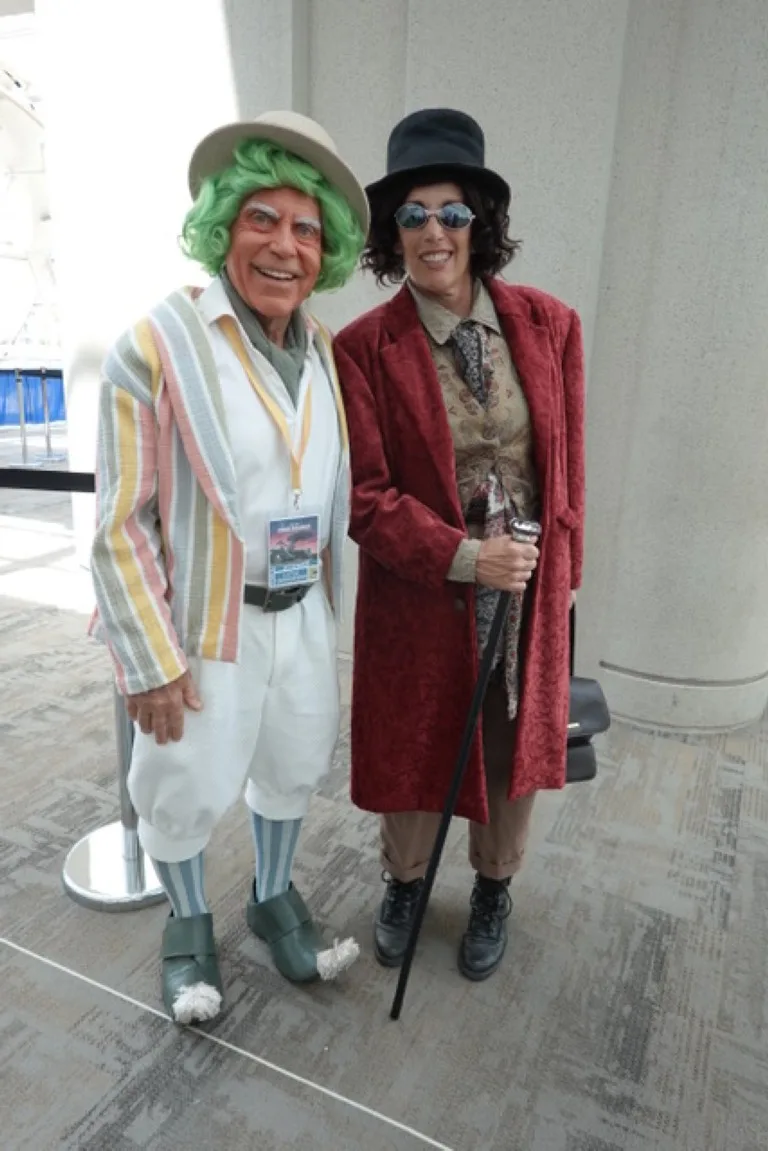
I love the way the more than 100,000 San Diego Comic-Con attendees always cheer each other on, no matter what fandom they support. As I went through the gigantic exhibition hall and saw people of all sizes, shapes, genders, races, abilities, and ages wearing snarky t-shirts, fan regalia, and full-on, homemade costumes, buying items from a few dollars to more than a mortgage payment, it was impossible not to feel how much joy the most passionate fans get from the lively arts that are most meaningful to them. As Crunchyroll’s Leslie Bland said on a panel about SteelBooks for Blu-Rays. “We don’t try to make something for everyone. We try to make everything for someone.”