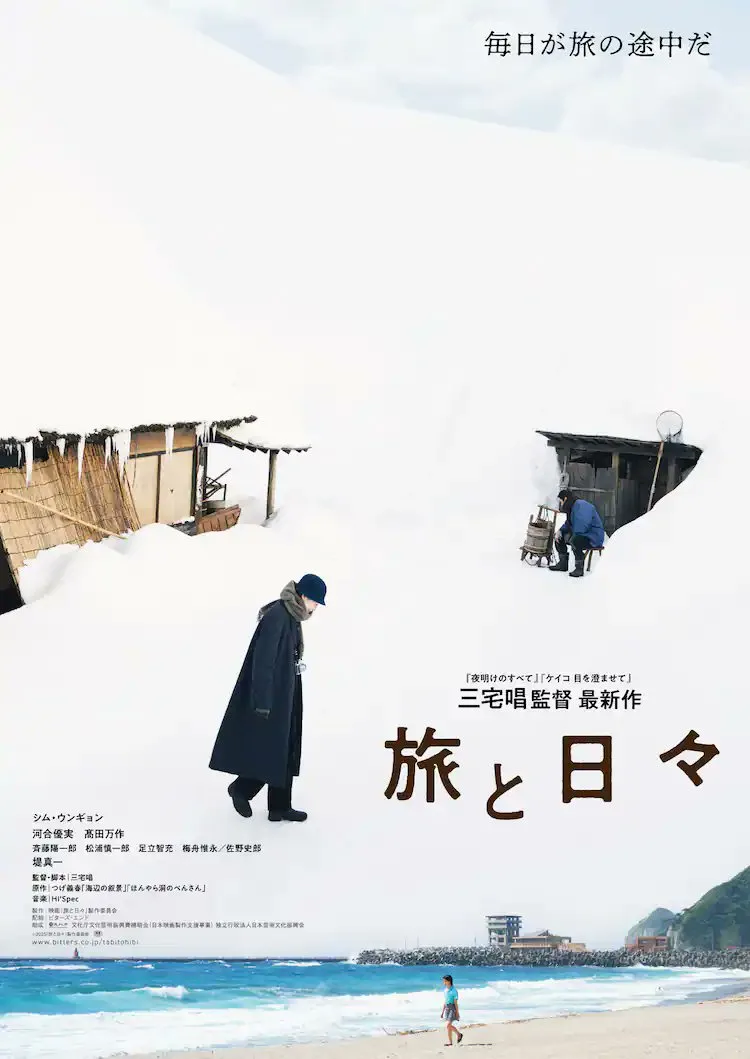
Sho Miyake’s “Two Seasons, Two Strangers” sees the director returning to what’s become his primary themes: longing and loneliness. An adaptation of two Yoshiharu Tsuge manga—A View of the Seaside and Mr. Ben and his Igloo—Miyake’s meditative film is similarly split into two parts. The first takes place in an idyllic Japanese coastal town, where two young people, an adolescent boy and a girl, find companionship through conversation. The second half occurs at a snowbound mountain inn, where a vacationing screenwriter encounters a crabby innkeeper. When combined, the diametric halves form a charming diptych whose thematic and emotional profundity make for Miyake’s most accomplished work yet.
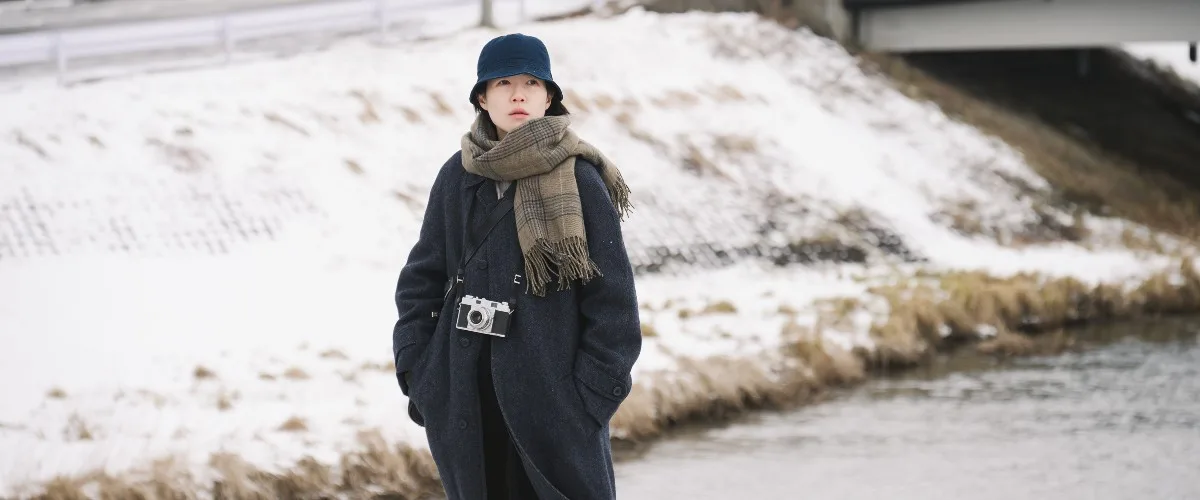
“Two Seasons, Two Strangers,” which won the Golden Leopard at the 78th Locarno Film Festival, is the director’s ninth feature. Over time, his visual approach has evolved, shifting from the woozy black-and-white aesthetic of his early work, such as his debut “Playback,” to his current classical style, whose static frames recall Yasujirō Ozu’s observational work. This newest film not only continues his stylistic evolution but also captures the feelings, expressions, and concerns found in Miyake’s previous two films: the deaf boxing movie “Slow, Small But Steady” and the platonic, ruminative picture “All The Long Nights.” Like those films, the two parts here are conjoined by the dashed hopes of its woman protagonist—Li (Shim Eun-kyung).
A Korean expat living in Japan, Li is a screenwriter penning a script during the film’s opening half. Miyake and his editor, Keiko Okawa, skillfully cross-cut between Li sitting at her desk, writing, and the movie she’s imagining. Li conceives of Natsuo (Mansaku Takada), a young, solitary teenager who spends his days visiting the picturesque beach of his far-flung town. While at the shore, he spots Nagisa (Kawai Yuumi), a woman visiting the town for vacation. Backgrounded by vivid blue skies on a granite white beach or standing atop craggy cliffs overlooking cobalt blue waves, they share stories with one another. He recalls finding two dead bodies, a woman and her baby, nested by octopuses. She imagines what it would be like to escape as another person to another place. Both tales suggest a fear of permanence. Yet the overall narrative, by virtue of Li’s writing, is naturally destabilized. Is this the anxieties of the writer bleeding into her work, or the whims of the director capturing this script?
Miyake playfully navigates that tension in the film’s engaging second half. He snaps viewers away from the vibrant temperatures of Li’s fictional beach to a monochromatic classroom auditorium where her film is being shown. Li and the movie’s director take questions from the audience. Li’s former mentor and professor calls the film “unchallenging” and maybe even “sexy,” inviting astonishment on Li’s face (one of the many moments Shim provides a wealth of information without saying a word). A woman student, tellingly, inquires whether Li has ever felt that what she wrote didn’t translate to the screen. A hesitant Li, who nervously taps her hand on her thigh, gives a noticeably indecisive answer. At this moment, is Miyake questioning any potential limitations he might have for understanding women protagonists? Also, who is the ultimate author of any given film?
The latter question, frankly, swims through Li’s mind, particularly when tragedy strikes. She inherits her mentor’s camera and then sets out for a mountain village. Upon arriving, Li discovers that there are no hotels remaining. But there is a disused inn owned by the abandoned Benzo (Shinichi Tsutsumi) that may provide some shelter to her. Like the young man and woman in the film’s first half, Li and Benzo are an unlikely pairing. The writer can look around the messy inn and spot Benzo’s entire melancholic backstory. And while Li, a kind of empty vessel, doesn’t immediately hold the same sorrowful life experiences as Benzo, she does recognize a kindred soul in him. In the evolution of their relationship, one can sense two people desperately trying to ascertain why they’re so lonely and so unhappy. They clearly aren’t bad people. But for some reason, in this apathetic world, that doesn’t matter.
Miyake understands that life doesn’t pick clear heroes and villains, winners or losers. It’s why films like “All The Long Nights” and “Slow, Small But Steady,” which similarly pair opposites-attract friendships, resonate with such immediacy. Miyake knows that meetings, conversations, and even memories rarely move with haste. They develop with the firmness of his eloquent still shots, which rely on little to no camera movement, arising with the suddenness of a breeze. Miyake is not only one of the great Japanese filmmakers of his generation. He is also among the best at imbuing neglected people with humanity and injecting aching empathy into modest stories. “Two Seasons, Two Strangers” might be him at his best.