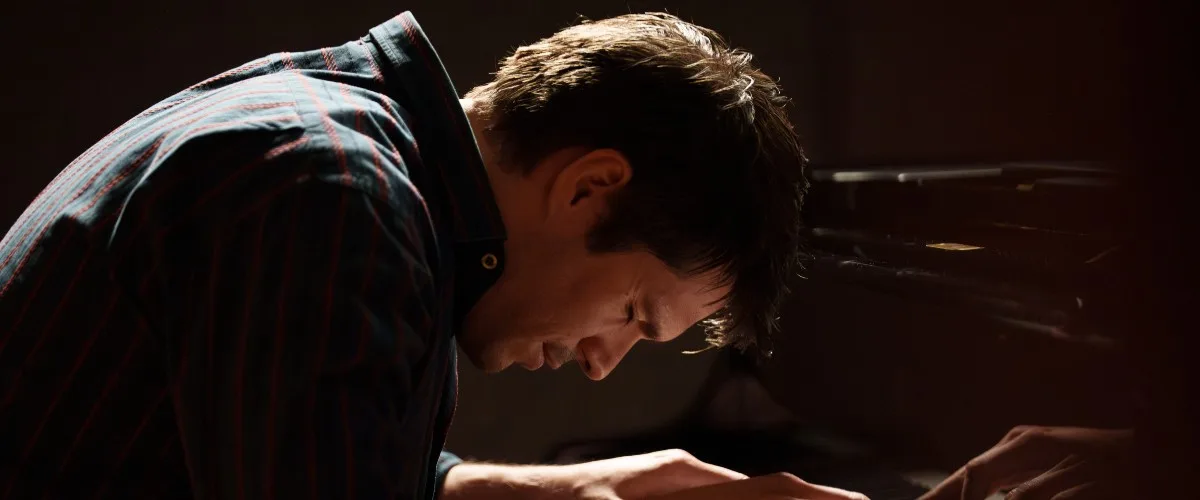
“Two Pianos” is a melodrama, and damned proud to be one. The main character is a pianist named Mathias (François Civil) who returns to his hometown of Lyon after eight years of teaching in Japan. He was once a child prodigy who seemed to have the world in his pocket. Then he left town. Fled, really. He might have remained in Japan if he hadn’t been contacted by his mentor Elena (Charlotte Rampling), who is throwing a party and wants him there.
Then comes the gut punch: after Mathias’s leaves Elena’s party, he takes the elevator down to the apartment building’s lobby and runs into his one-time lover, Claude (Nadia Tereszkiewicz). They’re both stunned. Without a word, Claude whirls and leaves, a haunted look on her face. Mathias faints dead away. After regaining consciousness, Mathias goes on a drinking spree that lands him in jail, where he’s bailed out by his irritated but loyal manager, Max (Hippolyte Girardot). He shows up for the next morning’s rehearsal in such bad shape that Emma calls out his hangover and lambastes his mediocre playing in front of the rest of the orchestra.
This might all sound excessive. But in the world of “Two Pianos,” the latest from French writer-director Arnaud Desplechin (“Kings and Queen,” “Brother and Sister”), it’s what you expect to happen. You might even have been disappointed if the same material had been presented subtly. The movie is photographed (by Paul Guilhaume) and edited (by Laurence Briaud) like one of those ’90s American indie movies or contemporary “prestige” cable dramas in which raw performances, handheld camerawork, and occasional jump-cuts signify authenticity. But the material is somewhere between opera and soap opera, and the movie is filled with character types that are familiar from other movies, especially older ones.
The hero is a handsome, rakish, entitled, womanizing, coulda-been-somebody who’s obsessed with the girl that got away. There were a lot of these characters in pre-millennial films. They were often played by Warren Beatty, Paul Newman, or some other actor who could make audiences sympathize with basically awful characters, mainly through incredible handsomeness. Mathias’s onetime flame married their mutual friend Pierre (Jeremy Lewin), this year’s model of the safe but dull screen mate—the latest in a long line typified by Ralph Bellamy in “His Girl Friday” (who lost his fiancé, wisecracking bombshell Rosalind Russell, to Cary Grant—nothing to be ashamed of) and Danny Aiello in “Moonstruck” (a worrywart who loses Cher’s grieving but still passionate widow to Nicolas Cage’s opera-loving one-handed baker). “Pierre’s love was sane,” Claude tells Mathias, “not crazy like yours.” Still, Pierre is a solid, loving, stable man who takes care of Claude and their son Simon (Valentin Picard).
Leaning coquettishly against side three of this love triangle is Claude, a woman of powerful appetites who thought a bourgeois life would save her from own worst impulses and is in denial about how wrong she was. The film’s gallery of supporting types includes the devoted teacher who demands fealty from her star pupil, and the gruff, stressed-out, hilariously profane manager who repeatedly stops a self-destructive client from ruining himself. Both relationships have a hint of surrogate parenthood: Emma and Max are the parents Mathias always needed, and he’s the son they never had. “Two Pianos” approaches this material like a musician remaking a well-liked but overplayed song into one that it takes a moment to recognize.
Desplechin cowrote the screenplay with Kamen Velkovsky. It flows like water. Just when you’ve absorbed the implications of the scene you’re watching, another scene comes in to lay more heavy news on you. The filmmakers craft scenes in which actors can pair off and play intimate duets that add dimension to characters you thought were flat.
In time, “Two Guitars” unearths the selfish, needy impulses at the hearts of several people, including ones that initially charmed you—like Claude’s best friend Judith, who at first seems like the sensible half of a duo consisting of a Wild One and a Responsible One. That assumption vanishes when you watch Judith and Mathias in conversation. Her chaste, just-friends energy is betrayed by the lust in her eyes. Sometimes we sour on a character we enjoyed because we’ve spent enough time with them to see through the lies they tell to justify their failures. Mathias and Claude are the most prominent examples. They are less star-crossed lovers than danger seekers who get an erotic charge from flirting when they know they shouldn’t even be communicating. Their teasing smiles confirm that they’ve run these lines before.
“Two Pianos” embodies two statements that would seem to be incompatible: Oscar Wilde’s “I love humanity—it’s people I can’t stand,” and Abraham Lincoln’s “I don’t like that man—I must get to know him better.” The main characters are mostly disasters, from the young genius who wrecks his own rise to stardom to his manager, who seems to have let his most exasperating client become his life’s work, to the young husband who knew he was his wife’s second choice but got over it because he adores her. Even the worst of Desplechin’s characters have redeeming qualities, and their brokenness makes them hard to entirely hate. Their flaws and contradictions are emblematic of the species. I wanted them all to be happy, but only after I’d gotten a chance to yell at them.